Insider Trading in Crypto: Hidden Profits and Regulation
By Captain Trading··6 min
Contents14 sections
Insider trading means using privileged information deemed confidential in order to gain an advantage on a financial market. It typically involves company executives or insiders within their professional or private circle: supervisory boards, company board members, chief executives, and so on.
And contrary to what you might think, it is a practice that happens very regularly in the emerging world of cryptocurrencies.
Imagine someone holding information nobody else has, and using it to trade on the markets and multiply sums of money artificially. That creates a major imbalance, because it is unfair to those who do not have that information and are therefore flying blind. With cryptocurrencies becoming more and more popular, this raises serious issues of security and trust.
Holding sensitive information is an extraordinary responsibility. Some people simply cannot handle it.
In the crypto market, insider trading is harder to detect than in traditional financial markets. That is because these markets are often anonymous and do not depend on a central authority. This article will help you understand how these opaque practices operate in our favorite corner of finance, and how to anticipate this type of manipulation. We will look at real-world examples and what it all means from a legal standpoint, in France and elsewhere in the world.
As a reminder, insider trading is enshrined in the French criminal code. It is no minor offense, since it carries a penalty of several years in prison. It is also covered by Article L.465-1 of the French Monetary and Financial Code.
Insider Trading in Crypto: A Reality Little Known to Retail Investors
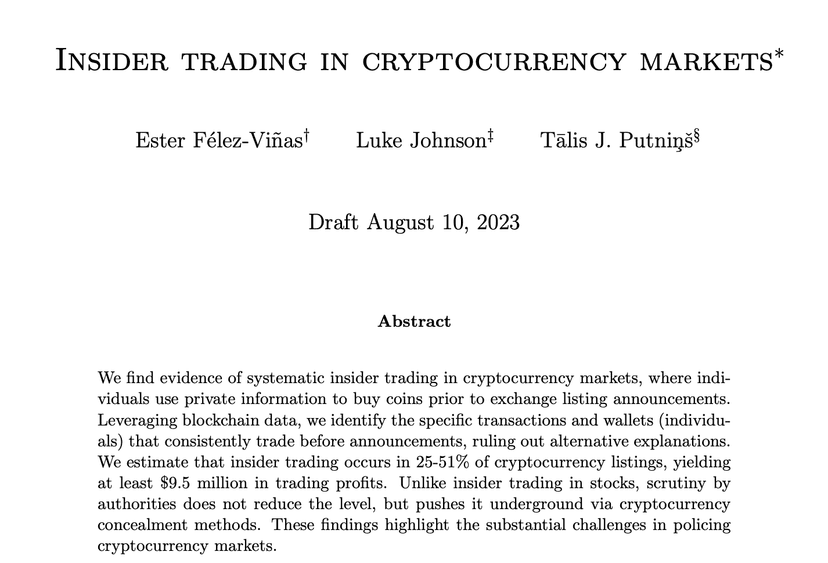
Detailed studies and in-depth analyses, such as those presented in the paper “Insider trading in cryptocurrency markets”, highlight a worrying phenomenon for any investor hoping to approach this market on a level playing field.
Insider trading — in other words, using confidential information to make money — appears to be alive and well, and particularly common, in the cryptocurrency universe.
This practice, already familiar in traditional finance, is now playing out on a large scale in the crypto world. Here, since participants can remain anonymous and transactions happen very quickly, it is far easier to manipulate prices without ever being troubled. One more good reason to master the fundamental rules of risk management before taking a position on a new token.
The study excerpted above indicates that between 25% and 51% of new cryptocurrencies appearing on various platforms could be affected by this kind of manipulation, with gains that can reach millions of dollars.
So we are not talking about a few isolated trades. There are often well-organized groups behind them, using techniques sophisticated enough to avoid detection.
For example, they spread their activity across multiple digital accounts and use transaction mixers such as Tornado Cash to make their transactions extremely difficult to trace.
Finding and stopping these fraudsters in our favorite financial sector is particularly complicated. That is partly because cryptocurrencies do not depend on a central authority, and we do not always know who is behind the transactions. This creates unique challenges for those tasked with enforcing laws and rules, as they struggle to apply the usual regulations to a sector that is new and constantly changing.
The Most Notorious Insider Trading Cases in the Crypto Sector
The Coinbase Case: Breach of Trust and Illicit Profits by a Former Employee
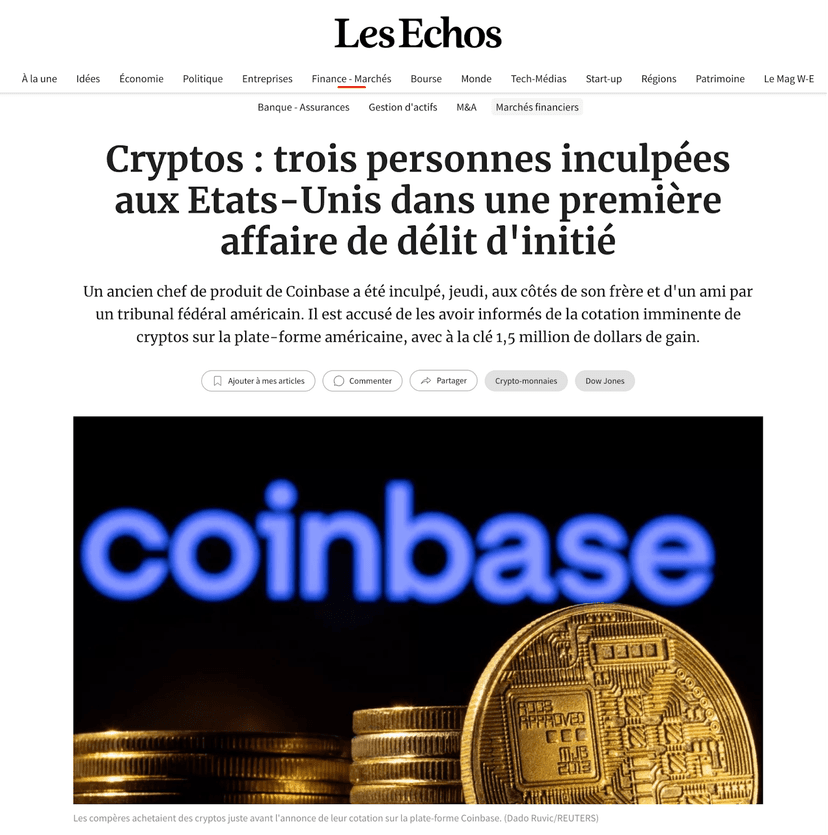
One of the most notable insider trading cases in the cryptocurrency world involves a former Coinbase employee. Ishan Wahi, together with his brother and a friend, used confidential information about crypto assets due to be listed on Coinbase to carry out illegal trades. Between June 2021 and April 2022, the network traded some fifteen “tipped” crypto assets, generating roughly $1.5 million in illegal profits. source
This case stands as a major landmark because it was one of the first formal convictions for insider trading in crypto, marking a turning point in the legal recognition of these practices. Faced with this type of risk, many investors turn to platforms with stricter compliance standards, such as OKX, known for its regulatory rigor and its strict internal procedures when listing new assets.
2026 update — the outcome of the Wahi case. Ishan Wahi pleaded guilty in February 2023, then was sentenced on May 9, 2023 to 2 years in federal prison (followed by 2 years of supervised release) by Judge Loretta Preska. This was the first criminal conviction for insider trading involving digital assets in the United States: a clear signal to the entire sector that blockchain anonymity does not shield anyone from prosecution.
The Argus Case: Manipulation and Suspicious Profits on Binance, Coinbase and FTX
Another revelation, stemming from an analysis by the firm Argus, sheds light on suspicious transactions across the Binance, Coinbase and FTX platforms. According to the data collected, anonymous investors profited heavily from privileged information about upcoming token listings. For example, wallets accumulated $17.3 million worth of Gnosis (GNO) tokens in August 2021, selling them immediately after they were listed on the major trading platforms, generating a profit of more than $1.7 million. source
Worth noting: FTX, cited here among the platforms involved, no longer exists in that form. The platform went bankrupt on November 11, 2022, and its founder Sam Bankman-Fried was sentenced in March 2024 to 25 years in prison for fraud. Beyond insider trading alone, this collapse illustrates just how much a lack of transparency and safeguards can cost a platform’s retail investors.
These cases demonstrate not only that insider trading exists in the sector, but also how sophisticated and ingenious the strategies used to exploit confidential information have become. They also underscore the urgent need for stronger regulation and oversight to protect market integrity — especially in crypto, which still escapes many regulations.
The Challenges of Regulating Insider Trading in Cryptocurrencies
Regulation in France: Legal Framework and Applicable Penalties
In France, insider trading in the cryptocurrency space is governed by the Monetary and Financial Code. While merely possessing sensitive information is not in itself an offense, exploiting it unfairly carries heavy penalties — up to a €100 million fine (an amount that can be raised to ten times the profits made) and five years in prison. French law thus aims to preserve fairness and transparency on financial markets, including in the crypto sector.
The AMF (France’s Autorité des Marchés Financiers) plays a central role in detecting and punishing these practices, working ever more closely with Web3 players and exchanges registered as PSAN (Digital Asset Service Providers).
MiCA: The New European Framework Against Crypto Market Abuse
Since this article was first written, the regulatory landscape in Europe has changed profoundly. The MiCA (Markets in Crypto-Assets) regulation has been fully applicable since December 30, 2024. For the first time, the European Union has a harmonized framework that explicitly covers the prevention of market abuse on crypto assets: insider trading, unlawful disclosure of inside information and price manipulation are now targeted across all 27 member states, no longer just case by case by each national regulator.
In practical terms, the French PSAN status (created by the PACTE law) is giving way to the European PSCA / CASP status (Crypto-Asset Service Provider), with a transition period running until July 1, 2026 for players already registered. Licensed platforms must now monitor, detect and report suspicious orders and transactions, exactly as traditional financial markets have been doing for years. For retail investors, this is a major step forward: the crypto “wild west” is gradually closing down, and listing manipulation is becoming riskier for those orchestrating it.
International Perspective: Comparison and Global Regulatory Trends
Internationally, insider trading regulation in cryptocurrency continues to take shape, with approaches that vary across jurisdictions. Recent cases, such as the conviction of the former Coinbase employee, show a growing trend toward recognizing and prosecuting these illicit practices around the world. However, the decentralized and often anonymous nature of cryptocurrencies poses significant challenges for implementing effective regulatory measures.
In a global context, regulation must not only adapt to the specifics of blockchain technology, but also foster international cooperation to fight insider trading. Striking the balance between protecting investors and preserving innovation in the cryptocurrency ecosystem remains a complex goal for regulators worldwide.
How to Protect Yourself as a Retail Investor
You will never have the same information as an insider, and that is precisely why you need to adapt your approach. A few simple reflexes can sharply reduce the risk of serving as “exit liquidity” for an organized group:
Be wary of unexplained pumps just before a listing. A token that skyrockets with no public news is often a sign that someone knows something you do not.
Favor regulated platforms that are transparent about their listing procedures, rather than those that churn out opaque listings of unknown tokens.
Never chase a move that is already well underway.FOMO (fear of missing out) is exactly the lever manipulators play on.
Educate yourself before investing. Understanding market mechanics remains your best defense: it is what allows you to spot the classic mistakes retail investors make and avoid blindly taking a position on a potentially manipulated token.
Implications and Consequences of Insider Trading on Financial Markets
The existence of insider trading has profound repercussions on market trust and integrity. These practices create inequality among investors and raise questions of security and information protection. Effective regulation is crucial to balance preventing these practices with promoting innovation.
Insider trading in the crypto sector poses unprecedented challenges, highlighting the need for suitable regulation and greater vigilance from investors themselves.
As the sector keeps evolving, it is imperative to establish a robust legal framework, both in France and internationally, to guarantee market integrity and protect investors. These regulatory efforts must go hand in hand with awareness-raising and international cooperation to effectively counter these strictly illegal practices and preserve trust in the ultra-dynamic ecosystem that is the crypto market.
Today we walked you through examples of insider trading in the crypto sector, but rest assured it is also rampant on traditional markets — and sometimes at far higher levels of power…
For example, cases implicating the US administration and the banking sector in insider trading are extremely frequent despite the regulations in place. Your best protection therefore remains education: understanding market mechanics, mastering trading psychology and knowing how to objectively analyze suspicious moves will spare you many disappointments in your investments.
FAQ — Insider Trading in Crypto
Is insider trading illegal in cryptocurrencies?
Yes. In France, it is governed by Article L.465-1 of the Monetary and Financial Code and punishable by up to a €100 million fine and five years in prison. Since December 30, 2024, the European MiCA regulation has also explicitly covered market abuse on crypto assets across the entire European Union.
What was the first crypto insider trading conviction?
That of Ishan Wahi, a former Coinbase employee, who pleaded guilty in February 2023 and was sentenced on May 9, 2023 to 2 years in federal prison for exploiting privileged information about upcoming listings.
How can you spot possible listing manipulation?
Watch out for a sharp, unexplained rise in a token just before its official listing, abnormal volume concentrated in a handful of wallets, and the absence of any public news justifying the move. When in doubt, stay out: you risk serving as liquidity for insiders.