RWA Tokenization: Definition and Key Principles
The tokenization of Real World Assets | RWA consists of fractionalizing high-value assets — real estate, works of art, commodities, bonds, and so on — into tokens recorded on a blockchain in order to secure their value and make them easier to trade.
How to Visualize RWA Tokenization
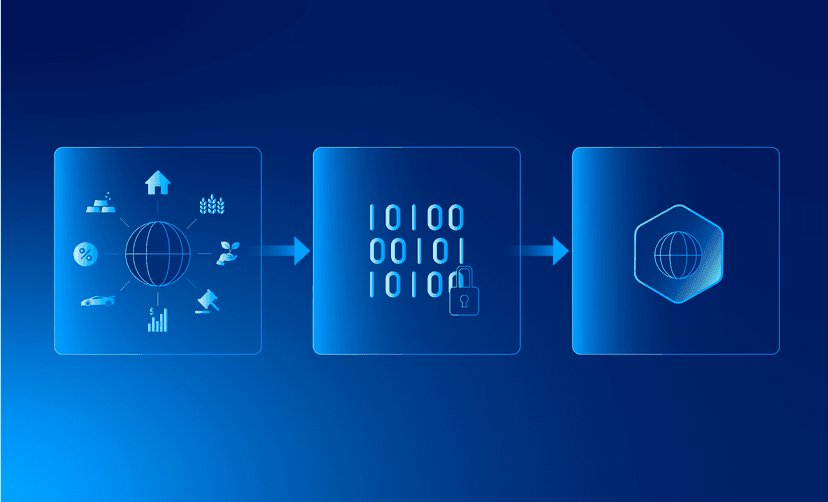
This technological revolution makes it possible to split these assets into smaller, more affordable units. RWA tokenization is made possible through the use of smart contracts and blockchain technology, which guarantee the transparency, security, and immutability of transactions. To better understand this ecosystem, feel free to check out our complete guide to DeFi.
2026 Key Figures: Where Does the RWA Market Stand?
In 2024, real-world asset tokenization was still largely experimental. By 2026, it has become one of the most dynamic segments in crypto. The value of on-chain RWAs (excluding stablecoins) has grown from around $6 billion in early 2025 to more than $30 billion by mid-2026 — nearly quadrupling in a single year. A few reference points to put this acceleration in perspective:
- Tokenized U.S. Treasuries: the leading RWA category, at around $9-10 billion on-chain — classic “risk-free” finance, but accessible 24/7 on the blockchain.
- BlackRock (BUIDL fund): launched in March 2024 with $40 million, it surpassed $1.8 billion on-chain by late 2025. The world’s largest asset manager has clearly picked its side.
- Franklin Templeton (BENJI): its tokenized money market fund (deployed notably on Stellar) manages several hundred million dollars.
- Tokenized stocks: with the launch of xStocks, what was merely a hypothesis in 2024 is now a market reality (see below).
And this is just the beginning: according to several studies (BCG, Citi), the RWA market could reach $16 trillion to $30 trillion by 2030. In other words, what you are reading about here is not a technological niche, but quite possibly one of the biggest value migrations of the decade.
Imagine you want to buy a house, a work of art, or even a share of gold. Rather than physically owning these assets, tokenization lets you turn them into digital “tokens,” securely stored in a wallet on a blockchain.
These tokens represent your ownership of these real-world assets, and you can buy, sell, or trade them as you see fit, from your smartphone or computer, anywhere in the world.
It is also a new bridge between traditional finance (TradFi) and digital assets!
Now, you are probably wondering: “Why would I want to tokenize my real-world assets?” Here are the main benefits:
Greater accessibility: By tokenizing assets like art, real estate, or commodities, you make these investments accessible to a much wider audience. Even on a modest budget, you can now own a share of a famous artwork or a prestigious property.
Improved liquidity: Traditionally, it can be difficult to sell physical assets like art or real estate quickly. But with tokenization, you can trade your tokens at any time, 24 hours a day, 7 days a week, on centralized or decentralized trading platforms. Regulated platforms such as OKX have already taken the leap by adding tokenized assets to their offering.
Lower fees and fewer barriers: By removing intermediaries and automating processes through blockchain technology, tokenization reduces the fees and hurdles associated with investing in real-world assets. No more endless bureaucratic processes and exorbitant fees!
Here are the different approaches that exist today for turning a physical asset into a digital token:
1. Direct Tokenization
In this approach, the real-world asset is directly represented by tokens on a blockchain. Each token represents a specific share or right in the asset, enabling its fractionalization. For example, a painting can be tokenized into 1,000 tokens, with each token representing 0.1% ownership of the artwork. This method often requires clear regulation and a clear legal structure to manage token ownership and transfers.
2. Tokenization via a Legal Entity
This method involves creating a company or a dedicated legal structure (such as a limited liability company or a trust) that holds the real-world asset. Tokens are then issued to represent ownership stakes in the entity rather than in the asset directly. This structure simplifies the legal and regulatory management of ownership, allowing token holders to have indirect rights to the asset through their stake in the entity.
3. Tokenization via Smart Contracts
Smart contracts on blockchains enable automation and transparent execution of transactions and of the rights attached to tokens. In the context of tokenization, smart contracts can manage token distribution, voting rights, dividends or other financial distributions tied to the asset, as well as the conditions for transferring and selling tokens.
4. Tokenization Through Fund Creation
Another method involves pooling several real-world assets into a fund, which is then tokenized. Investors buy tokens representing a share of the fund rather than of an individual asset. This approach offers investors diversification and reduces the risk associated with investing in a single asset. It is often used for real estate portfolios or art collections. It is, in fact, exactly the model behind the BUIDL (BlackRock) and BENJI (Franklin Templeton) funds mentioned above.
5. Tokenization via Debt or Equity Issuance
Tokenization can also be structured through the issuance of tokenized debt or equity. In this case, the tokens represent either a loan (with interest) to the entity holding the asset, or a share of the equity in that entity. This method allows investors to benefit from potential income streams and a share in the profits generated by the asset.
The 2025-2026 Turning Point: Tokenized Stocks (xStocks)
If there is one concrete example to remember of RWAs entering the daily lives of retail investors, this is it. In June 2025, xStocks were launched: tokenized U.S. stocks and ETFs (Apple, Tesla, Nvidia, S&P 500…), tradable on the blockchain.
Starting from around sixty assets at launch, the catalog now exceeds one hundred listed securities, with a stated target of 500, and has already generated more than $20 billion in cumulative volume — including perpetual contracts (futures) on tokenized equities. In concrete terms, an investor outside the United States can now gain exposure to a U.S. stock 24/7, in fractions, directly on-chain, without a traditional broker.
RWA: The Challenges and Limits of Tokenization
While tokenization offers many advantages, it is not without challenges. Regulation remains one of the major concerns, as each jurisdiction has its own rules. In Europe, the MiCA regulation has been fully applicable since December 30, 2024 — but watch out for an essential nuance: MiCA mainly covers “pure” crypto-assets (utility tokens, stablecoins) and excludes security tokens. An RWA that resembles a transferable security (a tokenized stock or bond) actually falls under MiFID II and the DLT Pilot regime, not the core of MiCA. In the United States, the SEC is in the driver’s seat. In short, the framework is still shifting and depends heavily on the nature of the asset.
Security is also a central issue. Since assets are represented in digital form, they can be targeted by hackers. Implementing robust security measures, such as secure token storage (cold wallets, multi-signature) and protection against data breaches, is essential to maintain investor confidence. To dig deeper, check out our guide on risk management applied to digital assets.
In addition, the valuation of tokenized assets can be a challenge. Determining the fair value of a work of art, a property, or a commodity and splitting it into tradable tokens can be open to interpretation and debate. Clear standards must be established to guarantee transparency around tokenized assets.
Despite these challenges, the potential of real-world asset tokenization is immense. We are already witnessing growing adoption of this technology by institutional investors and traditional financial market players. Companies such as Franklin Templeton, BlackRock, and Bank of America have already launched funds and products based on asset tokenization, paving the way for broader adoption and exponential market growth.
Tokenization and DeFi: A Powerful Synergy
Real-world asset tokenization plays a crucial role in the development of decentralized finance (DeFi), by enabling these tangible assets to be integrated into the digital ecosystem of blockchains.
One of the main applications of tokenization of real-world assets in DeFi is the use of these tokens as collateral for lending and borrowing. For example, a real estate owner can tokenize part of their property and use those tokens as collateral to obtain a loan on a DeFi platform. Likewise, holders of artworks can use their tokens as collateral to access liquidity without having to sell their assets.
Furthermore, real-world asset tokenization facilitates the creation of liquidity pools and decentralized lending markets, where investors can provide liquidity in exchange for yield. The most advanced protocols in the RWA collateral niche today are specialists such as Maker/Sky, Centrifuge, Ondo Finance, and Morpho, which directly integrate tokenized Treasuries and receivables as collateral. General-purpose lending protocols such as Aave and Compound are also starting to open up cautiously to this type of asset.
Moreover, real-world asset tokenization paves the way for new forms of decentralized financial products. For example, tokens representing shares of real estate funds or artworks can be traded on decentralized markets, giving investors diversified exposure to assets traditionally reserved for the very wealthy.
Thanks to tokenization, investors can now access assets traditionally reserved for a financial elite, while enjoying the benefits of DeFi such as liquidity, transparency, and transaction automation.
RWA: Future Outlook and the Road Ahead for Tokenization
Real-world asset tokenization is still young, but it is already revolutionizing the investment and finance industry. This technology offers enormous potential to transform the way assets are bought, sold, and traded on global markets. As mentioned above, several studies (BCG, Citi) point to a market of $16 trillion to $30 trillion by 2030.
As blockchain and tokenization technology continues to mature, we can expect widespread adoption. Benefits such as increased liquidity, transparency, and ease of access will continue to attract the attention of the financial world.
At the same time, we can expect a diversification of tokenized assets, with new asset types such as intellectual property rights, mortgage receivables, and even music royalty rights. This diversification will broaden investment opportunities and help energize tokenization markets.
As real-world asset tokenization becomes mainstream, it will become increasingly important to ensure interoperability between different blockchains (Ethereum, Solana, Polygon, etc.).
One final word of caution, especially if you are just getting started: easy access is no substitute for method. Before putting a single euro into a tokenized asset, take the time to understand what you are investing in. Our guide “Investing Your Money: 12 Mistakes to Avoid” is an excellent starting point to frame your approach.
Oracles: Their Key Role in RWA Tokenization
RWA tokenization is revolutionizing the financial industry by giving investors access to a diverse range of assets traditionally out of their reach. For this transformation to be effective, however, it is essential to ensure the reliability of the data being used.
This is where oracles come into play. Oracles act as bridges between blockchains and the real world, delivering real-time data from reliable external sources (prices, market conditions, legal data…). This allows smart contracts to make decisions with confidence, based on up-to-date, verifiable information. Oracles are therefore fundamental to ensuring transparency, trust, and security in the process of tokenizing real-world assets, by facilitating interoperability between traditional systems and decentralized infrastructures.
Oracles also help reduce the risk of data manipulation and potential errors, by guaranteeing that the information used to tokenize real-world assets is accurate and verified. This reliability is crucial for building investor trust and encouraging the widespread adoption of tokenization, enabling market participants to make informed decisions safely.
The constant evolution of oracle technologies such as Chainlink and PYTH continues to improve the efficiency and security of the real-world asset tokenization process, opening the door to new investment and growth opportunities in the field of decentralized finance.
FAQ: Tokenization and RWAs
What Is an RWA (Real World Asset)?
An RWA, or “real world asset,” is a tangible or financial asset (real estate, gold, artwork, stock, bond, Treasury bill…) whose value is represented by a token on a blockchain. Tokenization makes it possible to split this asset into digital fractions that can be traded 24/7 and accessed on a small budget.
The simplest way is to go through a regulated platform that offers tokenized assets (for example xStocks tokenized stocks), or through specialized DeFi protocols (Ondo, Centrifuge) for tokenized Treasuries. In any case, you will need a wallet to hold your tokens and a solid understanding of the risks before getting started.
Are RWAs Covered by MiCA?
Only partially. The European MiCA regulation, applicable since late December 2024, covers “pure” crypto-assets but excludes security tokens. An RWA that resembles a transferable security (a tokenized stock or bond) falls instead under MiFID II and the DLT Pilot regime. Regulation therefore depends on the exact nature of the tokenized asset.
Conclusion: Tokenization, a Major Turning Point for Finance
In conclusion, RWA tokenization clearly represents a major step forward for finance, offering significant benefits in terms of accessibility, liquidity, security, and innovation. And between 2024 and 2026, it went from being a promise to a market worth tens of billions of dollars, driven by BlackRock, Franklin Templeton, and the arrival of tokenized stocks.
With concrete applications across a range of sectors (real estate, art, commodities, sovereign bonds), it is set to play an increasingly important role in the global financial landscape. As a driver of financial innovation, tokenization opens the way to new forms of investment and financing, creating unprecedented opportunities for retail and institutional investors alike.
Keep a close eye on technological developments and the regulatory framework in this constantly evolving field, because the tokenization revolution is only just beginning!