Risk management is a topic covered at length in trading books and trading courses, because it’s a sensitive one! Building a solid trading strategy, developing your edge and turning a profit consistently is already a whole other level!
I’ve been through several liquidations, as you probably already know if you’re reading me today. And that happened even though the trading system and trading plans I had put in place were solid.
You should know that the foundation I’ve used to put this content together is Van Tharp’s “Super Trader.” I can only recommend it. Here, I’ll try to simplify part of it so I can present it to you in a more accessible way.
Risk Management: A Definition
Risk Management in Business
Every business has to manage the risks tied to its activity. The same goes when you set up a trading activity. You need to identify the risks that threaten how well your strategy works and limit their impact!
In the corporate world, risk assessment mainly comes up when a company expands abroad to establish itself in foreign markets. You go through the identification of the types of risk and their potential impact: political risk, regulation, security risk, financial risk, and so on.
Once the risks have been identified and assessed and the potential risks clearly defined, the company adapts its strategy in order to achieve the best possible risk reduction!
The risk management system is designed to put compensating measures and responses in place in the event of a crisis: anticipating a change of regime, a change in regulation, an attack on facilities, and so on.
What Is Risk Management in Trading?
When I talk to you about risk management in trading, it can seem much simpler, because there are far fewer factors to take into account!
In my view your risk analysis should be relatively simple, because when you take a short- or medium-term trading position, the ever-present risk is the invalidation of your scenario. A little too binary for our times, isn’t it?!
Risk Assessment
The risks tied to the proper functioning or reliability of the platform you use are a different matter entirely here! Of course, I’d never recommend putting all your eggs in one basket, especially after the FTX affair and all the exchanges that have gone under since the early BTC years.
That said, when we talk about risk management in trading, we’re mainly talking about the average risk taken per trade as a % of our capital, or of the capital we’ve set aside for trading!
As a trader, here is the risk register you need to consider:
is my trading strategy more or less risky
as a result, how much can I lose without eating into my firepower
What is my overall relationship with money: how much can I lose before I start to feel psychological discomfort in my decision-making?
Once you’ve identified the risks surrounding your trading activity, you can move on to defining your risk management strategy!
Risk Management: Why Does It Matter on the Financial Markets?!
When you’re guiding your flock, you have to understand that the wolves will try to attack you sooner or later. That’s why you always have to stay alert and anticipate every scenario when you have open positions. You also have to prepare for it and put a suitable risk management method in place, so you can fend off any attack and become impervious to the unexpected, or at least get close to it!
As I’ve already mentioned. I’ve lost all or almost all of my capital on several occasions; a PnL of -90% is no fun at all.
When we talk about HODLing, it doesn’t mean holding against the trend. Holding, in my view, means buying at the right moment and keeping your coins for as long as the trend is bullish. You are NOT AT ALL obliged to take a drawdown. ( As a reminder, this article dates from October 29, 2021, roughly 3 or 4 weeks before BTC’s ATH )
Your price and the timing of your entry determine the trend. The trend is in fact one phase of a market cycle from the standpoint of your entry. Let me explain…
If you bought a few BTC at $100, there’s no reason to do any risk management because the identified risk is low. You’re sitting pretty!
But if you bought your BTC at $40K or $50K, you need to act concretely and stay alert so you can make sound short-term decisions.
If you agree that it’s not a good idea to lose 80% to 90% of your capital in the mere hope of making a gain 4 years from now, then what follows is for you.
Now that you understand the issues involved in risk management, let’s begin…
- Remember that if you hold a position at an 80% loss for 4 or 5 years, you’re holding an asset that will probably never turn a profit.
> take the people who bought XRP at $3.30 in 2017
2. You’re holding an asset where all you have left is the hope of getting back to break-even
> not sold, not lost… but not gained either.
3. You’re wasting time and money that you could invest elsewhere.
What I’m saying may sound a little harsh, but it’s the reality, and it’s all for the better!
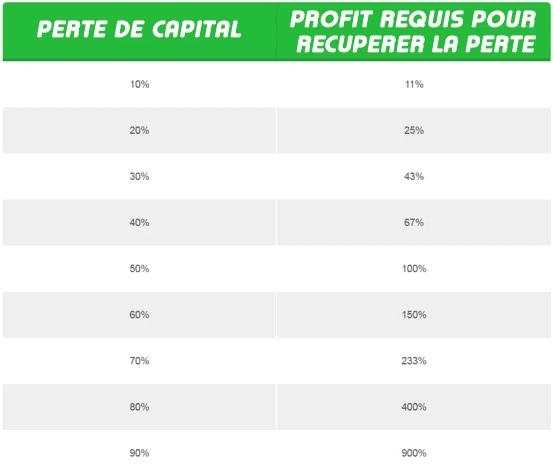
If you’ve already seen the table below, you know what I’m talking about…
Here is a table that shows the gains you need to get back to break-even point after a loss.
Risk Management and Loss of Capital
To keep it simple, if we take the first row, it’s not easy to grasp.
On the other hand, if you take a look at the last row, it’s much clearer right away!
In short, if you lose 90% of your capital. To recover that loss, you’ll need to make +900% growth just to start turning a profit…
If that were to happen, can you imagine the lost earnings simply because you didn’t buy at the right time?
Avoiding what’s described above by practicing balanced risk management is the first thing. I can’t say it enough; when you bet small, it’s much harder to lose big.
Diversifying to ensure good risk management is the second thing!
Finally, make sure that the only good reason to take a loss is a change of trend.
When the trend changes, your trades change with it — that’s normal!
Set invalidation points, stop-losses and be rigorous in applying them.
As a side note, an invalidation point is defined before you place the trade, and you must not move it afterward hoping for something. Stick to your plan!
It’s a lesson that can cost you dearly if you try to learn it on your own, so stay vigilant!
Risk Management & Trend
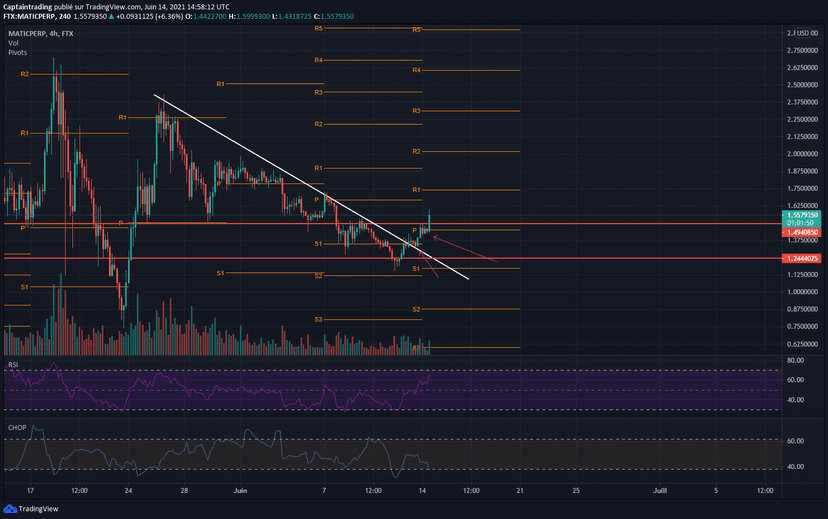
An uptrend is defined by higher highs and higher lows. Whereas a downtrend is defined by lower highs and lower lows.
Here’s an example of a change of trend with 2 new lows at higher levels.
Risk Management and Range Trading
When you practice range trading, you’re actually trading “the absence of a trend.” From that point on, two things matter: the edges and the middle of the range.
Very often when we’re in a range, the majority gets trapped because they think the range is breaking out, whether to the upside or the downside; hence the importance of defining market conditions in your trading plan.
Here’s an example of a range
 View the chart directly on TradingView | TradingView Course
By observing the chart above, we can conclude that:
- The market always forms a structure, it may not always be clear or easy to define, but it’s undeniable.
- Holding positions in the opposite direction to a new trend is absurd
- A trend meets precise technical criteria. The different trends are respectively defined by higher highs and lower lows, or by a stable channel.
Without Self-Reflection, There Is No Progress!
Larry Williams used to say that you don’t necessarily have to buy the bottom and sell the top. What is essential, though, is knowing where and when to exit!
Please keep in mind that these points apply equally to Long entries and Short entries. The beginnings of an entry point must always sit on a trough or a peak. That holds for Long entries just as much as for Short ones.
A range can be identified on any timeframe, whether it’s seconds or months, but still avoid entering in the middle of a range…
How Do You Manage Your Funds?
When you trade, you have to define clear and precise risk management so you can apply your plan, which is why I always recommend limiting your trades to 3% of your capital MAX.
After that, you can adjust based on the risk taken on each trade, but don’t go above 3%.
And now you’re thinking, but why do I have to limit myself to 3% of my capital?!
Careful, that’s not what I’m asking. What I’m asking is that you limit your risk to 3% of your capital per trade.
Indeed, all you have to do is align your stop-losses with that 3% risk, telling yourself “I can” lose 3% Max of my total capital on this trade.
“A risk is defined by the potential loss, not by the capital committed!”
Rigorously set entry and exit points let you risk little while still maintaining large initial “stakes.”
Careful, your SLs must also line up with technical levels; it’s not 3% every single time, obviously!
- How do you choose your position size and/or your leverage?
- Why not exceed 3% of risk on a trade?
Choosing a position size and your invalidation point both depend on the levels at which the trend changes, because we trade in the direction of the trend!
You can hand that calculation off to a tool, too: on the traditional markets via MT4/MT5, Trade Assistant applies it live on the chart — the stop moves, the size follows, the risk stays fixed.
The trend changes?
Then your trade ends, unless you had anticipated that shift in trend.
Simple, right?!
Of course, your invalidation points also depend on the way you interpret the market and the trend.
Let’s try to clarify this with an example I really like; the “Fakeout,” in other words the false breakout. I like it a lot because it made me lose a lot…
I’m neither the first nor the last to suffer the curse of “fakeouts,” which is why I no longer trade breakouts.
As I often say, an entry point should sit on the re-test of a former resistance!
There are many ways to place your stop-loss depending on your style, but be smart when the time comes to do it. Be flexible with your stop or your entry points, you never know… A flash crash can always happen on the crypto market!
To define my invalidation points, you should know that I prefer horizontal levels.
So I generally choose my invalidation points at a former resistance that has broken out. If price drops below that level, in my view, the trend changes; the breakout no longer holds and we go back into the previous range.
Defining and Calculating Position Size
x = % of risk ÷ SL distance in %
1. If you enter a market, be certain of the “why”
2. If you’ve found SEVERAL good reasons, there is necessarily a point beyond which those reasons no longer hold; define it clearly on the charts.
Every decision to enter a trade must come with an exit plan for both the upside and the downside!
1. Trading involves both long and short positions! So it’s not necessarily about selling.
2. The point is to exit a trade, an exit you make following a change of
trend.
3. It’s about focusing on the fundamentals and price action, so you can make real profits!
What should you do if the trend reverses from the levels I’ve defined?
What should you do if you notice a false breakout or a false breakdown?
1. False moves happen less often than organic moves. We fight against false moves so often that we forget to capitalize on the moves that are coherent.
2. If the trend can reverse, then re-enter in a coherent way, that is, while maintaining your usual risk management.
Which seems best to you?
Exiting positions, limiting the damage and re-entering on a coherent position?
OR
Not exiting positions and hoping ( desperately ) for another change of trend?
It’s up to you…
Risk Management: 10 Practical Tips
Bringing your risk of ruin down to almost zero is the ultimate goal of risk management!
1. Never enter a trade before you know where you’ll exit if you’re wrong.
> At what price level will you place your Stop Loss?! Careful, because placing your stop-loss is a
2. FIRST find the price level that’s likely to give you that invalidation point, and only then set your position size based on that price level and your risk management
> When you set your risk management at 3%, it’s not because you stake 3% of your capital on each trade, but because you risk 3% of your capital on each trade!
To keep working on this, I recommend my free trading course on YouTube!
3. Focus on the amount of capital you can lose on a trade before entering it, not on the profit you might make.
4. Structure your trades through your position sizing and your stop-losses so you never lose more than 1% to 3% of your capital on a losing trade.
5. Never expose your trading account to a total risk of more than 10% at the same time.
6. Understand the nature of volatility and adjust your position size according to the increased risk that comes with volatility spikes.
7. Never, ever, ever double down on a trade after a losing one. It will end up destroying your trading account, and you’ll wind up trading against the trend.
8. All your trades must end in one of the following four ways:
a/ a small gain
b/ a big gain, a small loss or
c/ break-even
d/ a small loss
e/ there’s no e!
You are absolutely not allowed to end with a large loss if you’ve perfectly defined your invalidation scenario, respected your risk management and placed your Stop Loss accordingly. That would be intolerable!
What’s more, know that by getting rid of the big losses, you take giant strides toward success.
9. Be incredibly stubborn about your risk management rules, don’t give an inch. If you don’t concede a goal, you can’t lose, so beef up your defense!
10. Most of the time, trailing stops are very profitable when you trade the trend!
Don’t deprive yourself of them, because when you trade with the trend, it can sometimes go very far, especially in the crypto space.
To learn more about risk management, I strongly recommend my written tutorial !
Risk Management: 10 General Tips
1. “Deal with what is happening… not with what you think is going to happen.” – Doug Gregory
2. In the beginning, don’t hesitate to overdo it on the rules, but don’t forget that there will always be a dose of uncertainty left.
3. Find your advantage ( the famous edge ) over other traders.
4. Your trading system must be built on quantifiable facts, not on opinions.
5. Analyze Price ( price action ), not the news.
6. A robust trading system must be designed either to have a high proportion of winning trades, or to have big wins and many small losses.
7. Only take trades whose risk and reward are skewed in your favor.
> Trading is not a game of chance! If you have a good feeling because you’ve started to gain experience, then check it against your indicators according to your system!
8. The answer to the question “What is the trend?” is “What is your Timeframe?” – Richard Weissman.
Trade mainly in the direction of a market’s trend on your timeframe until it reverses.
That doesn’t mean you can’t anticipate a trend reversal, but they’re rare, so don’t get lost in it! Betting on a reversal can only make sense if you do it very rarely.
9. Only take entries that offer a real advantage over other assets, avoid getting caught in the noise. Don’t just follow a profitable market; also take the time to find the best assets to trade: the most volatile ones, the ones whose technology and use case you appreciate, and so on
10. Place your stop-losses outside the “noise of the crowd” so that you only get stopped out when you’re surely wrong! Don’t get hunted, be smarter than the crowd!
Bonus Tips
- Define your entry points based on your strategy and your style
- Clearly define your invalidation points with stop-losses.
- Define your targets and automate them just like your stop-losses.
- You need to record all of it in a trading journal so you can instinctively understand what you need to improve later on.
In Conclusion
The charts tell you when the fundamentals are weakening. No matter your style and how you take positions, you must place the preservation of your capital — in other words your risk management — at the absolute top of your priorities!
The sooner you’ve understood this, the more comfortable you’ll feel, and the more profit you’ll make. On top of that, the emotional side becomes negligible!
Be STRICTLY free of emotion when it comes to limiting losses, because you’ve defined concrete invalidation points that mark a change of trend.
If you enjoyed this content and you want to go further in learning risk management, I invite you to watch my tutorial on YouTube right now!
Enjoy the video!

Every guide here is free. Browse the full course and join a community of traders who share ideas every day.