After my guide on the trading plan, here’s my guide on the trading system. If you still find the two hard to tell apart, I’d encourage you to revisit my training/tutorial on the trading plan, because I’m using this article to clearly draw the distinction between the journal, the plan, and the trading system.
Enjoy the read!
Trading System: Introduction
By definition, a trading system brings together the rules and principles that govern a trader’s approach when they’re about to trade on a financial market.
So a trading system lays out the types of transactions a trader can make, the markets they can engage with, the specific setups and structures that trade entries can be based on, risk management, the rules tied to times of day or trading sessions, and so on.
This list isn’t exhaustive. It’s up to you to round it out!
There’s certainly a wide range of possibilities when it comes to how much precision a trader can bring to their approach.
Some trading systems settle for giving general guidance on setups and risk, then leave the rest to the trader’s discretion.
Others offer far more than that. Choosing one largely comes down to your preferences and your experience. We’ll come back to this later.
The Advantages of a Good Trading System
A good trading system defines the conditions under which a trader is most likely to be profitable, and points to the best way to take advantage of those conditions.
A good technique is really about finding opportunities with an asymmetric risk/reward on high-probability technical structures. That means precisely defining your risk both before and after your trade entries.
A well-honed trading system helps you spot profitable structures — when and where they form, and how to trade around them (and also when to avoid them).
If you want to grasp the value of a well-built trading system, the idea is this:
Trading is a very hard activity. Yet it remains all too easy to make decisions on a whim. Your trading plan acts like your conscience, that guardian angel telling you:
“Hey, whoa — what do you think you’re doing?! …
… Well, sure, maybe — but first WE CHECK. Rules are rules!”
Instinct — the kind that comes with years of experience — is excellent …
The kind that shows up after a few days or a few weeks is a very different beast!
Conversely, a disorganized trader isn’t profitable! Some may seem to be, but if they’re profitable, it’s because they’ve built a solid trading system.
The trading system in two words: discipline and organization
The Foundations of a Trading System
To have the tools to build a solid trading system, it’s essential to meticulously log your trade entries — first the simulated ones (backtesting), then the real ones.
Also, don’t try to reinvent trading every morning, because otherwise you’re toast …
I do (rarely) add indicators to my panel of potential signals, but the basics are there!
Throughout my training, I always push you toward maximum independence, critical thinking, and a healthy contrarian streak, so you can constructively question what you learn.
That said, when something works for me, it should work for you too — so at the start, don’t hesitate to take what works according to me and other traders, and simply test it! It’ll give you leads that, with experience, you’ll be able to refine.
Record every one of your moves in the markets and build your paradigm, your own algorithm — but don’t stop there!
Truth be told, it’s only once your win rate is high enough to be profitable that you’ll be able to build a system entirely shaped by your own experience! Stay humble …
It’s entirely possible to build a template — the skeleton of a trading system derived from what you’ve learned from other traders — then build your record, gradually add optimizations, and tailor it to your needs and preferences.
This is generally what I recommend to beginner traders who aren’t quite sure where to start. I also recommend this method to intermediate traders who feel they’ve wasted too much time piling up bad experiences.
The advantage is that you don’t have to (re)invent anything, and if you choose the right sources, you’re building on a solid base of trading principles.
The risk, of course, is picking clowns and basing your rules on the fairy tales they teach. That’s another topic, but any decent dose of critical thinking will usually steer you in the right direction.
Look for people or groups who are credible, transparent, capable, and whose methods hold up under your own testing.
What’s more, whatever you’re trying to do … it has to resonate with you! There’s no point trying to apply something you don’t understand, because if you move forward blindfolded, you don’t stand a chance.
Suppose your copy trading works for a while — if the guy whose trades you’re copying retires, do you retire too?
That’s exactly why every trading plan I share within my ongoing training is educational! I explain them so that:
1. you can save a considerable amount of time finding opportunities.
2. you understand why and how I stepped in, so you can integrate my method little by little.
Key takeaways:
1. How rigid your system is can vary … with time and success!
2. A good trading system is essential to reduce the influence of emotion on your decision-making.
3. A trading system is always built on the combination of your own experience and that of other traders.
How to Build a Trading System
As suggested in the intro, the form and content of a trading system can vary. That said, a solid base is essential. So here’s the typical content of a trading system “put down on paper.” It’s neither exhaustive nor perfect. That’s why I’d encourage you to round it out with your own rules.
I Your Trading Style
Picture your system as a tree whose crown springs from your trading style.
Indeed, depending on whether you want to do aggressive scalping or low-risk swing trading, most of your system will be different.
The idea is to define the type or types of trading that resonate with you (or that work), the time horizons and trade durations you’re comfortable with, and so on.
Example of a trading-style definition: I’m mainly a directional intraday, swing-ish trader. I trade using support/resistance. I enter at reversal points with a well-defined risk. I trade from one level to the next (level to level). I trade setups that generally let me know quickly whether I’m right or wrong. I don’t like holding positions for more than two or three days.
This example may work for you and not for others. It’s up to you to find the style that suits you — it’s very important for what comes next.
Maybe you’re a trend trader who doesn’t really care about exact entry points, and perhaps you use a set of indicators to tell you when to get in and out. You might not care about reversal points and simply want to capture the bulk of the move, happily holding a position for weeks or months.
Here are a few points you can consider when describing your style:
- Which combination of timeframes suits me best?
- Are you psychologically able to take and hold a position long enough to test your strategy?!
- Can you stand being underwater on a position for days or weeks, hoping to catch a broader trend — on the options market, for example?
Or do you prefer to get in and out of the market more frequently, based on very specific intraday structures?
Besides, the only way to know what works for you is by testing!
You can call yourself a scalper as much as you like — until you’ve tested it, it’ll carry little weight in your profits anyway. In fact, we often think we’re good at one style when a different or even completely opposite style is the one that actually suits us.
On top of that, there can be more than one answer to these questions. Your trading style doesn’t need to be 100% fixed (even though that would probably be useful, at least at the start).
For example, many swing traders can also scalp effectively using the same techniques, simply applied to lower time horizons. Despite this overlap, as we mentioned, it’s best to start with your strong suit and broaden your arsenal later.
Finally, know how to set your limits — sometimes the market is so hard to trade that it’s better to wait patiently and calmly prepare for what’s next.
II. Risk Management
If you already know me a little, you know just how big a role risk management plays in my method and my training.
If you haven’t heard about it yet, that’s no problem at all, because I’ve produced two tutorials on the subject precisely to help you quickly master your risk management!
So here’s a first written tutorial and a second video tutorial on risk management!

Once you’ve defined your style or styles, defining your risk management is the first thing to do — no hesitation.
There’ll very likely be no reason to worry about anything else if you start out wanting to go all in …
Here, I won’t dwell on risk management again, because I’ve already done that.
Still, here are 4 essential points of risk management:
- How much am I able to dedicate to my trading without it messing with me psychologically in my decision-making? Don’t put yourself in financially difficult situations, because it’ll show up in your results right away. On the contrary, if you take your time and your risk is measured, you’ll surely be inclined to make optimal decisions and avoid FOMO, for example.
- What portion of my trading capital am I willing to stake on each trade?!
Personally, I recommend starting with a risk of 1% MAX per trade (careful — this doesn’t mean you stake 1% of your capital, but that you risk 1% of your capital see the Stop-Loss tutorial)
- What’s the plan when I’ve messed up several times in a row? How will I react to defeat, and what’s the optimal process to respond to it and come back strong?!
- What’s my risk/reward, known as R:R?! Will I take high-probability trades with a small reward, or will I instead take on significant risk to (hopefully) win more?! I recommend quality setups with a minimum R:R of 1:2.
- Don’t hesitate to re-specify your risk according to the “TFs.”
> What’s my max loss per day, per week, per month, etc.?!
It’s essential not to charge back in right after taking a hit that’s left you reeling … This kind of rule helps with exactly that!
There’s a solid base — but don’t forget the existing tutorials; they’re far more complete and say more about the method I’ve developed.
III. Trade Entries and Exits
A. The Entry
This is clearly about defining how and why you’re going to take a trade.
Obviously, this section is essential. It’s also the one that stays the most “customizable.” Some are able to spell out an ultra-rigid set of rules here, while other traders will keep many elements at their discretion.
There’s no perfect solution. That said, it’s clear that the best traders start with an ultra-rigid version, only to end up keeping an optimized, lighter framework that allows for faster decision-making.
Here are a few criteria and combinations you can build into your trading system in order to enter a position:
1. What should you look at and look for?
What should I notice to consider a setup, and which combination of signals makes my decision instant?!
Examples of indicators that allow signal confluence to produce attractive entry points:
- Support & Resistance levels ( see S/R YOUTUBE TUTORIAL )
- specific price-curve setups
- Fibonacci levels ( my most-watched YT tutorial )
- Specific MA levels ( Moving Averages )
- Chop Index ( my favorite indicator )
- Open Interest
2. The characteristics of the setups you’re looking for.
Are you able to literally sketch out the perfect setup?
If not, you’ve still got work to do, because it means you don’t even know what you’re going to look for. And please, don’t fixate on a single setup …
Stack the odds in your favor by anticipating every plausible scenario!
Don’t hesitate to take a moment to make some nice drawings to train your visual memory, because after a few years, I can promise you you’ll see setups coming at a single glance. After a few years, indeed, discipline will mainly prompt you to verify your intuitions. Be patient — put in a few months full-time first, and it’ll come.
3. Timeframes
Which timeframes are you going to use to identify (and refine) the structures you trade?
Which combinations?
Can every setup be traded on each timeframe you prefer?
What’s the minimum timeframe for seriously considering a setup?
4. The Trigger
What type of order will I place, depending on the setup, once it’s in place?!
Limit or Market Order ( I recommend the former in 99% of cases )
At which level of my structure should I place my orders?
Will I enter in several parts, scaling in progressively, or at one very specific level?
If I focus on a single entry point, what does the price movement need to be for me to enter, and on which candlestick setup?!
To wrap up briefly on entries, what you need to remember is that it’s really about defining what and how to trade it, what it looks like, how to take a position, and finally how to exit and take your profits ( see the Take Profit tutorial )
By the way, the entry is defined at the same time as the exit …
B. The Position Exit
So, likewise, which levels are you targeting, and why are you targeting them?!
Are they discretionary, or are they clearly defined by the right setup?
Which indicators, and what settings, prompt me to take my profits?
How far from Support & Resistance levels should I exit in order to capture enough liquidity?
In this section I regularly add new elements, because after placing hundreds or even thousands of orders, you always notice new clues.
If you’re a beginner, unlike with entries, it’s better not to overload this compartment of your system. The first step will be to adopt exit rules that are simple to apply, to encourage fast, effective decision-making ( = free of emotion ).
To round out, or completely rebuild, this section, I’d encourage you to revisit my tutorial on the profit-taking phase, as well as my tutorials dedicated to setting up Stop-Losses.
IV. Trade Management: the in-between is actually the hardest part!
Indeed, managing a trade — the stretch between the moment you enter a position and the moment you exit it — is actually the hardest part, because it’s often neglected. Setting your take profits at the same moment as your trade entries doesn’t come naturally to everyone. And when it comes to management, I can tell you it’s the same story …
Let anyone who’s never “panic sold” only to then watch the price explode raise their hand!
If you’re a beginner or currently in a phase of questioning everything, here I’d advise you above all to leave nothing to chance.
Enough dithering — let’s now move on to a concrete working base:
- It’s entirely possible to spare yourself this phase and program 2 possible exits: 1 on the upside and 1 on the downside, along with a deadline. OR you decide to take trade management into your own hands.
This may be tied to a setup that requires it, because it’s a first trade after a backtesting phase, or simply because you enjoy it.
- Define the specific timeframes on which you prefer to monitor your trades.
It’s recommended to monitor how a setup is playing out on the same timeframes that let you anticipate it in the first place.
- Under what conditions is it acceptable to move my Stop-Loss?
Will you do it more to increase your risk or to reduce it?
- Under what conditions is it acceptable to move my Take Profit?
- Is it possible to take profits in a pyramiding fashion or with another specific method, and what should you watch out for in that regard?
- Can my long-term bias influence my intraday decision-making?!
If so, it’s essential to remember how you determined your bias and under what conditions it will be invalidated. Finally, it’s about anticipating how all of this affects the management of my trades.
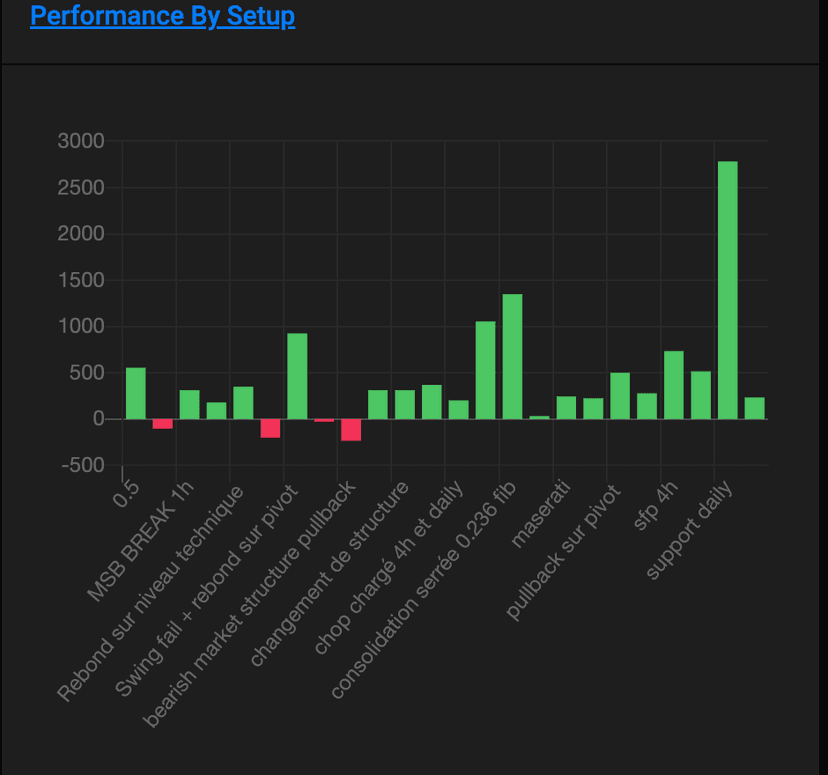
The important thing is that you’re meticulous in how you record your transactions; the best management practices will be drawn from your trading journal!
Don’t neglect it.
If you start getting into the habit of exiting too early, don’t hesitate to systematize your trade management, so you avoid emotional decision-making and thereby optimize your win rate.
If, on the contrary, you regularly see fine gains turn into losing trades or trades hovering around the break-even point, that suggests a more interventionist management strategy (or more realistic targets, a better take-profit strategy, etc.)
Every guide here is free. Browse the full course and join a community of traders who share ideas every day.