Captain Trading regularly releases new free trading courses to help you get started in trading on the right footing. That way, you can find your feet in this complex world with the tools you need. In this course, we’ll walk you through the essentials of building a trading plan.
Among those essentials: entry rules, the roadmap, entries and exits, and so on.
Of course, how much each one matters depends on your style — scalping, day trading or swing trading — but please, don’t neglect a single one!
Once your trading strategy for operating in the financial markets is clear, it’s time to put it into practice! So, ready to invest in your own skills?!
The aim of this Trading Plan course is to pin down three things:
What Is a Trading Plan?
Building a trading plan comes down to writing up a summary of the trader’s agenda. That agenda brings together the various strategies used over a specific period.
Put simply, it’s the real-time application of the strategies that make up your system.
The trading plan lives up to its name: at its heart it’s an agenda that logs the various setups that have shown up, the ones taking shape, and how to make the most of them. A trading plan lets you operate along a clear, defined line of conduct when placing your trades.
Building your own trading plans will, over the long run, help you get better every single day — and along the way, it will define what kind of trader you are!
At a minimum, a trading plan includes:
For results and tracking, see you over in the trading journal!
Why Make a Trading Plan?
Now that you know what it is, the value of a trading plan should be obvious. In case it isn’t, here are a few reasons to believe a well-built plan will move your trading forward:
- It keeps your head clear when it’s time to take a trade live.
- A good trading plan lets you act with confidence within a defined framework; it saves you from having your eyes glued to the charts all day long.
- Your plan will fold in your risk management along with your support and resistance levels.
- It makes recording your results easier.
- It improves discipline and organization.
The dilemma is simple! Would you rather act at random or follow a plan?! Rigor is a must. Using a trading plan — even a bare-bones one — is essential!
You can’t take a position without knowing in advance how you’ll get out of it, whether that’s in profit or at a loss …
Your trading goals have to be clear, otherwise you’re going to fall flat. If you want to test that for yourself risk-free, go ahead and open a demo account!
How to Build a Trading Plan
First, let’s draw the line between a trading plan, a trading journal, and a trading system.
The Trading System: It gathers every rule a trader applies — think of it as the theoretical side.
The Trading Journal: This is the document that records your past and current trades. It’s a bit like your ledger.
The Trading Plan: This is the document that sits between the two just described, since it’s drawn up for a specific window of time, pulling together all the specific rules and setups you’ve judged coherent for that given period. Of course, your plan won’t end on a set date, but when the market has shifted course and can no longer fit the framework you laid out for yourself with the utmost discipline.
Your technical analysis should be jotted down quickly, as you’ll see in our examples — no need to write a novel!
System vs. Plan
Like your trading system, your plan should be “adaptable” and carry a certain degree of flexibility, which will help define your style.
For instance, trader 1, being very disciplined, will note every level where they might place a trade. Matched to each of those are the stop-losses paired with risk management, and so on.
Trader 2 (less disciplined), on the other hand, will use their plan more to sketch out the trend and the possible opportunities in broad strokes. The rest they’ll keep in their head. To each their own, but if you know me, you know full well I lean toward the first style of plan.
Whatever style you’re aiming for, it’s generally wise to be more disciplined than average when you’re starting out. Only with real experience will you be able to gradually let your style evolve.
The Captain’s Trading Plan.
So here’s an example of a conventional trading plan to get you off to a good start:
1. The Pre-Open Routine.
In this section, the goal is to highlight all the little things to scan before you even start picturing your trades. Don’t even think about placing a trade before you’ve checked that the news hasn’t moved, that the levels haven’t shifted, that you’ve reviewed every open order and the ones that were due to be lifted, and so on.
This routine is obviously very personal, but you’ll have grasped the idea; it’s about mastering the context and therefore the bigger picture. This routine, like the next one, can also include rereading the previous day’s journal or this plan. Personally, I add physical and mental preparation to this market prep: exercise, meditation and yoga, a good night’s sleep. I’ve noticed that my biggest mistakes were made when I wasn’t meeting the physical and mental conditions.
Note in your journal how you’re feeling and whether you’ve properly worked through your market-prep checklist as well as your psychological prep.
2. The Post-Close Routine
This one should mostly turn to your trading journal to sum up the day efficiently: Gains / Losses | did you stick to the plans? | mistakes made and why | entry points | assets to watch.
In short, it’s about concisely noting the positives and negatives of your day. Again, this is very personal, but I encourage you to acknowledge any mistakes from the day before so you avoid making them the next day. Since you’ll have jotted these points down as the day went on, it should be quick.
3. The Market
It goes without saying: you absolutely have to note the markets you want to place a trade on and lay out a plan that fits each of them, even if they’re all connected in one way or another. Always keep the support and resistance levels on the major timeframes in mind. Personally, I delete them every day so I can redraw them and commit them to memory better.
4. Your Bias
Directional bias is a delicate subject, but to keep it simple, it’s the overall trend.
Your timeframe can vary when defining your bias depending on your approach. It can shift based on the levels or on the setups and patterns you’ve spotted. The best move is to combine several analyses to define your bias clearly and optimize your win rate.
This section can also be set aside to note the strategic levels that will let you redefine your bias very quickly, and so avoid stubbornly pushing in the wrong direction.
5. News and Fundamentals
This section should include all the information you need to operate in a market. In the crypto market, I’m selective about the news and rely mainly on taking the temperature of the US markets and precious metals. Otherwise, I also lean on the trend of BTC and ETH, since those are usually the coins that call the tune.
6. The Market’s Targets, in Your View.
Here you’ll want to note the expected move in the market. You’ll also need to define a “preferred” scenario and an opposing scenario, so you have an escape route that cleanly caps your losses. Don’t be stubborn — accept your mistake, or the new trend, when it’s obvious. Planning for the worst will help you a great deal with that!
Considering every possible scenario lets me avoid being caught off guard and so make well-thought-out decisions. On top of that, I’ve noticed that being ready for each scenario had a positive impact on my win rate. That’s why I dwell on it.
7. Price Levels
These are the alerts that tell me whether or not I should take a look at a given chart. Or whether I should simply place a pending order.
8. The Setups
This section should bring together the setups you plan to exploit according to the system you’ve put in place.
9. Risk.
You know how important your risk management is… It has to be clearly defined in your plan.
I’ve put together a video tutorial on risk management. It will be published soon. It’s essentially the percentage of capital you’re going to commit to each trade, depending on the setup, the market conditions, or your win rate.
10. Invalidation Points
This is about pinpointing exactly when a setup will be invalidated, so I can remove it from my plan and reassess it by setting the stop-losses. It can also take the form of avoiding or adjusting an entry.
11. Targets
At last, here we are! Defining your targets is the conclusion of your plan. And yes, when things have gone well, you also have to know how to take your profits and step back, at least partially, depending on your profile: short, medium or long term. After that, it’s about re-framing the market to set new positions if you think there’s still some juice somewhere …
Trading Plan Examples
Example of a Trading Plan Executed on EUR/USD (14/03/24 to 22/03/24)
Join the free Captain Trading space: with a simple account, you get the daily plan in your trading journal, decoded COT reports, lives and their replays, and the community help room built right into your dashboard — you ask your question in your language and we answer in your language! It’s all free. If you’d like to support us, open an account with one of our partner platforms through the Cashback page: 5% of your trading fees are yours for good, and 10 to 20% in the months when your volume justifies it — that’s what allows us to keep going.
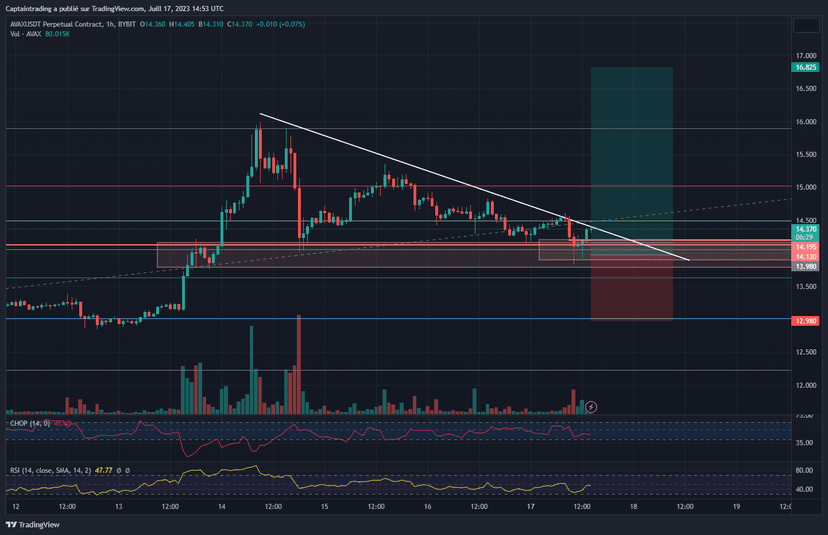
Trading Plan Example on AVAX/USDT (17/07/23)
Timeframe: H4 (SWING)
Risk: 1%
Entry Zone: $14.35-14.10
Take Profit 1: $15
Take Profit 2: $15.89
Take Profit 3: Runner | Trailing Stop
Stop Loss: $12.97
Reasoning: Swing Failure Pattern on a decisive low | Former resistance turning into support!
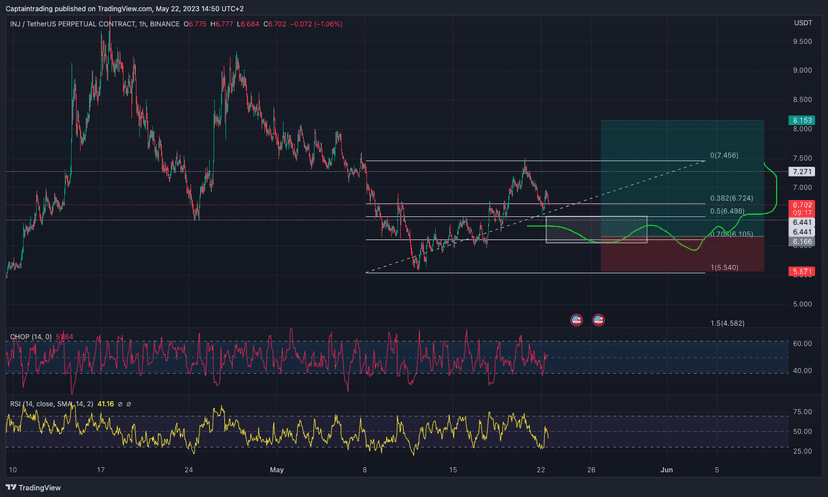
Trading Plan Example on INJ/USDT (22/05/23)
Timeframe: H12- H1 | INTRADAY
Risk: 1%
Entry Zone: $6.44 – 6-16
Take Profit 1: $7.01
Take Profit 2: $7.22
Take Profit 3: $7.43
Take Profit 4: Runner in case of a range breakout
Stop Loss: $5.57
Reasoning: Wazerati Daily pullback / Bounce off a pivot zone?
My Advice and Take on Trading Plans
To keep it short, the trading plan should be the operational arm of your trading system on a daily basis, forcing on you the discipline that trading demands.
A plan shouldn’t eat up too much of your time over the long run. Nor does it need to be perfect down to the last comma.
That said, if you’re not used to being disciplined, I urge you to be seriously so with your trading plans — at least the first ones, and I’m talking about several dozen, even hundreds. As long as it helps you place your trades consistently, it will serve you well. In truth, it remains indispensable to any trader, beginner or seasoned.
I hope this trading plan tutorial has been useful to you. If you want more, I invite you to take (or retake) a tour through my free trading course.
Finally, if you feel your trading plans are well put together, I invite you to move on to the next step with my Money Management course!
Every guide here is free. Browse the full course and join a community of traders who share ideas every day.