You set your Stop Loss the moment you enter a position on a market: it is part of your trading plan!
The SL is set at a fixed price, yet it must correspond to a variable share of your capital.
What’s more, triggering my SL must correspond to an acceptable loss and to solid risk management that stays consistent. I usually mention 3% MAXIMUM of the capital committed to a single trade, but it can also be 0.1%, 0.5% or 1%…
You can never be too careful, but be warned… If you want to commit to a trade, you’ll need to have nerves of steel, an unshakeable psychology: be rigorous and tolerant at the same time.
You need to define invalidation points that are consistent with support and resistance, with “liquidity pools”, and so on.
Stop Loss Definition
A Stop Loss is an automated or scheduled sell order whose purpose is to sell losing positions. The goal, then, is to limit your losses if your plan doesn’t play out as hoped/expected!
A bad Stop Loss does precisely the opposite: it closes your position when it would have been a winner had you held under the pressure!
Managing Risk and Controlling Your Losses With a Stop Loss
Most traders get liquidated because they haven’t set their SL, or haven’t set it properly.
Although the SL can be “optional” in trading, in my view it is strictly mandatory whenever you use leverage.
When a trade fails, the SL represents what I’m “allowed” to lose. That loss will therefore have no impact on my future as a trader or on my state of mind…
On many occasions, I paid the price for not respecting my risk management, or for the absence/oversight of a stop loss — out of ignorance at first, then out of carelessness. I know you want to win fast and watch your capital grow fast, but having to work for however long just to recover your losses can turn out far worse.
Managing your risk and respecting your SLs are the two tools that will keep you in this business. My own case says it all, since the win rate of my
trade entries sits around 54% and yet I am well into profit.
It is essential to know how to anticipate and limit losses in order to preserve your capital, because it is your most precious asset in the world of investing. Your capital is your tool of the trade — without a tool, you no longer have a job, and it’s back to square one.
Your S.L Must Be Placed According to a Technical Level!
Indeed, to be consistent, an SL must correspond to a percentage that is acceptable both
for me and for the scenario I’ve mapped out. There would be no point in setting my
SL at 3% if I know my scenario is invalidated at 0.5%. It’s always wise to leave a bit of room while optimizing your position size.
This link between your stop and your position size matters enough that we gave it a guide of its own: on MT4/MT5, the Trade Assistant add-on runs that math automatically — move your stop line, and the size recalculates on the spot.
Stop Loss and Trailing Stop

My 7 Tips for Placing a Useful, Effective Stop Loss:
1. The Stop loss is an essential part of your trading plan, so it must be set the moment you enter a position — and definitely not after!
2. An SL lets you stay unfazed. For that to work, you need to define your invalidation point before you even think about your take profits ! Do you accept this loss? As Larry Williams would say, if you assume your trade will be a loser, you wouldn’t risk as much.
3. An SL isn’t simply a percentage of my capital, above all it’s an invalidation point for my winning scenario: “if it’s hit, I can no longer win.” I get out, I accept it and I move on, and I also try to understand what’s wrong with my trade…
4. An SL must correspond to a key technical level, not to an opinion. Your technical analysis skills are there for exactly that!
5. Start by defining your SL objectively, then adjust your position size to it according to your risk management.
6. Once you’ve honored these first 5 points, you can allow yourself a hint of leeway: be tolerant when you set your SL for good — it would be a shame to get “hunted” out! ( stop hunt )
When there’s an invalidation, there’s no need to argue; it’s over, we move on. Did I respect my plan?
Yes — so no problem.
7. Your ego has nothing to do with any of this. Accept your losses, it’s essential. No trader wins 100% of the time. Without a stop loss, especially with leverage, you end up getting liquidated!
Following on from these few tips, let’s go over 5 mistakes you must never make when placing your Stop Loss!
Stop Loss: The Mistakes to Avoid
I. Failing to set your stop in advance.
You must know exactly where you’ll get out before launching a trade. If you don’t, it means you can’t follow your risk management precisely. Without this definition of your exits, losing control of your trade is all but guaranteed. In practice, you mostly risk becoming hesitant and finding any excuse to pull out, or worse, re-entering just as it’s already taken off…
This kind of behavior isn’t acceptable over the long run. By setting your stop loss before defining your position, you detach yourself from all emotion in how you apply the plan and the risk, and there you have it; you’ve won everything.
Finally, I’d add that if you skip placing your stop in advance, you can risk very heavy losses on a market as volatile as crypto.
The captain’s risk management rule #1:
Always define your SL and TP exits before you’re even in a position : how much I make and how much I lose. I’ll repeat this catchphrase to you ad vitam!
II. Placing your stop loss haphazardly.
A stop loss must respect precise levels that you’ve calculated in advance through the confluence of several methods selected and tested beforehand. It can’t be set at random, and even though I regularly share my stop zones in my technical analyses, I encourage you to find your own method that suits you best in order to optimize your trades and refine your risk management.
The stop loss isn’t a fixed percentage meant to produce a pretty “risk reward” ratio. Your stop must sit at an invalidation point specific to your scenario. Once you’ve established this invalidation point, you must calculate your position size based on your stop and your risk.
III. Moving your stop loss after placing your trade.
Just as you don’t place a stop after your trade, you don’t move it once the trade is live. If you’ve generally placed your Stop at a specific level, it’s because you have a good reason to. If not, analyzing your losing trade will let you identify that it is indeed in the wrong place.
A classic mistake that has cost more than one trader dearly, myself included, is removing your stop loss at the last moment because your subconscious decided otherwise… Never do that!
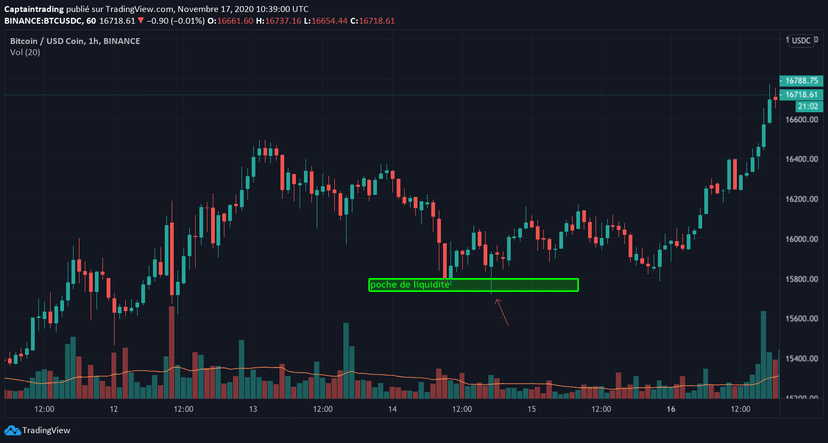
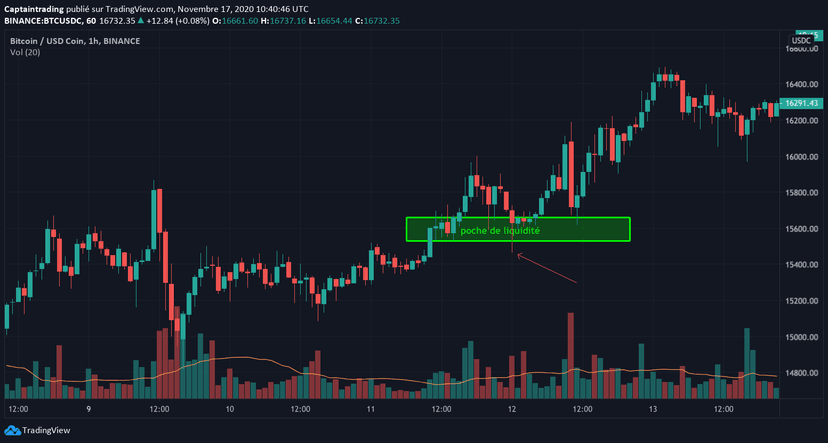
IV. Placing your SL on a liquidity pool.
There are certain price structures that are regularly targeted by whales in order to inflate their liquidity before a market reverses.
To make it easier for you to handle everything around liquidity, order waves, and so on, I’ll soon invite you to a video tutorial.
Still, let’s briefly recap the point. Here it’s above all about avoiding placing your stop right on key zones, because there’s a high probability the market will linger around them before setting off on a clear trend. If you place your stop loss flush against the last peak or the last trough, your odds of being stopped out and “hunted” are too high.
You’ve surely had the chance to observe those infamous stop-scraping wicks… Don’t be their victim! If price snaps right back in and draws a nice bullish or bearish wick, it’s because price went to grab a liquidity pool.
So should you avoid placing a stop, or simply let your trade breathe and use a stop that’s further away?! You already know the answer, and yet…
Every time you place a stop, you’re never safe from being a target — hence the importance of staying vigilant, and rigorous within flexibility!
Here are two fine examples of “hunted” stops before a Bullrun. The levels are highlighted with a red arrow.
V. Turning your Stop Loss into a stop win without good reason.
Earlier I told you not to move your stop loss. I meant it in the sense that you shouldn’t move a stop loss into a loss.
On the other hand, it is possible — even advisable — to move your stop loss to the break-even point ( break-even ) or into profit (stop win). That said, moving the stop requires a lot of practice and intuition. Without it, you risk cutting your winning trades too early and kicking yourself for it!
When you’re starting out and don’t yet fully master your strategies and your statistics, it’s better to stick to your initial plan and show humility. The more successful your trading plans become, the more you can afford the flexibility of moving your stop.
Only a winner’s attitude will let you win. You’ll acquire that attitude by stacking up winning trades. The only source of certainty I can offer you is experience.
Conclusion
Keep firmly in mind that the market is not your friend. It has no obligation to respect the levels and targets you’ve set; it owes you nothing!
The stop loss is your friend, not your enemy. It alone is capable of limiting your losses while still giving you the chance to position yourself in the market.
Think of the stop loss as the guardian angel that will never let you down! It is positive and should be remembered as such! “Forgetting it” is not acceptable.
Think carefully before placing your stop loss. Ask yourself two questions:
- How much do I lose if my stop loss is hit?
- At what point is my scenario invalidated?

Here’s a breakdown of the stop loss percentages to consider based on position size, for risk management with a 1% “allowed” loss per trade:
A position of 100% of your total capital gives you a potential of 1% stop
loss on your position, equal to 1% of total capital.
A position of 50% of your total trading capital gives you a potential of
2% stop loss on your position, equal to 1% of total capital..
A position of 25% of your total trading capital gives you a potential
of 4% stop loss on your position, equal to 1% of total capital.
And so on…
These basics can be useful to you and serve as a reminder when it comes time to set your Stop Losses!
To go deeper, I invite you to watch or rewatch my videos on the Stop Loss and on Risk Management.
Limiting Losses Through Risk Management

I sincerely hope this stop loss tutorial has been useful to you, and I’ll see you very soon for new content designed to help you learn trading.
Follow these few tips, and I’m sure you’ll make considerable progress.
To pick the Captain’s free trading course back up, it’s right here!
Happy trading, everyone!
Every guide here is free. Browse the full course and join a community of traders who share ideas every day.