Knowing your break-even point or Break Even Point when you invest, run a business, or step into the financial markets is essential if you want to make profits over the long term. In fact, it’s the foundation of every transaction.
Under what conditions is my trading strategy profitable, and at what point do I start losing money? Most people who lose money do so because they don’t know their costs precisely, so make sure you define and use your Break Even Point properly before you commit!
What Is Break Even?
It’s the equilibrium point, the break-even point. Traders call it the Break Even Point (BEP). Put simply, once this point is reached as prices move, the investor or trader breaks even: nothing is lost, but nothing is gained either. It’s also called the break-even point or equilibrium price of a trade or an investment.
It’s determined by comparing an asset’s market price to its initial cost. The break-even point is reached when the two prices are equal. Beyond the Break Even Point, we’ll also take a deeper look at the techniques used to set a Stop Loss!
The break-even point is an equilibrium point where there is neither loss nor profit. It sits halfway between profit and loss. In forex, this level would ideally be somewhere near your entry point, once you’ve accounted for the spread.
The concept of Break Even is a concrete and psychological element that’s essential in both trading and investing. It’s worth taking a closer look. Here’s how I analyze it!
In practice, on the traditional markets, moving to break even means bringing your stop loss back to your entry price once the trade has moved your way. On MT4/MT5, the Trade Assistant add-on handles that stop move — along with trailing and partial closes — right from the chart.
Break Even Point: Where It Matters
Break-even points (BEP) can be applied to a wide variety of contexts.
For example, the break-even point of a property is the amount of money the owner would have to spend to make the sale.
That includes all the costs, such as: closing costs and repairs, taxes, fees, insurance, and the interest paid on the mortgage, and so on. At that price, the owner would break even exactly, neither making nor losing money.
The B.E.P When It Comes to Investing
When it comes to investing, the BEP is the point at which the initial cost equals the actual selling price. In options trading, the BEP occurs when the market price of an underlying asset reaches the level at which the buyer won’t take a loss. The concepts are very close, I know… What’s important to understand is that before you make any money, there are a thousand factors to take into account. It’s not just a matter of buying and selling!
Break Even Point: The Benefits When It’s Clear!
A Break Even Point (break-even) analysis allows for better management and has many uses, including:
- Identifying upcoming expenses to avoid nasty surprises.
- Limiting decisions driven by emotion. A clear Break Even lets you rely on hard facts. It gives you a more objective view of the situation, especially when you have to take a trade.
- Setting precise targets to make sure you actually turn a profit.
- Raising funds from investors by showing them where the BEP sits in the management plan.
- Setting a product’s selling prices appropriately.
How to Calculate the Break Even Point?
The break-even calculation can be used whether you’re talking about a business or trading. The moment you plan to incur costs and make profits, it’s essential.
Options traders also use this technique to work out what price level the underlying needs to reach for a trade to expire “In the Money”. The break-even calculation often also factors in the cost of any fees, commissions, taxes and, in some cases, the effects of inflation.
In short, it’s the selling price minus the “cost price”, where the cost price equals the purchase price plus all the fees you’ve put in.
Total Revenues – Fixed Costs + Variable Costs = Revenue
If revenue lands exactly at zero, you’ve hit your break-even point.
If your revenue is positive, you’ve passed your break-even point; if not, you’re not there yet!
The Break-Even Point in Trading
Traders have to apply this concept every single day. In any trading plan, it’s absolutely essential to determine what price a security has to reach to cover exactly all the costs tied to that position.
This includes commissions, management fees, the spread, and so on.
The break-even point of a commercial business is calculated in a fairly standard way.
Revenue – rent – wages – cost of goods/storage/transport/taxes
In the profitable trader’s daily practice, it simply means moving your stop loss to your entry level. Actually, it’s just a little further in the direction of the trade (Buy on Sell) once you account for fees. If you’ve already watched or read my lessons on the Stop Loss, you know it’s a bad idea. That said, it’s still an option you can practice at leisure in paper trading… just to see!
Break Even in Classic or Spot Market Trading
Suppose an investor buys Apple (AAPL) shares at $145.
In this example, we’re not counting the broker’s fees—which do exist—so the Break Even Point is $145 (BEP).
From then on, if the price rises above the BEP, the investor makes money.
On the other hand, if the stock falls below the BEP, they lose money.
If the price stays at $145, they’re at the Break Even Point, because the investor neither gains nor loses anything.
The Break-Even Point and Options Trading
In options trading, the break even point is the market price an underlying asset has to reach for an option buyer to avoid a loss if they exercise the option.
For a call option, the Break Even Point is reached when the underlying asset equals the exercise price—the strike—plus the premium paid.
For a Put Option, the BEP is reached when the underlying asset equals the exercise price minus the premium paid.
The BEP generally doesn’t account for commission fees, although some Brokers sometimes include them in the calculation.
Calculating the Break Even Point of a Put Option
Suppose the premium (the premium price) is $265 for a BTC put option (Put Option) with a strike price (Strike) of $25,000. This lets the Put Option buyer sell 1 BTC at 25,000 dollars up until the option’s expiration date.
The break-even price (BEP) of the short position is $25,000 minus the $265 premium, i.e. $24,735. If the asset trades above this price, the option’s benefit hasn’t exceeded its cost.
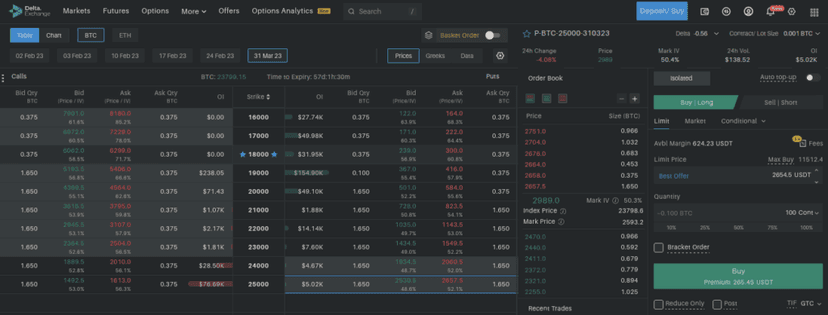
Calculating Your Break Even Point on an Option via Delta Exchange
If the asset trades at a market price of $20,000, for instance, the trader has a profit of $4,735 (Break Even of $24,735 minus the current market price of $20,000).*
Moving Your Stop Loss to the Break Even Point
Moving your stop loss to break-even, that is, to your entry point, can be a good or a bad thing, depending on your timing. There is indeed an ideal moment to move your SL to break-even.
When Should You Move Your Stop Loss?
It depends on the context…
Asking ourselves what the best moment is to move our stop loss to Break Even is, on the face of it, a good thing. However, doing it systematically can seriously hurt our profitability. Sure, almost everyone would say it’s a good thing to protect your account from a potential loss by moving the stop loss to Break Even, and that reasoning makes a lot of sense. But that’s not the point.
What matters is understanding the psychological motives that push us to do it:
Do I want to move my stop loss to Break Even to keep myself from taking a loss, out of fear that my plan won’t hold up? Or am I doing it after making a profit that I want to lock in?
The first motive is a fallacy, and the answer to whether I should move my stop loss (SL) to Break Even (BE) in that case is: Never! Here, my motivation is fueled more by the fear of losing than by the desire to win. This mindset—refusing to risk a loss for the sake of a gain—is catastrophic, and it’s almost impossible to be a profitable trader if you don’t cure yourself of this flaw.
But if it’s about securing my profit, can moving my SL to BE be considered? In that case, the move can make perfect sense.
Strategy: How to Move Your Stop Loss
First, you need to make sure you’ve made enough profit on the trade. This most often corresponds to your first target, Take Profit No. 1 (profit-taking), which we abbreviate as TP1.
For some traders, the first target is hit when the price moves 50 pips in the right direction. For others, it’s when the price is 1.5 times their initial stop loss. Here we enter what I consider a hugely important area: risk management, or Money Management.
It’s up to you to determine your win/loss ratio, your win rate, and to make sure the game is worth the candle: the profit has to be enough. I’ve made online lessons on YouTube about this, and I strongly encourage you to watch them.
The next step is to take a percentage—say 50%—of the profit made on the trade and move the stop loss to Break Even. On top of securing our profit, this leaves part of the capital in the trade so it can become even more profitable should the price keep moving in the direction we planned from the start.
This way, you can set several TPs (TP1, TP2, TP3) based on your Price Action analysis. A stop loss at BE ensures you won’t take any loss on the trade. But be careful not to move your SL to BE too quickly and too tightly! You could regret it!
Especially in the case where the price comes to hit your SL at BE only to shoot “to the moon” right afterward. You’d miss out on substantial gains.
I’ve made this mistake many times and kicked myself for it. Now, I can teach you never to make it again.
Moving your stop loss to the Break-Even Point is generally quite easy. It all depends on which platform you trade on.
How to Move Your Stop Loss Based on the B.E.P
On Bybit, for example, once you’ve built your trading plan in advance through Price Action analysis, you generally open a limit order at the same time as you place your initial TP and SL, based notably on supports, resistances, pivot points, and so on…
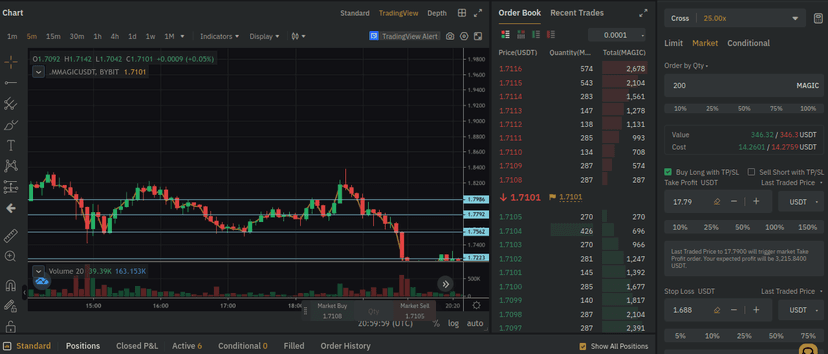
Break Even Point: Setting Your Stop Loss on Bybit
Once the trade is open (filled), you can place several TPs by setting up sell orders in “Reduce Only”. When TP1 is reached and Price Action has easily broken through a resistance, that resistance tends to become support.
When you’re sure that’s the case, you can move your SL to BE. As the trade continues, you can move your SL all along the path of the Price Action, always leaving a wide enough gap between the SL and the resistance if the price rises, and between the SL and the support if the price falls.
In practice, you just left-click on the rectangular SL label shown as a line on the chart of the asset you’re trading, and drag that label and line below the next support while holding down the left mouse button
In Conclusion
Of course, this is a brief summary of one part of my teaching, which introduces you to market dynamics or Price Action.
Within that framework, I also teach you where to place your SLs and TPs so you become a profitable trader. One of the secrets of profitability in trading is resilience—your ability to lose and climb back into the saddle! To keep that strength and preserve your capital, I can only advise you to perfect your risk management!
For that, you have everything you need on Captain-Trading.com, with the free training and the pro training!
Every guide here is free. Browse the full course and join a community of traders who share ideas every day.