Venturing into cryptocurrencies and trying to become a trader without knowing the fundamentals can turn out to be very risky. Putting real money on the line — often hard-earned — calls for the right mindset, a rock-solid psychology as well as a solid level of skill and expertise. Before you dive in, it is absolutely essential to practice. Trading “for free” is an excellent idea to begin with, because practice is a world away from theory, and before you get good results you are going to have to grind hard!
“Free trading” in the strict sense doesn’t exist. If you don’t weigh the risks, disaster is guaranteed. In this guide, we’ll focus above all on defining how to learn to trade for free!
Of course, you can start practicing for free, the old-fashioned way — that is, with a pen and paper. This is called paper trading. A slightly more sophisticated approach is to log every trade you would have taken in a spreadsheet. Obviously, this remains insufficient if you want to become a pro trader.
“Without mastery, power is nothing”
You also need to fully master all the tools of the platform you want to trade on. This is where test networks called testnets and completely free demo accounts become useful. Their greatest benefit is that they let you practice trading in near-real conditions, without risking real money.
So you have a genuine way to trade for free with the Testnet, demo accounts and other simulations offered by crypto platforms and by platforms dedicated to traditional markets.
In that case, losses aren’t possible. Unfortunately, profits aren’t possible either! That said, you may well end up gaining something even more valuable than a few profits: I’m talking about skills!
Testnet and Demo Account
As their name suggests, testnets are a technical solution set up to test updates before they are implemented on the main network, to run trials and fix bugs where necessary. This can be a network, a blockchain or a web server.
In the blockchain world, a testnet is normally used by developers to make sure that smart contracts and decentralized applications (dApps) are functional and secure before deploying them on the mainnet. For us traders, it can also serve as a practice ground — and that works out nicely, because that’s exactly why I’m telling you about it in this guide!
As for demo accounts, they are generally dedicated simulations. The platforms that provide them let their users practice virtual trading based on real conditions.
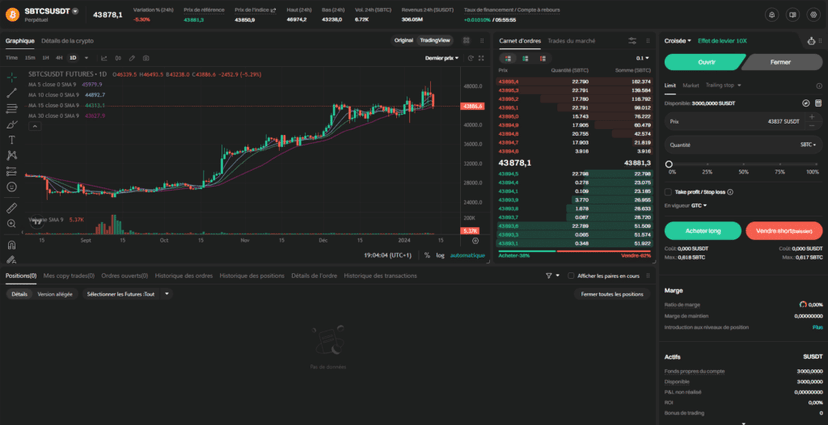
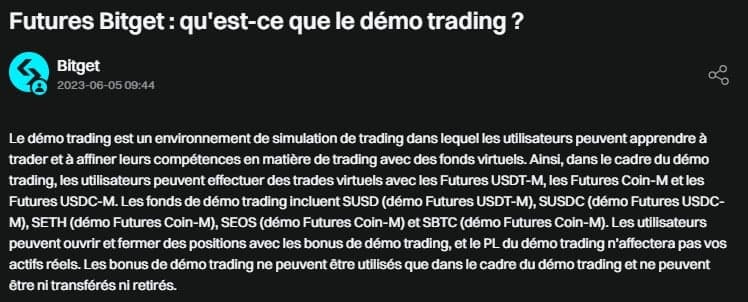
On Bitget, it’s a little different: you’re on the same platform, you simply trade fictitious assets that are indexed on the real ones. It’s a true simulator built for practice! This has several advantages, such as the fact that liquidity is respected, which isn’t often the case on classic testnets. On the other hand, there are only 4 assets to trade. In my view, that’s perfectly enough to get started.
Trading for Free: the Advantages of a Demo Account
First and foremost comes the absence of any risk of losing real money. Indeed, access to these trial accounts is completely free. Testnets and demo accounts offer a safe environment, almost identical to that of a real account. It lets you practice and experiment with virtual coins (worthless) and learn to use, with no constraints, all the features the platform provides.
Beyond the features, you’ll also get the chance to test different trading strategies and techniques without the slightest financial consequence. This lets you learn from your mistakes without suffering their consequences, all while sharpening your skills.
Trading for Free: the Drawbacks
If you follow me regularly on Youtube, you already know the role played by psychology in trading.
In my opinion, this aspect is actually the most important of all. The stakes are nothing alike depending on whether you’re trading virtual money or real money.
If you’ve ever played a game of poker for nothing, you know what I mean. At some point you get fed up and start bluffing, even though it’s impossible to bluff someone who has nothing at stake … In short, it’s tricky. That said, if you manage to detach yourself psychologically from the idea of money, then you might just make an exceptional trader.
In my own case, for example, accurately assessing performance is much harder when I trade with chocolate coins. As traders, we can develop a false sense of confidence by trading risk-free on a demo account.
We then become liable to grow overconfident. When we move to real trading on a main account (not a virtual one).
It’s inevitable — our psychology changes. It becomes easier to lose your composure and your self-confidence. This can lead to mistakes and costly, even fatal, losses!
When you stop trading for free, please don’t go All-in straight away! Put your risk management in place first!
What’s more, unlike true simulations, testnets sometimes fail to faithfully reflect real market conditions. This is especially the case when it comes to liquidity, volatility, and the impact of news and events, which sharply reduces their training value. Real conditions on Mainnet are often different!
The Platforms to Learn to Trade for Free
Many platforms dedicated to trading futures contracts on crypto and traditional markets offer a TestNet or a simulator.
These three platforms I use every day offer a range of features equivalent to those of their main network (mainnet). They were designed to help you refine your trading skills without any risk.
Whether you’re a beginner or an experienced investor, testnets and demo accounts are therefore an excellent way to improve your skills and build confidence.
In this article, we’ll first define what testnets and demo accounts are in trading. Then we’ll work out their advantages and drawbacks. Finally, we’ll look at which ones, in my view, will let you master the art of cryptocurrency trading while staying safe from mistakes or mishandling. So, let’s dive into the adventure!
The testnets on these platforms share many common features. They all offer functionality almost identical to that of the main network (mainnet). So there’s no real point in dwelling on this. I simply invite you to explore the guides we’ve published on our blog or on Youtube
To deepen your knowledge of how they work, I invite you to check out the corresponding blogs and video tutorials. (see the 3 links above)
Tips and Tricks for Using a Testnet’s Networks
Now that you understand the importance of a Testnet and how to use them, here are a few tips and tricks to help you get the most out of your practice and capitalize on it:
1. Start small: Don’t try to make big trades right away. Begin with small trades and build up as you gain confidence.
2. Learn to use every trading tool without fear that’s made available, and the charting tools in particular. They’ll help you better understand the market and help you build effective trading strategies.
3. Take advantage of the risk-free setting to test different strategies: Don’t be afraid to try out different strategies and see what works best for you.
4. Learn to use a trading bot : they can help you automate your trading strategies and execute more efficient trades.
5. Use it as a chance to learn to discipline yourself and to keep a trading journal: Keeping a trading journal can help you track your progress and pinpoint the areas where you need to improve.
Trading for Free: Paper Trading and Mock Trading
Paper trading and Mock trading are two terms used interchangeably to describe trading simulations, in which traders practice trading without risking real money. That said, there can be subtle differences between the two terms, depending on the context in which they’re used.
Paper Trading
Generally speaking, paper trading refers to the practice of recording hypothetical trades on paper. You don’t need to execute them on a platform to find out — this isn’t poker. To do paper trading, all you need is a sheet of paper or a trading journal to track the trades. The sole aim is to monitor the performance of a trading strategy.
Paper trading is often used to test new trading ideas or to refine existing ones. When you’re a beginner, it’s perfect for training without being tempted to do anything silly! It will let you build even more solid rules, because you’ll be truly objective when facing the break-even point.
Mock Trading
Mock trading, on the other hand, can refer to a more complete simulation of the trading environment, which may involve a virtual trading platform and real-time market data. It is often used by professional traders and proprietary trading firms. Brokers also use Mock Trading to simulate real market conditions: volatility, liquidity and order execution.
Mock trading can provide a realistic trading experience that mimics real market conditions without the risks tied to trading real money: this is the closest thing to trading for free with a good Testnet!
In short, while paper trading and Mock trading may carry different connotations, they can nonetheless be valuable tools that let traders practice and develop their skills without risking their real capital.
Is Trading for Free Necessary to Learn?
To become a pro trader, slow and steady wins the race — and above all, don’t skip any steps! Practicing on a demo account is one step that’s no exception to the rule. It is essential to your long-term “survival” in the world of trading.
What’s more, the latest research in education teaches us that systematically and regularly alternating between learning and practice or training is far more effective than 6 months of theoretical study followed by 6 months of practice.
That’s why I recommend opening a demo account from the very start of your learning journey. As you take in all the free courses I’ve published on my site captain-trading.com, I strongly recommend putting the lessons you follow into practice on a demo account.
To sum up and get to the essentials, you must (A) learn the basics of trading, then (B) train using testnets, and finally (C) practice for real once you’ve learned to manage your risk perfectly and to take trades. So here are the steps I suggest:
Learn for Free
- Read my ultimate crypto trading guide (completely free) and take it in thoroughly
- Open a demo account on the Bybit testnet and explore all its features
- Join our community on Discord (first tier free) to find help and support from the more advanced members (I’m often there too to lend a hand).
- Subscribe to my Twitch channel, to my Youtube channel and follow, live or on replay, all my free videos in which, several times a week, I analyze the crypto market and the trades I’ve taken or plan to take.
Please note: I don’t give financial advice, only education!
- Follow me for free on social media: Instagram, Twitter, Telegram
- Read my elementary trading dictionary and watch the accompanying YT video
Practice for Free
- Watch one or two free courses a week and practice on the trading simulator. Immediately put into practice what you’ve learned.
- Practice keeping your trading journal (paper trading or mock trading) by logging every trade you want to take. Above all, don’t forget the analytical elements you’ve drawn from your Price Action analysis, and the virtual results.
- Alternate between learning phases and training phases.
Practice for Real
1. Open a real account on a trading site to trade spot before you get into trading futures contracts on Crypto. If you want to take on the traditional financial markets.
2. Open an account with Coincall in order to trade options once you’re comfortable trading on a spot account.
Make sure your strategies are profitable over the medium and long term in paper trading or on a demo account. To do so, using your trading journal or backtesting, you must confirm this before truly committing to real trading.
3. Keep learning and deepening your knowledge: learning happens through repetition.
4. Master your risk management: it’s essential to know what you’re risking before you take a trade.
Keep following my analysis videos on Youtube and Twitch: you get nothing for nothing. You have to persevere!
5. Work on your psychology and mindset! Practice positive thinking and banish dark thoughts: build a will of steel! Learning to meditate will surely help you at one point or another, believe me! Having a healthy lifestyle is an essential soft skill if you want to start trading.
It’s what makes the difference between a profitable trader and an unprofitable one. You absolutely must learn to master your emotions!!!
Trade for Free, then … Move on to Practice!
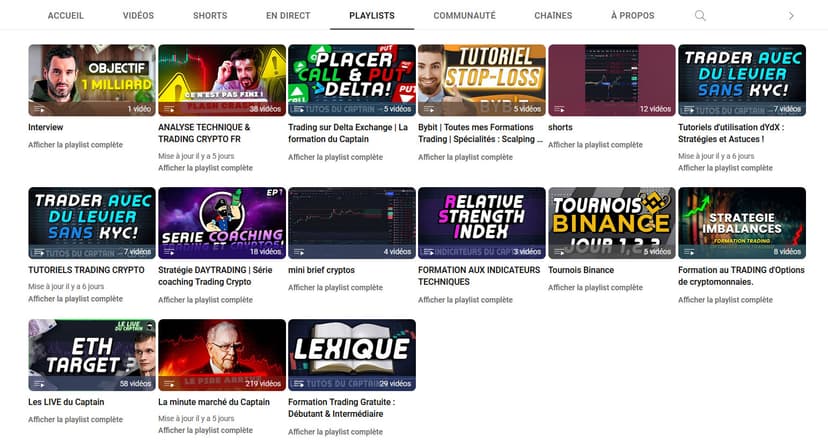
In fact, free trading is possible provided you accept that you won’t make any profits. To learn to trade cryptocurrencies, there’s no need to spend crazy amounts on mediocre courses sold at a premium. Getting started is actually completely free thanks to my youtube channel and the free training offered on my site.
Since 2017, I’ve been trading crypto full-time. I’ve gained experience and skills that I’m keen to pass on to those who are interested in crypto trading and who put their trust in me.
I’m passionate about this, and I’m happy to share that passion with you. That’s why I’ve made several dozen blog articles and videos freely available to you. The aim is for you to learn the basics of trading without loosening your purse strings.
Moving on to Practice Isn’t a Smooth Ride…
If you intend to start trading the financial markets through online brokers, I have to warn you that this is a long, difficult road with high risk! You won’t become a profitable trader in a day, nor a week, nor a month, and probably not even in a year, but beyond that!
There’s a lot to learn, and you’ll have to put in the time, persevere, and acquire the mindset of winners. It will be a discipline to build, a daily work on yourself to carry out.
What’s more, testnets and simulators are an excellent way to practice trading without risking your funds. Personally, I use their mainnet every day in my own trading. If you master these platforms, it will be more comfortable for you to learn trading with Captain Trading.
Learn and Practice as Much as You Can: that’s Truly Free.
On top of that, they genuinely offer features designed to help you improve your trading skills. By making the most of these features and following the tips and tricks presented in this article, you’ll be able to master the art of cryptocurrency trading and eventually make bigger and bigger gains, until the day you’ve finally become a profitable trader.
So, what are you waiting for?
Start learning to trade, and start practicing on a test network today!
Take your trading skills to the next level with Captain Trading:
Technical Indicators, Trading Tools, Technical Analysis of Financial Instruments and Online Trading are our specialties. So, if you’re looking for free trading courses, it’s very likely on our platform that you’ll find them!
Prop Firm: Can You Really Trade with Other People’s Capital?!
The answer is yes … or almost. Indeed, with a Prop Firm or Proprietary Firm, you can be granted funds whose size is relative to the cost of your challenge.
The concept and the deal are fairly simple: you pay for a test and, if you pass it, the Prop Firm provides you with funds so that you can operate on the financial markets with genuine firepower, even if your own starting capital is rather small.
If you want to know more about Prop Firm tests, how to pass a Prop Firm test, or if you’re looking for one because your demo trading is excellent, I’ll point you straight to our live trading sessions, where our instructors take on a Prop Firm challenge live!
Want the full rundown before you sign up? My Prop Firm trading guide covers challenge rules, funding, and the pitfalls to avoid.
Brokerage fees can be significant on the derivatives offered by Prop Firms, but if you blow it, it’s them who lose the money.
If I had to add one last piece of advice before I let you go practice or take your first challenge on a Prop Firm, it would be not to take the easy way out with copy trading, for example. I’d also add that you shouldn’t confuse fundamental analysis and technical analysis — here we practice trading, not investing!
Every guide here is free. Browse the full course and join a community of traders who share ideas every day.