2026 update. This article was published in September 2020, at the height of the “DeFi Summer,” and reflects the state of the market at that specific moment. Five years on, the landscape has changed dramatically: Andre Cronje left DeFi in March 2022 (walking away from Yearn, Fantom and some twenty projects, against a backdrop of SEC investigations), before returning in 2024 with Sonic Labs (the rebrand of Fantom). The YFI token, which had soared to around $40,000 in 2020, has since fallen back to roughly $2,000 to $2,400. On the product side, the old “Earn” service is now deprecated and the yVaults have moved to v3 (the ERC-4626 standard), while governance has shifted toward a reworked staking model. Finally, the rival Set Protocol V2 mentioned at the time has itself been deprecated (2023). We are keeping the original text for its documentary value: it tells the story of one of the first fair launches in DeFi history and the genesis of yield farming, which remain useful reference points today.
After our introduction to Yield Farming with a critique of Yield Farming, and 5 use cases of the protocols, here is our full deep dive on Yearn Finance (YFI), one of the flagship projects of decentralized finance.
In under 3 months (in the summer of 2020), Yearn Finance went from a small aggregator to one of the main catalysts of DeFi, with a market cap hovering around a billion dollars at the time. This meteoric rise was mainly driven by its native token YFI, positioned at the heart of the trend thanks to technology optimized to exploit Yield Farming at scale.
With this explosion of the token, it made sense to ask about the risks, the opportunities and, above all, the complexity of its true added value in order to determine whether or not this token was fairly priced. So it was time to dive into one of the most complex — and most promising — protocols in DeFi. Before we go further, if you are new to decentralized finance, we recommend you first learn how to create a MetaMask wallet, then read our free DeFi guide to get a solid grasp of the basics.
Yearn Finance (YFI): the genesis of a project and a meteoric peak
Until July 16, 2020, Yearn was just a simple aggregator focused on DeFi to optimize its users' returns. At the time, the protocol held a portfolio of assets worth about 8 million dollars… Over just a few weeks, we saw a move of roughly +1250%, one of the most spectacular growth stories in DeFi history at the time.
Since its launch in January 2020, cumulative returns had reached 10.58% per year for liquidity providers. However, there was still no governance token tied to the project…
YFI's “fair launch” by Andre Cronje
Everything changed the day Yearn Finance's founder, Andre Cronje, published a famous post titled “YFI.” With the aim of handing control of the protocol over to its users, Cronje designed an investment plan that let people take control of YFI by providing liquidity into the pools of Curve and Balancer. It was probably the first genuinely honest and transparent launch in years. Indeed, Cronje granted himself no tokens before listing, thereby forgoing all the perks traditionally reserved for founders. Every token was distributed to the protocol's users!
A few months later, this supposedly “useless” token reached a market cap of 1.25 billion dollars and generated roughly 20 million dollars a year in profit for its holders. It was hard to quantify the exact scale of the speculative bubble, but it was clearly substantial. (These figures date from 2020: see the “2026 update” box at the top of the article for current levels.)
Yearn and the industrialization of Yield Farming in DeFi
A few months earlier (in the spring of 2020), Compound had launched its liquidity mining protocol and set off the intense speculation across the sector. Put simply, liquidity mining is the process by which control of a protocol is decentralized in order to drive traction and its development. The community nicknamed it Yield Farming by analogy with the idea of harvesting in the fields.
The principle is simple: you invest capital in one of the many protocols that pay out returns in the form of tokens and other incentives such as governance. However, as new protocols piled up, the time required to invest with full understanding became very significant. On top of that, the price of Gas on Ethereum had risen considerably as the number of transactions exploded (well before The Merge of 2022 and the rise of Layer 2 solutions). Many small players pulled out because of this, until the arrival of the second version of the yearn.finance protocol.
How yVaults work
The easiest way to understand yVaults is to imagine a conventional market governed by supply and demand, in which liquidity providers team up with strategy developers to make up the supply side. The strategy deploys users' capital while the liquidity providers decide which strategy to stake their funds on. Strategies thus automate Yield Farming. With the launch of yVaults, investors can deposit their funds, which are automatically allocated to the best available strategies. This process reduces risk and lowers Gas fees by pooling them across all liquidity providers. (2026 note: the yVaults described here are v1; they have since been replaced by v2 and then v3, aligned with the ERC-4626 standard.)
The result: an undisputed number 1 in the Yield Farming industry in 2020, one that simplified access to strategies once reserved for advanced users.
YFI: a genuine decentralized cash-flow provider
YFI was no basic project. It offered two main services: yVaults (Yield Farming optimization) and Earn (lending optimization, now deprecated). Many additional products sat on Yearn.finance's roadmap, tied to insurance, stock trading, leverage, venture capital and liquidations. This tokenization of the economy was also backed by Delphi Digital and Gauntlet, two advisory firms partnered with Yearn.finance. In any case, it is important to understand how YFI generated its profits at the time via Earn and yVaults.
The model was simple: YFI charged a performance fee of 5% of capital and a withdrawal fee of 0.5% if the user withdrew their capital. The withdrawal fee applied to both services (Earn and yVault), while the performance fee applied only to yVaults. Put simply, the performance fee was taken at every “harvest.” (These fee and governance parameters correspond to 2020 and have changed since.)
Following the acceptance of the YIP-36 optimization proposal, it was decided that Yearn would use part of the fees collected to boost operating capital rather than allocating all of it to the treasury.
Within a week of its implementation, 463,000 dollars in revenue had already accumulated. That worked out to about 21 million dollars a year for a market cap of 390 million at that point. So we had a P.E.R* of X20 (*Price Earnings Ratio), given that the protocol had virtually no expenses.
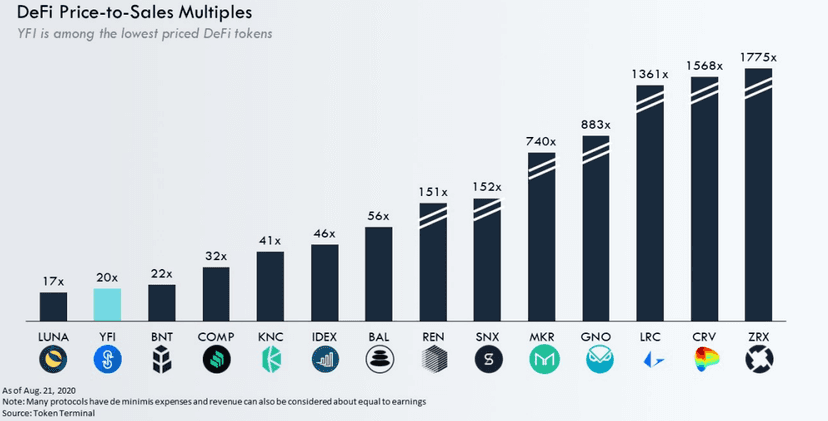
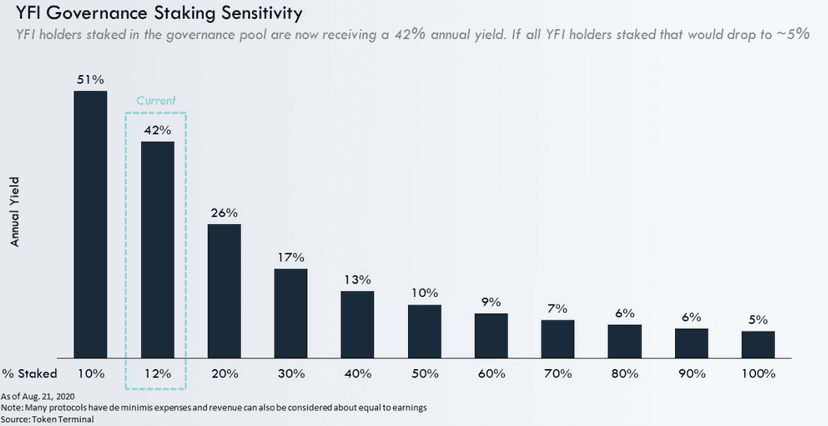
On this point, it is very important to keep things in perspective, because in reality very few users staked their YFI in the governance pool — which let them earn a return of around 40%, since only 10 to 20% of YFI was actually staked there. Had all the YFI tokens been placed there, the return on investment would have been just 5%… So you could view that 5% as a yield floor.
Yearn (YFI): analyzing market behavior
The strategies offered by Yearn were so effective that they quickly became a catalyst for market growth, pulling the entire ecosystem higher. It is essential to understand that yVaults don't just automate users' strategy: they also enforce a genuine harmony so that all the strategies complement one another.
As a result, instead of seeing some users sell their tokens after harvesting them and others hodl them for one reason or another, all yVault users act as one! When this collective behavior becomes systematic, the impact on the price of the assets involved can be considerable. For traders who want to take advantage of these moves, solid risk management remains essential.
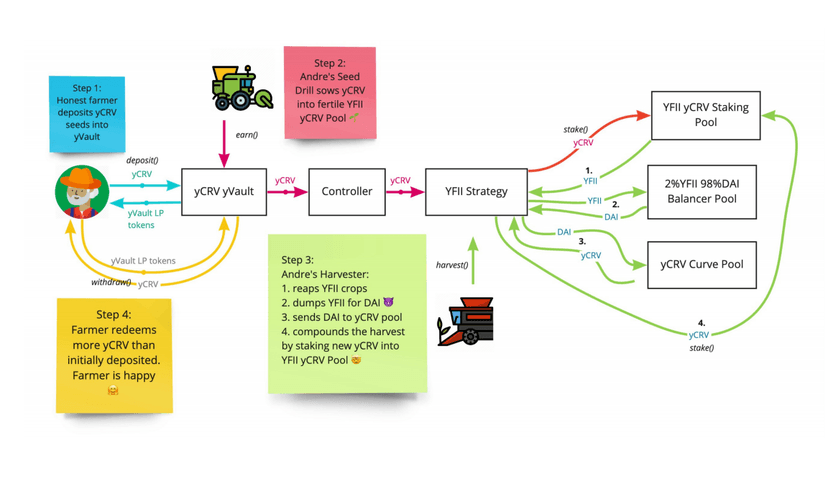
As the rollout of yVaults expanded, Yearn's system captured a growing percentage of the total profit from the most profitable Yield opportunities, as long as the trend held. So one could legitimately ask: was this sustainable growth or a speculative bubble?
Is Yearn (YFI) a good long-term investment?
The main reason for such cash-flow generation at the time was the Yield, which was extremely high. This was made possible because the protocols were fueled by particularly enthusiastic speculation around liquidity mining programs. The reason farmers could earn a yield above +1000% is simple: speculators piled in, creating more and more tokens. To sum up, in this scenario it was the speculators who paid the farmers' yield.
At the time, no one could predict how long the Yield Farming frenzy would last. We know the answer today: the bubble eventually deflated. But the underlying message still holds: if you venture into DeFi and Yield Farming, we recommend the utmost discipline in both your investment choices and your orders and operations. For those who want to buy or sell DeFi tokens safely, regulated platforms like OKX remain a recommended reference for traders. All the more so since, when the fever cools, token holders look for new sources of cash.
This could come from an increase in assets under management (AUM) coupled with a declining yield. The arrival of new products was also a possibility to bring fresh revenue to the protocol. However, even Cronje, the founder, was keen to point out that it wouldn't be easy to extract a simple annuity from potential new entrants.
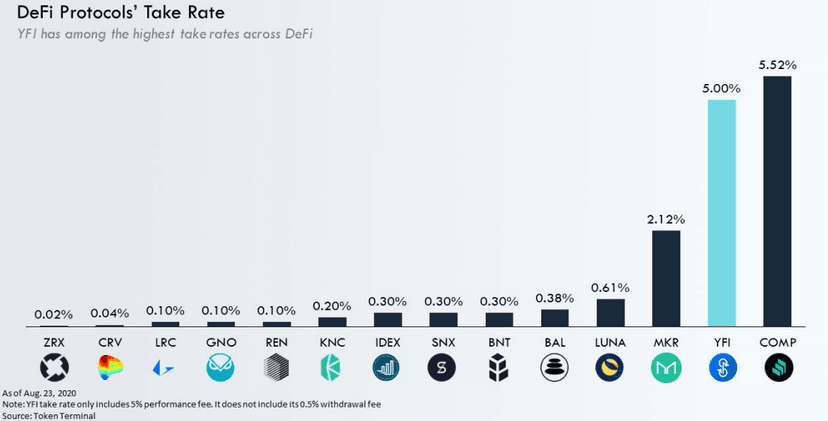
What's more, under the system at the time, Yearn didn't pay the strategy creators we mentioned earlier. It was like a traditional asset manager working for free. In the long run, this obviously wasn't sustainable.
Given that Yearn acts as a decentralized asset management platform, it would inevitably have to pay its “managers” at some point. Naturally, this would raise costs and reduce the net Yield for end users.
Yearn (YFI): outlook and market competition
There was no doubt that Yearn perfectly reflected the explosion of liquidity mining and DeFi in 2020.
However, even though YFI was one of the leaders in Yield Farming, it obviously wasn't the only project planning to grab a slice of the pie in this booming market.
Beyond the forks stemming from YFII, whose legitimacy was open to question, there were plenty of projects that could compete with YFI. For example, Set V2 also positioned itself as a decentralized asset manager. (2026 update: Set Protocol V2 and TokenSets have since been deprecated — 2023 — and are no longer active competitors.) Competition therefore kept intensifying month after month.
Moreover, as mentioned earlier, the level of Yield at the time couldn't last forever. As such, we could already picture a spectacular bursting of the bubble arriving in the medium term — which is exactly what happened.
That said, to keep things in perspective, one could also foresee comparable success for the new services planned on Yearn's roadmap that we discussed at the beginning of this article.
At that moment, YFI remained one of the most exciting projects tied to decentralized asset management. YFI's completely transparent and fair launch contributed heavily to the enthusiasm seen across the crypto world in 2020. Clearly, Cronje was a real professional and a shrewd leader — his eventful journey since (leaving DeFi in 2022, returning via Sonic Labs in 2024) has only confirmed his influence on the sector. Very few protocols maintained such a pace of new features and even genuine innovation. At Captain Trading, we had already made the popcorn — but not only that: right from this article, we stressed how important it was to prepare for the potential bursting of the bubble.
FAQ: Yearn Finance (YFI) in a nutshell
What is Yearn Finance (YFI)?
Yearn Finance is a DeFi protocol launched in 2020 that automates Yield Farming through its yVaults: the user deposits their funds, which are automatically allocated to the best-performing yield strategies. YFI is its governance token, famous for having been distributed with no pre-mine and no allocation to the founder (a “fair launch”).
How much is the YFI token worth today?
After a peak of around $40,000 in 2020, the YFI token has fallen back and trades at roughly $2,000 to $2,400 in 2026. Like any crypto asset, its price is highly volatile: always check the live price before making any decision.
What happened to Andre Cronje, the founder?
Andre Cronje left DeFi in March 2022 (walking away from Yearn, Fantom and other projects, amid SEC investigations), before returning in 2024 with Sonic Labs, the rebrand of Fantom.
Is Yield Farming risky?
Yes. High returns go hand in hand with high risks (smart contracts, impermanent loss, devaluation of reward tokens, gas fees). Before providing liquidity, learn the basics and apply strict risk management.
Wishing you discipline and objectivity, dear readers!