On September 16, 2026, as you read these lines, the twelve voting members of the FOMC are deliberating behind closed doors in Washington. The statement will drop at 2:00 p.m. Washington time — 8:00 p.m. in Paris —, followed thirty minutes later by a press conference that can, on its own, move trillions of dollars in assets worldwide. A Reuters poll taken ahead of the meeting put the odds of a policy rate hike to 3.75%-4.00% at roughly 91 to 93% — which would be the first hike since July 2023. Nobody, as this guide is being written, knows the outcome: not you, not us.
What we know for certain is how this mechanism works, how long it’s existed, and who sits around the table. This guide covers the committee’s history since its legal creation in 1913, its voting structure, how a meeting unfolds, its tools beyond the simple rate, and its current composition under the chairmanship of Kevin Warsh.
Key Takeaways
- The FOMC — the Federal Open Market Committee — was born with the Banking Act of 1933, but its modern structure (a Board of 7 governors + 12 regional presidents) dates from the Banking Act of 1935; the first committee under this form met in March 1936.
- 12 members vote at each meeting: 7 governors, the president of the New York Fed (a permanent seat), and 4 of the 11 other regional presidents, on an annual rotation by group.
- 8 scheduled meetings per year, 4 of which come with the dot plot (Summary of Economic Projections) — today’s September 15-16, 2026 meeting is one of them.
- 3.50%-3.75%: the policy rate range as set on July 29, 2026, the last confirmed decision at the time of writing — a vote of 9 to 3.
- Kevin Warsh, the 17th chair of the Fed, was sworn in on May 22, 2026, succeeding Jerome Powell, who briefly served as “chair pro tempore” from May 15 to 22, 2026 — a first in the institution’s history.
- The press statement drops at 2:00 p.m. Washington time, followed thirty minutes later by the chair’s press conference; the detailed minutes, meanwhile, aren’t released until three weeks later.
- The Fed’s legal dual mandate — price stability and maximum employment — frames every decision; the official 2% inflation target wasn’t formalized until January 2012.
- Emergency meetings, outside the regular calendar, do happen: the surprise cuts of January 2008, October 2008, and March 2020 are the most striking examples.
The FOMC: A Century of Institutional History
The FOMC — the Federal Open Market Committee — hasn’t always existed in this form. It all starts with the Federal Reserve Act, signed by President Woodrow Wilson on December 23, 1913, which created the US Federal Reserve System. At the time, nothing yet resembled today’s committee.
It’s the Banking Act of 1933 that gave birth to the FOMC as such, with a narrow mission: coordinating open market operations among the regional Reserve Banks, which had until then acted independently of one another. Its current structure, meanwhile, comes from the Banking Act of 1935: a 7-member Board of Governors in Washington, backed by the presidents of the 12 regional Federal Reserve Banks. The first FOMC organized under this architecture met in March 1936. Since then, the framework hasn’t changed — only the tools at its disposal and the reading of its mandate have evolved.
This mandate, set by law, comes down to two objectives: price stability and maximum employment — the famous “dual mandate.” For decades, no precise figure accompanied the price stability objective; it wasn’t until January 2012, under Ben Bernanke’s chairmanship, that the Fed formalized an explicit inflation target of 2% for the first time. To trace the full lineage of the chairs who have shaped this institution, from William McChesney Martin to Kevin Warsh by way of Volcker, Greenspan, Bernanke, Yellen, and Powell, the complete history of the Fed’s chairs details every term and every doctrinal shift.
Who Votes? The Committee’s Internal Mechanics
The FOMC has 12 voting members at each meeting, but brings together more participants than that: non-voters take full part in the discussions, without holding voting rights. The breakdown is fixed:
- The 7 governors of the Board, in Washington, always vote.
- The president of the New York Fed always votes too — the only permanent regional seat, given New York’s role in executing market operations.
- 4 of the 11 other regional presidents vote, on an annual rotation organized into four groups of Banks: Boston, Philadelphia, and Richmond; Cleveland and Chicago; Atlanta, St. Louis, and Dallas; Minneapolis, Kansas City, and San Francisco. Each group designates one voting president for the year.
Governors, for their part, aren’t appointed at random: nominated by the President of the United States, confirmed by the Senate, for a full 14-year term. The mechanism limits the influence of any single presidential term: a new governor term begins every two years, on February 1 of an even-numbered year. Details of the current composition are published on an ongoing basis on the FOMC’s official page.
Meeting Rhythm: What Happens in the Room
The FOMC meets 8 times a year on a calendar published in advance. For 2026: January 27-28, March 17-18, April 28-29, June 16-17, July 28-29, September 15-16, October 27-28, and December 8-9. Four of these eight meetings — March, June, September, and December — come with the release of the dot plot, that scatter chart where each voter anonymously places their own rate projection for the years ahead. The full calendar is published on the Fed’s FOMC calendars page.
The proceedings themselves are always the same. The 12 voters debate behind closed doors — no cameras, no open mics. Then, at 2:00 p.m. Washington time (8:00 p.m. in Paris), the official press statement drops: a few hundred words that make or break entire market positions. Thirty minutes later, at 2:30 p.m. ET, the FOMC chair holds a press conference where every word chosen or avoided is dissected live by trading desks. The meeting’s detailed minutes, meanwhile, aren’t published until three weeks later — that’s where you discover the nuances of the internal debate, the disagreements, the arguments that didn’t win out.
This calendar isn’t a straitjacket: the committee can meet outside the schedule if the situation demands it. On January 22, 2008, the FOMC cut rates by 75 basis points to 3.50%, its first decision outside a scheduled meeting since the September 11, 2001 attacks. On October 8, 2008, in the middle of the financial crisis, a coordinated 50-basis-point cut was decided jointly with several central banks worldwide. And on March 3, 2020, right at the start of the pandemic, the committee cut rates by 50 basis points — its first off-calendar cut since 2008 — followed by another cut on March 15, 2020 that brought the range down to 0-0.25%.
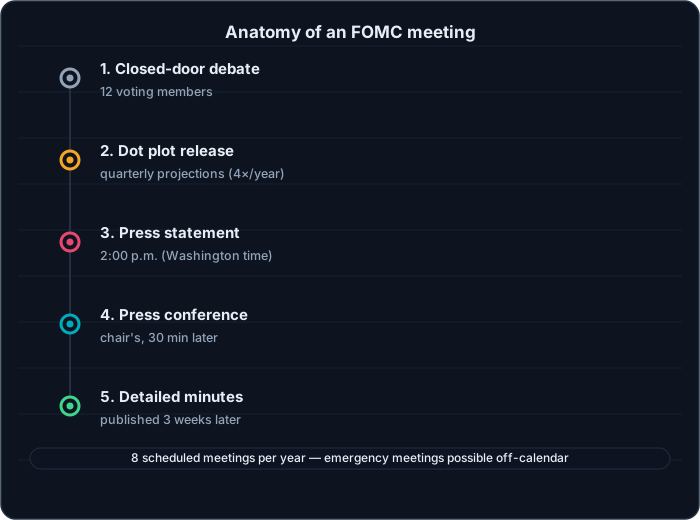
From closed-door debate to the minutes: an FOMC meeting’s timeline, hour by hour.
The Monetary Policy Toolkit
Cutting or raising a rate by a quarter point doesn’t sum up what the Fed does. The monetary policy steered by the FOMC has several instruments at its disposal, some of which were only invented — or pulled out of the drawer — during recent crises.
| Tool | What It Is | Timeline |
|---|---|---|
| Policy rate | Target range for the fed funds rate, generally adjusted in 25-basis-point increments | Historical tool |
| Forward guidance | Communication about the future path of rates, to steer expectations without moving the rate itself | Reinforced since December 2008 |
| Quantitative easing (QE) | Massive asset purchases (Treasuries, MBS) to weigh on long-term rates and inject liquidity | QE1: 2008-2010; QE2: 2010-2011; QE3: 2012-2014; pandemic QE: 2020-2022 |
| Quantitative tightening (QT) | Programmed balance-sheet reduction, letting assets mature without reinvesting them | Ongoing since June 1, 2022, cap of $95B/month |
| Overnight reverse repo (ON RRP) | Facility for absorbing excess liquidity overnight | Tested from 2013, permanent tool since December 2015 |
| Interest on reserve balances (IORB) | Single rate paid on bank reserves, the system’s technical floor | Merger of the IOER and IORR rates on July 29, 2021 |
Forward guidance deserves a word of its own: it isn’t a number, it’s a sentence. In its December 2008 statement, the FOMC promised rates would stay “exceptionally low... for some time” — a phrase that, on its own, anchored market expectations for years. The ongoing QT illustrates the mirror-image mechanics of QE: since June 2022, the Fed has let up to $95 billion a month roll off its balance sheet without reinvesting — $60 billion in Treasury bills, $35 billion in mortgage-backed securities (MBS) — instead of buying assets, it lets them run off the balance sheet to pull liquidity out of the system. Understanding how these tools connect to the policy rate is worth a detour through The Cost of Money: Understanding the Policy Rate.

 DEXon-chain
- Trade perps with 0 fees: your FC cover 100% of them
- Net deposit of at least $50 USDC — $3,000 FC prize pool, first come first served · Click [Join] and connect your wallet
- Trouble on the platform? Go through the Cap: our team never leaves you hanging.
- Fully on-chain perpetuals
- Wallet-based access
- On-chain order book
- Community-owned, no VCs
Offer runs Sept 16–23, 23:59 UTC · Affiliate link · trading involves risk of loss
Who Sits on the FOMC Today, September 16, 2026?
The committee’s makeup has seen a rare shake-up this year. Jerome Powell, chair since February 5, 2018, held the unprecedented status of “chair pro tempore” from May 15 to 22, 2026, before officially handing over to Kevin Warsh, the 17th chair of the Federal Reserve, who was sworn in on May 22, 2026 and was unanimously elected FOMC chairman that same day. His term as chair runs through May 21, 2030. Powell, for his part, remains a governor — his term in that role expires on January 31, 2028.
Around him, here’s how the leadership positions break down:
| Position | Holder | Note |
|---|---|---|
| Chair (FOMC and Board) | Kevin Warsh | In office since May 22, 2026 |
| FOMC Vice Chair | John C. Williams (president of the New York Fed) | Elected January 28, 2026 |
| Vice Chair of the Board of Governors | Philip N. Jefferson | In office since September 13, 2023 |
| Vice Chair for Supervision | Michelle W. Bowman | In office since June 9, 2025 |
| Governor | Michael Barr | Left supervision on February 28, 2025, remains a governor |
| Governor | Lisa Cook | Remains in office, Supreme Court ruling on June 29, 2026 |
| Governor | Jerome Powell | Term as governor runs through January 31, 2028 |
| Governor | Christopher Waller | — |
A word about Lisa Cook: in August 2025, Donald Trump attempted to remove her from her position as governor. The Supreme Court declined, on June 29, 2026, to suspend her continued service while the legal proceedings play out. She therefore still sits on the FOMC.
On the side of voting regional presidents for 2026: John Williams (New York, permanent seat), Beth Hammack (Cleveland), Anna Paulson (Philadelphia), Lorie Logan (Dallas), and Neel Kashkari (Minneapolis) — one president per rotation group.
On substance, the last confirmed decision dates from the July 28-29, 2026 meeting: the committee voted 9 to 3 to hold the range at 3.50%-3.75%, a level reached back in December 2025 after three consecutive cuts during the year. The three dissenters — Hammack, Kashkari, and Logan — wanted a 25-basis-point hike instead. It’s this disagreement, already visible in July, that gives today’s meeting its edge.
Hike, Hold, or Cut: The 3 Scenarios of an FOMC Meeting
Every scheduled meeting, for the policy rate, boils down to three possible outcomes. The vocabulary that goes with them — hawk or dove — describes the committee’s stance, not just the number that gets announced.
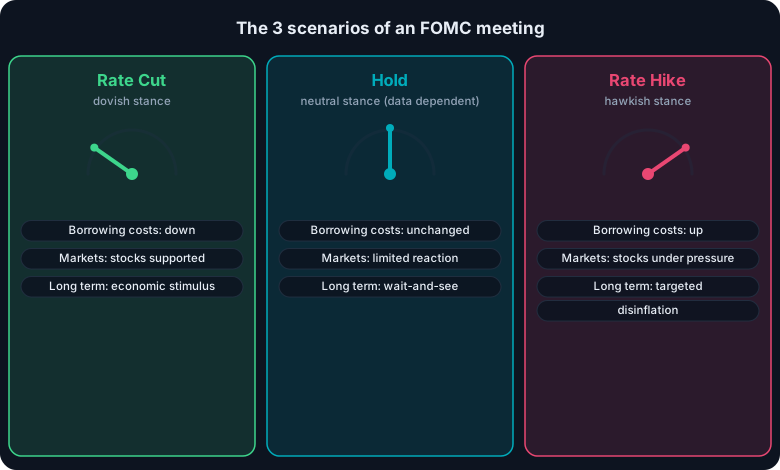
Three outcomes, three logics: what each decision changes about the cost of money and how markets read it.
The cut (dovish stance): the committee lowers the range, usually in 25-basis-point increments. Borrowing costs fall for households and businesses, which in theory supports investment and employment — at the risk, if it moves too fast, of reviving inflation. This was the logic that prevailed throughout 2025, down to the 3.50%-3.75% range reached in December.
The hold (neutral stance): the committee leaves the range unchanged, as it did at the July 29, 2026 meeting. This choice is never a non-event: the statement and press conference that go with it steer market expectations about what comes next, sometimes more than a rate move itself would.
The hike (hawkish stance): the committee raises the range to cool an economy seen as overheating or inflation judged too persistent. Credit becomes more expensive, which generally weighs on the assets most sensitive to financing costs — and especially on positions opened with leverage, where a change in the cost of money feeds directly into a position’s carrying cost. This was precisely the stance the market judged most likely ahead of today’s September 16, 2026 meeting — without the actual decision being known at the time this guide is written, and without it trying to predict it.
In all three cases, the transmission mechanism runs through the same channels: the cost of bank credit, government bond yields, the level of the dollar, and, ultimately, the valuation of nearly every publicly traded asset class in the world. This is why a committee of 12 voters, meeting eight times a year in a room in Washington, remains one of the most closely watched events across all of financial markets.
Frequently Asked Questions
What exactly is the FOMC?
The FOMC (Federal Open Market Committee) is the monetary policy decision-making body of the US Federal Reserve. It has 12 voting members: the 7 Board governors, the president of the New York Fed, and 4 of the 11 other regional presidents on an annual rotation. It meets 8 times a year to set the target range for the US policy rate and steer the other levers of monetary policy, within the framework of a legal dual mandate: price stability and maximum employment.
Why don’t all the regional presidents vote at the same time?
Because the Banking Act of 1935 set up a rotation by groups of regional Banks to balance influence across the 12 districts without letting the number of voters balloon. The 11 presidents outside New York are split into four groups — Boston/Philadelphia/Richmond, Cleveland/Chicago, Atlanta/St. Louis/Dallas, Minneapolis/Kansas City/San Francisco — and each group designates one voting president for the year. Non-voters continue to take part in the discussions: they only lose the formal right to vote.
Is the outcome of the September 16, 2026 meeting already known?
No. The meeting is held on September 15 and 16, 2026, with a statement expected at 2:00 p.m. Washington time (8:00 p.m. in Paris) and a press conference from Kevin Warsh thirty minutes later. The last confirmed decision remains that of July 29, 2026: holding the range at 3.50%-3.75%, voted 9 to 3. A Reuters poll conducted ahead of the September meeting put the odds of a hike to 3.75%-4.00% at roughly 91 to 93%, but a market poll isn’t a done decision.
What is the dot plot and what is it for?
The dot plot, or Summary of Economic Projections, is a chart published four times a year — in March, June, September, and December — where each FOMC member anonymously places a dot representing their own expectation for the policy rate level over the coming years. It isn’t a collective commitment: it’s a scattered snapshot of individual expectations, which markets read to gauge the likely path of monetary policy.
What’s the difference between a “hawkish” Fed and a “dovish” Fed?
A “hawkish” stance prioritizes the fight against inflation, even if it means raising rates or keeping them elevated longer than expected. A “dovish” stance prioritizes support for employment and activity, with lower rates. The same committee can shift from one stance to the other from one meeting to the next depending on the economic data: it isn’t a fixed doctrine, it’s a reading of the balance of power between the dual mandate’s two objectives.
Who is Kevin Warsh?
Kevin Warsh is the 17th chair of the US Federal Reserve. He was sworn in on May 22, 2026, and was unanimously elected FOMC chairman that same day, for a term as chair running through May 21, 2030. He succeeds Jerome Powell, who held the chairmanship from February 5, 2018 to May 22, 2026, and who remains a Board governor until January 31, 2028, after overseeing a brief transition under the unprecedented status of “chair pro tempore.”
Can the FOMC meet outside its official calendar?
Yes, and recent history offers three striking examples. On January 22, 2008, a surprise 75-basis-point cut was decided outside the calendar, the first since the September 11, 2001 attacks. On October 8, 2008, a coordinated 50-basis-point cut was announced jointly with other central banks worldwide. And on March 3 and 15, 2020, at the start of the pandemic, two emergency cuts brought the range down to 0-0.25% within the span of two weeks.
Every guide here is free. Browse the full course and join a community of traders who share ideas every day.