If you’ve opened this course, chances are you still don’t know enough about using leverage on the financial markets or in crypto.
That’s good news, because leverage is not a topic to take lightly!
It goes without saying that leverage is a double-edged sword. If you pull it off, it multiplies your results accordingly. If you get it wrong, it’s the same story: your risk of loss is multiplied just as much!
Leverage does, however, offer one huge advantage. It lets you trade large amounts with limited equity and a limited personal stake.
It’s a professional-grade tool that demands discipline, self-control and agility.
Unfortunately, the people who can use it brilliantly are a minority. That’s why the first goal of this article is to urge you to be cautious!
The aim here isn’t to turn you into a seasoned futures trading expert, because that status is earned after many years of experience in a market.
It’s simply to explain what leverage actually is on a trading platform. On top of that, the goal is to equip you so you start out with the right instincts if you ever get the idea to use leverage.
The point of this tutorial is to simplify your approach to futures and leverage. Order types, Funding, Open Interest and the rest have deliberately been left out of this tutorial for the sake of efficiency. If those are concepts you’re missing, just check out the matching free courses on my site or my YouTube channel.
Before we start, let me remind you that trading is a matter of survival…
Let me explain: as long as your capital “survives,” you’ll have the ability to make profits! That’s why, until you’re making consistent profits, there’s no reason to use leverage. It’s obvious — you’re only increasing your chances of losing.
The concepts of Risk Management and Edge are equally important.
Risk Management is essential to your “survival,” while your Edge is there to make the difference when market conditions line up!
Following Twitter and then slapping 100x on a coin that I or someone else happened to post an encouraging analysis on is not an Edge. Even the members of my community know full well that you don’t blindly follow trading plans, or you’ll bite the dust…
Anyway… now that you’ve been sufficiently warned, we can begin your initiation!
Heads-up: this article is inspired by content published by @CryptoCred. I thought it might be more useful to you presented in my own way, with my examples, my tips and my recommendations!
Leverage and Trading
To start with, it’s essential to understand how leverage works.
In reality, it’s a short-term loan — except that instead of borrowing from a friend or a broker, you borrow from an exchange, a trading venue.
Let’s say you have 1,000 USDT to place an order.
In your view, it’s not enough, because this is a golden opportunity — every indicator is green, you want to make the most of your potential… In short, you want $2,000.
From there, all you have to do is pledge part of that sum as security (collateral) in order to get your $2,000.
Leverage: 2 Practical Examples
1. You have $1,000 and you want to open a $2,000 position.
So you’ll use 2x leverage.
2. You have $200 but you want a $2,000 position
So you’ll be running 10x leverage.
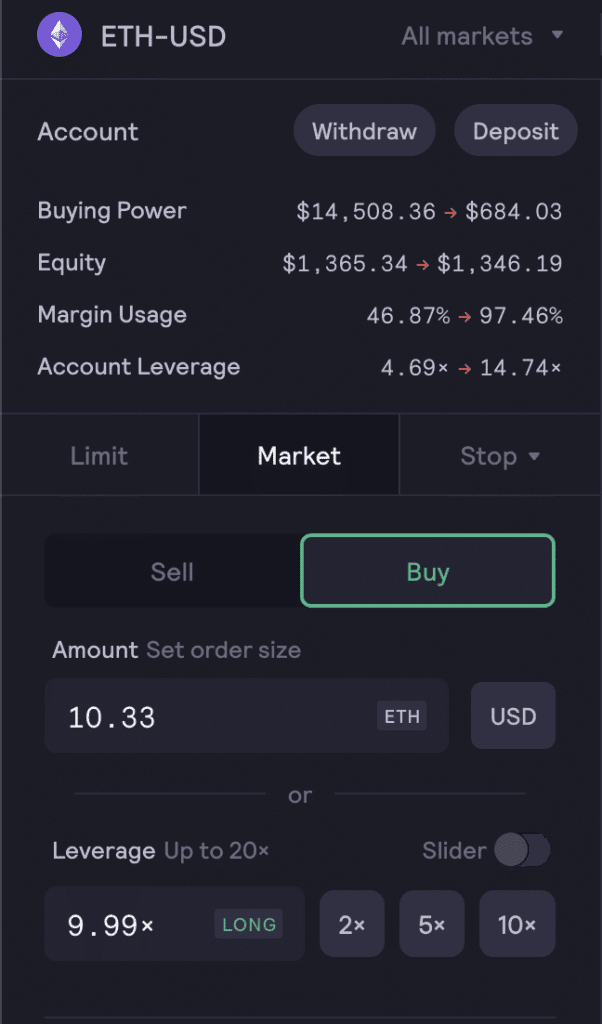
Careful: the more you borrow, the more dangerous your situation becomes, because your room to maneuver relative to price, before liquidation, tightens considerably.
The higher your leverage, the higher your chances of getting liquidated.
Leverage, then, is a loan taken out with an exchange in order to increase our position size.
That said, you have to clearly understand that it’s our collateral (and therefore our liquidation) that depends on leverage, not our position size!
Which is exactly why the right instinct is to work backwards: start from the risk you accept and your stop, and let those set the size — leverage is just a byproduct. That's precisely the calculation the Trade Assistant add-on automates on the traditional markets via MT4/MT5.
To make sure this is clear, here’s a concrete example.
Let’s say Cryptoskud buys 1,000 BTC/USD perpetual contracts at 2x leverage and I buy 1,000 contracts at 5x leverage,
Since we have exactly the same position size, our gains/losses will be exactly the same, because it’s the same trade!
Leverage affects the level at which I’ll be liquidated; it won’t affect the PnL if we hold our positions to the same price level. (except perhaps in fees)
When it comes to margin trading, this point needs some nuance if we’re talking about Isolated Margin or Risk Limits, but we’ll get to that a bit later. Up to now, the goal was just to understand the basics!
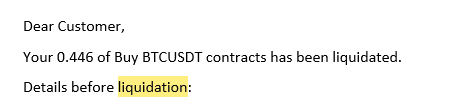
Liquidation Defined: What Is It?!
The liquidation process consists of the forced closing of your positions by the exchange you’re operating on.
This happens because price reaches your “liquidation price”. This figure must be clear before you enter your position.
Technically, liquidation occurs when your margin falls below your maintenance margin level.
Put simply, it’s when you cross a certain level of losses with the borrowed money.
If you use lower leverage, you put up more collateral, you have more margin, and your liquidation price will be “further away.”
If you use higher leverage, you put up less collateral, you have less margin, and your liquidation price will be tighter.
This is why high-leverage trading is not recommended; it demands a very high degree of precision (which most market participants don’t have).
Even small price movements can close out our positions.
That’s a shame when our read is correct, isn’t it?!
Cross Margin vs Isolated Margin
There are two main methods for posting collateral and taking a position: cross margin and isolated margin.
These mechanisms affect both your liquidation price and the consequences of your liquidation.
Cross margin means that your entire account balance is used as collateral to take a position.
The advantage is that this generally translates into a lower liquidation price, because you have to use less leverage given that your collateral base is larger (it’s your entire portfolio).
The downside is that if you get liquidated on a cross-margin position, you lose your entire account balance…
In other words, the losses from a cross-margin liquidation aren’t limited to the collateral you posted for that one position. They wipe out your entire account. As you’ve gathered, this is the ultra-risky version of leverage.
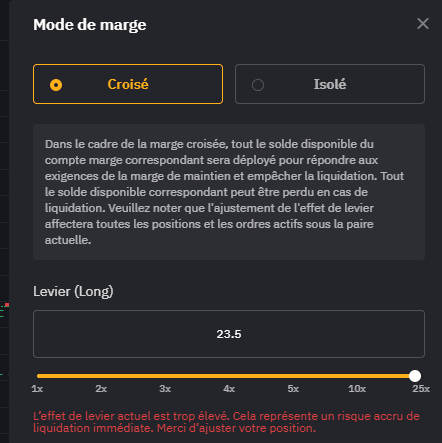
I think you’ve already understood what isolated margin is after reading the first paragraph…
But you never know, so… As the name suggests, isolated margin means that if you get liquidated on a position, the losses are limited to the collateral you posted for that specific position.
The usual trade-off is at play here, meaning that isolated margin generally implies a smaller collateral base, which means higher leverage (for the same position size) and therefore a liquidation closer to price.
To be clear, this section is essentially informational. It’s meant to inform you about the risks you run if your position reaches the liquidation price.
It’s worth restating the obvious: give yourself absolutely no chance of being liquidated, no matter what!
In most cases, you should have protections in place to close your position before your liquidation price, with a good stop-loss. (which should be placed close to the invalidation level of your scenario
The Different Price Types: Last Traded, Index, Mark
Exchanges generally let you choose a price-reference mechanism for your orders.
This mechanism is designed to protect you against abnormal wicks. It also lets users be more precise when setting their orders.
Price differences between exchanges are common, which is why having this room to maneuver can be worthwhile.
Setting a Price on an Exchange: the 3 Methods
The Last Traded Price
This is the last price traded on the exchange.
The Index Price
It’s an average price of the financial product you’re trading, derived from a basket of different spot listings.
The Mark Price
It’s the price of a future minus the basis.
In general, using the Last Traded Price works perfectly well. It also lets you be more precise.
Using the Index Price or the Mark Price can be helpful if your chosen exchange has a high frequency of abnormal or oversized moves that you’re trying to avoid, but this has become increasingly rare.
Liquidation is generally dictated by the Mark price, or Mark Price: “ By default, unrealized profits and losses are calculated based on the last traded price. Unrealized gains and losses are displayed and calculated based on the reference price ”
Coin-Margined Futures: Definition
So far, I’ve given more or less concrete examples assuming that your collateral — your margin — was denominated in USD(T).
In that case, it’s easy to calculate your PnL, margin requirements, and so on, because the value of your collateral stays fixed.
In truth, most futures are traded this way, but for some financial products it simply isn’t possible to trade with leverage and Dollar-denominated collateral.
Some products are “coin-margined,” meaning your collateral for the position isn’t denominated in USD but in a specific crypto — for example, trading BTC/USD with BTC as the collateral for the position.
While this idea may seem attractive at first glance, it introduces an additional risk vector given that the value of your collateral can fluctuate.
In short, the risk increases because it can come from both sides:
- a drop in the value of the coin posted as collateral.
- the contracts you bought.
A specific risk arises when you use these instruments to bet on the upside…
For example, suppose you buy 1,000 contracts of a BTC/USD product with BTC as collateral. You post your collateral for the position in BTC. The price of BTC/USD falls. In this scenario, not only do you lose money on your position because you got it wrong, but you also move closer to your liquidation price, since the value of your BTC collateral has decreased.
It’s a double whammy: you lose money on the trade and, at the same time, you move closer to your liquidation price.
Coin-margined trading can be useful for hedging, but the double unknown it imposes can quickly become a problem if you’re long and you’re wrong.
If you don’t have a clear understanding of these products, it’s better to stay away, given that the margin and PnL calculations are more complex than with “linear” futures (as opposed to exponential, convex curves)
Leverage: When Should You Use Futures?!
Leveraged trading has a bad reputation that is, ultimately, fairly undeserved.
Indeed, that bad reputation doesn’t come from these financial products being poor quality. On the contrary, they efficiently meet a financing need in a matter of seconds. No bank could say the same…
For the most part, especially when it comes to futures contracts and perpetual contracts, they’re highly liquid and cheaper than spot contracts! Perfectly suited to hedging, futures also let you gain exposure to assets without having to own them! As you’ve gathered, futures have many advantages.
The reason for their bad reputation simply comes from those who haven’t mastered the tool and go wild with it before having a viable win rate; they get liquidated on cross margin and become full-time trolls…
That’s obviously not what I wish for you, which is why I wrote this introduction to futures.
This misuse of a tool doesn’t mean the tool itself can’t be used productively.
So here are a few sensible examples of trading with leverage.
1. Margin Trading: Reducing Counterparty Risk
When you keep funds on an exchange, you’re trusting them to be responsible for your assets.
As we know all too well in the crypto space, that can be a (serious) mistake.
It’s probably wise not to keep all your assets on a single CEX.
Leveraged trading is useful in this respect, because it effectively lets you access your trading portfolio without keeping all your capital in one place.
For example, suppose you have 10,000 USDT for your trading.
Instead of keeping all of that $10,000 on a single exchange, you can deposit a fraction of that amount while trading $10,000 using leverage — for example, depositing $5,000 and trading with 2x leverage.
This reduces the likelihood of being completely wiped out, even if your exchange goes bankrupt and freezes your funds.
2. Hedging: Using Futures to Protect Your Capital From Correction Risk
Hedging is a broad term that implies reducing risk, usually by taking a position opposite to your existing one.
In this specific context, futures are a good way to hedge, because you can manage the directional exposure of your spot holdings without having to touch them.
For example, suppose you own 1 BTC in your wallet. You think price is going to fall, but you don’t want to sell that physical BTC. Instead, you can use futures to short-sell 1 BTC to protect yourself against downward price movements.
This principle can also be extended to staking, yield farming, or simply reducing your overall directional exposure without having to close your best positions, and so on.
3. Margin Trading and Pair Trading
Pair trading involves taking a long position on a pair you’re bullish on and taking a short position (of an equivalent size) on another pair that looks weaker to you.
As a result, you neutralize directional exposure to the broader market, and your PnL is dictated solely by the performance of those pairs relative to each other.
For example, suppose you think Polygon is strong and Ethereum is weak. You buy 1,000 MATIC/USD contracts and, at the same time, sell 1,000 ETH/USD contracts.
In doing so, you’re effectively long MATIC/ETH.
If your view on the relative strength of the moves is correct and the market rises overall, you win.
If your view on relative strength is correct and the market falls overall, you also win.
Indeed, by creating and trading this synthetic pair, your only concern is the relative strength between the pairs, not the direction of the market itself.
Pair trading can also be useful in the context of a basket of trades. For example, if layer-1s or meme coins are in fashion, you can buy the strong coins and sell the weak ones. That said, you aren’t forced to buy a multitude of coins that you wouldn’t want to hold for any significant period.
The possibilities are endless. In fact, creating custom synthetic pairs that limit your exposure to the underlying direction of the market in general is extremely valuable and underrated.
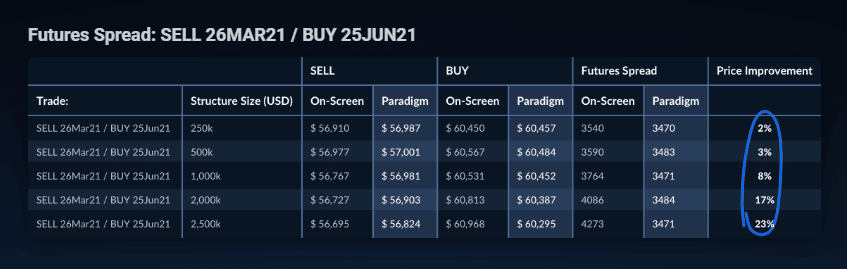
4. Margin Trading and Arbitrage
When the market is bullish, futures generally trade at a premium.
Under these conditions, there’s outsized demand to be long and to own cryptocurrencies. And that demand is reflected in the cost of holding a bullish position (higher funding rates on perpetuals, larger premiums on futures, and so on).
Futures let participants “capture” that premium.
For example, if the quarterly BTC/USD futures trade at a 10% premium to spot BTC/USD, you can buy spot, sell the futures contract, and capture that 10% premium (minus transaction costs).
The same mechanism can be used for perpetuals when funding is high — that is, buy spot, sell futures, and collect the funding rate.
This trade essentially amounts to arbitraging the difference between the spot crypto price and the crypto futures price.
Overall, it’s a good way to earn a return in a bull market with more limited directional exposure.
Choosing Your Leverage Wisely
How to Trade With Leverage on OKX
My Take on Leveraged Derivatives
For me, leverage is a working tool that isn’t accessible to beginners.
What’s more, it has a cost! If you want to learn more about this, I invite you to revisit my free trading course on funding and Open Interest!
Before venturing into borrowing, you need solid practice and rigorous methods so you don’t use it in a way that produces random returns.
The lure of quick gains and the search for thrills is unfortunately the main reason so many people turn to leverage.
Don’t fall into that trap, and don’t skip steps!
So, if you’re a beginner, I recommend you continue your training and set this tutorial aside for later. Entering this mindset was important, because it lets you think the subject over at length before getting into it in the right frame of mind.
That said, if your performance is consistently positive, leverage becomes an essential tool, especially in a market where volatility is slow to arrive…
Sure, it takes many years of experience, but once used correctly, the field of possibilities suddenly widens!
I say it often: prove yourself on a small account, and the big account will follow…
Every guide here is free. Browse the full course and join a community of traders who share ideas every day.