Open Interest is an essential concept when it comes to crypto trading, but also across the conventional sectors of finance. It’s one of the most important metrics for professional traders. O.I lets you gauge the market’s liquidity and anticipate future trends in the price of the assets you watch. It’s one of the rare indicators I don’t really track on TradingView. Instead, I head over to Basedmoney formerly Coinoptionstrack.
Open Interest Definition: Bitcoin and Ethereum
Analyzing Open Interest (“intérêt ouvert” in French) is crucial to understanding its importance in crypto trading
O.I is a term used to describe the total number of options contracts or futures contracts that are currently open without being offset by an opposite transaction.
Open Interest is calculated from all the open contracts in circulation. In other words, it’s the number of contracts awaiting settlement at a future date. Open interest can be used to assess market liquidity and the overall market trend.
It’s a measure of the money flow in the market for futures or options contracts. It’s an important indicator for traders because it lets you assess a market’s liquidity and the strength of the trend.
How to Calculate and Interpret Bitcoin Open Interest
The fluctuation of O.I can give important signals about the coming trend of the markets. Especially in the crypto market, in my view O.I is a significant indicator.
A rise in Open Interest indicates a flow of new money coming into the market. It can be a sign of trader confidence in a particular price direction.
Conversely, a drop in O.I can mean that traders are pulling out of the market.
It’s important to keep in mind that Open Interest is calculated from the total number of contracts.
It is not the total of every transaction from every buyer and seller.
The value of O.I only changes when a new buyer and seller enter the market, thereby creating a new contract. This also happens when a buyer and a seller meet, thereby cancelling out both positions.
Example Scenario
For example, say a trader is short (selling) with ten contracts. And another is short with ten contracts (buying). If these traders then buy and sell ten contracts each, those contracts are now closed and will be deducted from O.I.
O.I is commonly associated with futures and options markets, where the number of existing contracts changes every day. These markets differ from the traditional stock market. In “spot” markets, a company’s shares stay constant once the share issuance is complete. It’s roughly the same for cryptos: the level and pace of issuance are set in advance.
A common but persistent misconception about O.I lies in its supposed predictive ability. It cannot forecast price action. A high or low open interest reflects investor interest. That said, it doesn’t mean their view is correct or that their positions will be profitable. Open Interest only comes as a complement to my Price Action analysis! If there’s confluence, now we’re onto something…
The Importance of Open Interest on Bitcoin and Ethereum
Open Interest is a measure of market activity. When it’s low or zero, it means there are few or no open positions.
A high Open Interest means there are many contracts still open. Which means market participants will watch it closely.
A rise in O.I represents money flowing into the market, while a drop indicates money flowing out.
O.I is particularly important for options traders, because it provides key information about an option’s liquidity.
A high O.I indicates that a large number of traders have taken active positions in a derivative contract. If Open Interest rises over time, it means new traders are taking positions. If it falls over time, it means traders are starting to close their positions.
Volume, O.I and Options
Normally, high volume and high open interest indicate a liquid market. Because many buyers and sellers are positioning themselves on a particular option.
Changes in O.I and volume can also be interpreted to confirm market sentiment. For example, a rise in price, volume and open interest indicates that the market for an option is solid. Whereas a rise in price with a drop in volume and open interest suggests a weak market.
Open Interest Bitcoin and Ethereum vs. Liquidations
O.I and liquidations are two closely linked concepts in the world of finance and the stock markets.
O.I is the total number of contracts open at a given moment. It gives an idea of the total number of commitments made by investors on a given asset. Liquidations, for their part, represent the closing limit at which these futures contracts are liquidated…
They can be carried out voluntarily or by force, and are often tied to the price of the underlying assets. A sudden spike in liquidations can drive up volatility and cause significant price swings in the markets.
As a result, a combined and thorough understanding of Open Interest and liquidation levels is essential in my opinion!
O.I vs. Volume
Simply put, volume represents the number of buy or sell contracts that were traded on the market over a given period of time. It’s obviously a key indicator of a market’s activity and liquidity. Volume also measures the buying or selling pressure on an asset.
On the other hand, O.I represents the total number of buy or sell contracts that are outstanding on the market at a given moment. This can be seen as the number of pending positions on a particular asset. Open interest can be used to assess the total demand for an asset, and therefore its popularity on the market.
In short, the main difference between volume and O.I is that volume measures activity over a given period of time. Whereas open interest measures the total number of pending contracts on the market. Both are indicators to take into account in your market analysis.
Volume and Open Interest on BTC and ETH: Interpretation
If an option shows high transaction volume and low O.I, there is a limited secondary market for that option, which means there may also be low liquidity. A trader trying to sell that option may struggle to find a buyer or may run into a wider-than-usual bid-ask spread.
Trend Strength and O.I
O.I is the total quantity of futures or options contracts that are currently open. This means they have been bought or sold and have not yet been closed. Open Interest is often used to assess a market’s liquidity.
Trend Strength, or the strength of the trend, measures the power behind the current trend in a market. It’s generally calculated using technical indicators such as moving averages or oscillators. The stronger the Trend Strength, the more solid the trend is considered to be.
These two concepts can converge to help you make decisions in the market. For example, if Open Interest is high and Trend Strength is also high, that could indicate a strong trend supported by a large number of market participants.
Conversely, if O.I is low and Trend Strength is also low, that could indicate a stagnant and illiquid market.
It’s important to understand both concepts because they let the trader better understand the current state of the market and make more informed trading decisions.
Momentum and O.I
A rise in open interest together with bullish momentum can indicate a strong, lasting uptrend, while a drop in open interest together with bearish momentum can indicate a downtrend that is losing its strength. Ultimately, using these two indicators together can help traders and investors make informed decisions about buying or selling financial assets.
Open Interest Bitcoin and Ethereum: Observing It
This information doesn’t let you know the market’s mindset with certainty, because it’s theory. However, like any indicator, it can shed light on the situation. If other indicators point in the same direction, it can form a particularly interesting cluster of confluent signals!
There are several sites that let you analyze O.I on the crypto markets. The one I prefer is Basedmoney.io, formerly Coinoptionstrack.
BasedMoney, formerly Coinoptionstrack
BasedMoney is perfect for tracking the Open Interest of Bitcoin and Ethereum on options. I recommend it to all my students as well as to my community. It’s not very complete. So you have to combine it with other platforms for the observation to become useful, but it’s an absolute must to master!
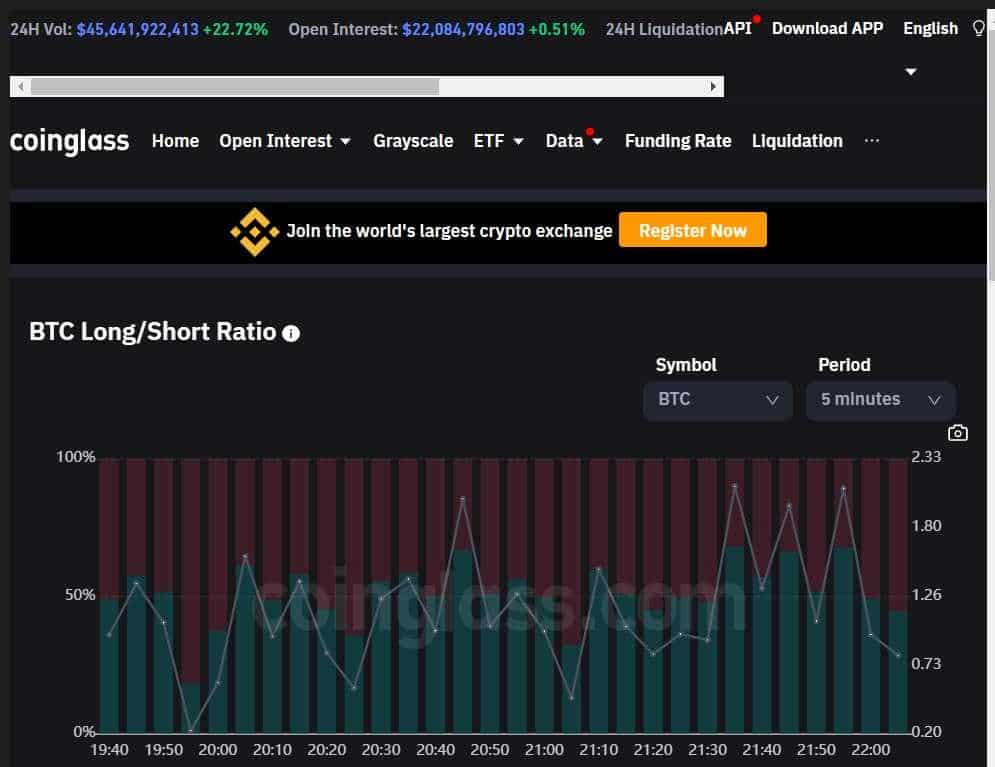
CoinGlass
CoinGlass is a platform offering features such as chart-based tracking of asset values. You’ll also find market analysis, price alerts and secure crypto wallet services.
This platform lets traders see the open interest for several Bitcoin futures contracts across different exchanges.
Coinglass also provides information on market sentiment and trading volumes. All in all, Coinglass is a fairly effective, useful tool for monitoring Open Interest, in real time, on Bitcoin
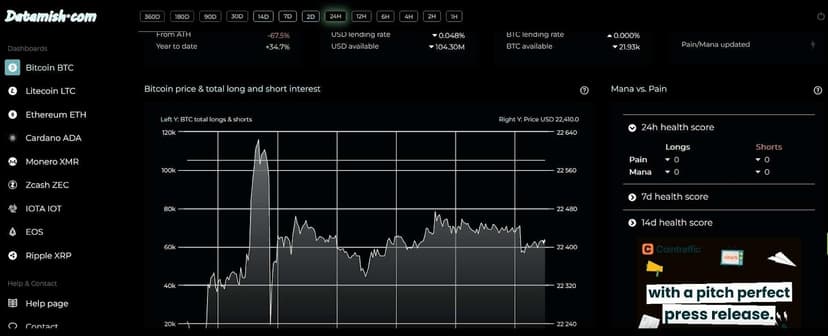
Datamish
Datamish is also a platform that lets you monitor Open Interest on Bitcoin.
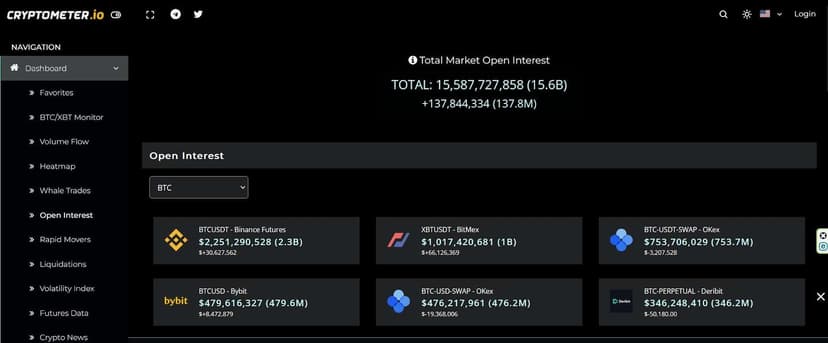
Cryptometer.io
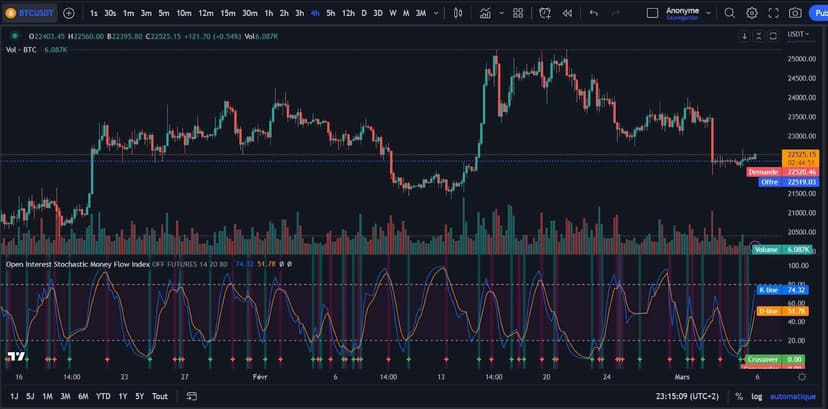
TradingView
TradingView is probably the most complete market-monitoring platform in the crypto space; I recommend it.
Laevitas
Here’s one last data-analysis platform, built on quantitative-finance models for the crypto-asset market. It aims to provide analysis by applying mathematical models to data coming from a variety of crypto-asset derivatives markets. It also provides information on open interest.
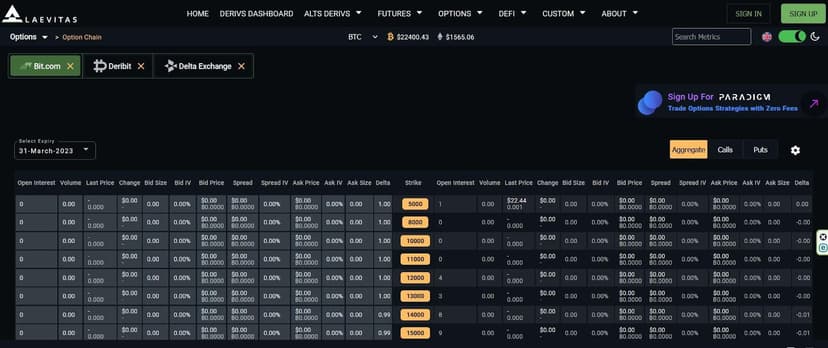
It’s important to note that these platforms each have their own methodology for collecting and analyzing data. So it’s normal to see differences in the figures and conclusions presented.
What to Make of Open Interest: My Take
O.I must be watched carefully, because a sudden surge in the markets can also be purely down to speculation rather than solid fundamental backing.
In my view, to become profitable, it’s essential to know how to interpret Open Interest in confluence with other “indicators.” For me, it has become important for confirming or refuting a trading plan idea.
My Open Interest Course on Video

Every guide here is free. Browse the full course and join a community of traders who share ideas every day.