Crypto Tax in France 2026: The Flat Tax Is 31.4%, Not 30%
By Captain Trading··23 min
Contents36 sections
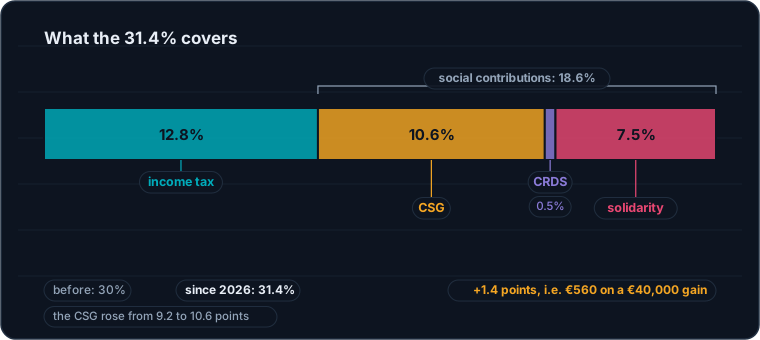
If you look up the tax rate on your crypto gains in France, you’ll find 30% almost everywhere. That figure is no longer right. The flat tax on disposals of crypto-assets (the “prélèvement forfaitaire unique”, or PFU) is 31.4%: 12.8% income tax and 18.6% social contributions. It’s written word for word on the page of the DGFiP (the French public finance directorate), amended on 17 July 2026: “single flat-rate levy (PFU) of 31.4%”.
That isn’t the only discrepancy. Since 25 June 2026, NFTs have had their own article in the General Tax Code (the “Code général des impôts”, or CGI), applied retroactively to disposals made since 1st January 2026. And if you trade perpetuals with leverage, you aren’t even under the regime that every online tax guide describes.
What follows covers 2026 income, declared in spring 2027, and is up to date as of 3 September 2026. Every rate is backed by an official text, with the link provided; where no text settles a point, we say so instead of making things up.
The essentials at a glance
31.4%, not 30%, since the CSG (the “contribution sociale généralisée”) rose from 9.2 to 10.6 points under the 2026 Social Security Financing Act (LFSS).
The default regime, Article 150 VH bis of the CGI, covers only fungible crypto-assets held on a spot basis.
Exchanges with no cash balancing payment (the “soulte”) aren’t taxed: the tax hits the exit into euros, goods or services.
Full exemption below €305 of cumulative disposal prices at household level: a sales threshold, not a gain threshold.
The capital gain is calculated pro rata to the overall value of your portfolio, never line by line.
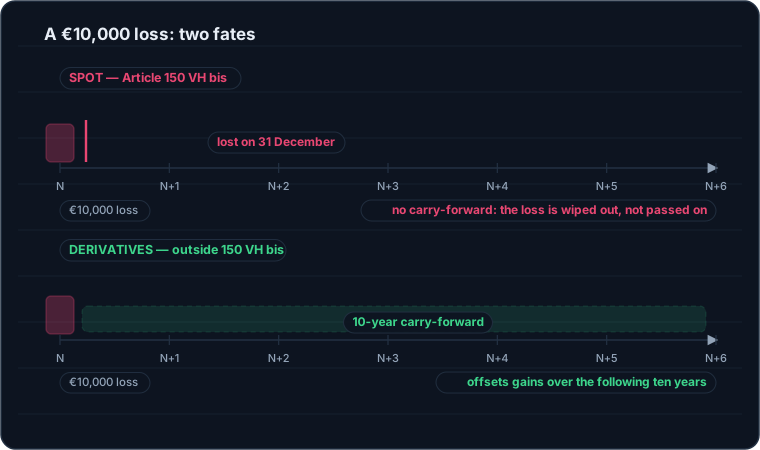
Derivatives fall outside the regime: no €305 threshold, no deferral, no form 2086 — but their losses can be carried forward ten years, while spot losses can’t be carried forward at all.
NFTs fall under Article 150 VH ter, applicable to disposals since 1st January 2026 with no official commentary.
Mining and staking are taxed as non-commercial profits (BNC), from the moment of receipt, not on resale.
An undeclared foreign wallet means a €750 fine and a possible audit going back ten years — and the tax administration will receive your 2026 transactions as early as 2027.
Why the whole French-language web still says 30%
It isn’t laziness, it’s a source problem: the administrative doctrine, published in the BOFiP (the “Bulletin officiel des finances publiques”), was never updated. BOI-RPPM-PVBMC-30-30, the reference commentary on rates, dates from 23 April 2024 and still shows 17.2% of social contributions and 30% in total. Worse: BOI-RPPM-PVBMC-30-10 and BOI-RPPM-PVBMC-30-20, which describe the scope and the tax base, are still in their 2 September 2019 version and explain that habitual buying and reselling falls under BIC (industrial and commercial profits), a criterion that was in fact replaced back in 2023. Check the BOFiP and you’ll read an outdated rate and a repealed rule.
Ordinance No. 96-50 of 24 January 1996, Article 19
Solidarity levy
7.5%
Article 235 ter of the CGI
Total
31.4%
—
On a €40,000 capital gain, the gap with the old rate means €560 of additional tax.
The 31.4% in detail: it’s the CSG, up from 9.2 to 10.6 points, that tipped the overall rate.
Which regime for which transaction?
Before any calculation, identify the right branch: the regime everyone talks about covers only part of your transactions.
Fungible spot (BTC, ETH, stablecoin, altcoin): Article 150 VH bis, 31.4% flat tax or the progressive scale if you opt for it.
Derivatives (perpetuals, futures, options, CFDs): outside 150 VH bis, see the dedicated section.
NFTs: Article 150 VH ter for disposals made from 2026.
Mining and staking: BNC from the moment of receipt, Article 92.
Conditions comparable to those of a professional: BNC, Article 92, 2, 1 bis, and no more deferral on exchanges.
Holding through an SAS (a French simplified joint-stock company) or a holding company subject to corporate tax: corporate income tax, a regime not covered here.
Non-resident at the time of the disposal: out of scope, no taxation in France.
A myth to bust: trading a lot doesn’t make you a professional. Since 2023, the test is no longer how habitual your transactions are but, according to the BOFiP, “the possession, mastery and use of specialised information and intervention techniques, together with their organised search”. The weight of gains in the household’s income, a criterion cited everywhere, comes from the old BIC case law and doesn’t appear in this text. Reclassification remains exceptional: a very active private individual stays under 150 VH bis.
The default regime: Article 150 VH bis
The version in force on 1st July 2026 no longer speaks of “digital assets” but of “crypto-assets subject to Regulation (EU) 2023/1114”, in other words MiCA. That isn’t cosmetic: it’s this cross-reference that takes derivatives out of scope. The logic is that of a global portfolio: as long as you stay within the crypto universe, nothing is due — the tax is triggered on exit into legal tender, into goods or into a service.
The €305 threshold
You’re exempt if the sum of your household’s disposal prices doesn’t exceed €305 over the year. It’s a threshold on the disposal price, not on the gain: selling for €400 with a €20 gain makes you taxable, selling for €300 with a €250 gain exempts you. Exchanges with no balancing payment don’t count towards it, and the exemption isn’t automatic: you have to file form 2086 to show that you’re below it.
A fair caveat: the legal text refers to the “sum of disposal prices” in gross terms, whereas form 2086 aggregates amounts net of fees and balancing payments — at €320 of gross sales with €20 of fees, you’re taxable on a legal reading and exempt on a reading of the form. This threshold hasn’t been indexed since 2019.
The tax deferral on exchanges
This is the pillar of the French regime, and its real strength: switching from BTC to ETH or taking shelter in a stablecoin triggers no immediate tax. Three exceptions: an exchange with a balancing payment is taxable to the extent of the balancing payment received; and the deferral applies neither under the BNC regime for conditions comparable to a professional’s, nor to derivatives.
It never removes the obligation to trace your transactions: the total acquisition cost is the only thing that will reduce your future tax. A properly kept trading journal is worth more than three weekends of reconstruction.
The calculation formula, with a worked example
France doesn’t calculate line by line: no FIFO, no LIFO, no weighted average price per token. There is a single, mandatory method, and it gives a different result from most platform exports.
Capital gain = disposal price net of fees and balancing payments − [total net acquisition cost × (disposal price net of balancing payments ÷ overall value of the portfolio)]
In the numbering of form 2086: line 218 − [line 223 × (line 217 ÷ line 212)]. The technical trap is right there: fees are deducted from the first term, but not from the numerator of the quotient, which is line 217, net of balancing payments but not of fees. Many tools subtract them on both sides and skew the result.
Léa, single, a French resident
She bought 1 bitcoin for €40,000 in 2024, then 10 ETH for €20,000 in 2025: a total acquisition cost of €60,000. In June 2026, she swaps 2 ETH for SOL with no balancing payment: deferral, nothing to declare. In September, she sells 0.5 BTC for €45,000 with €200 of fees, her portfolio then being worth €150,000.
Form 2086 line
Description
Amount
212
Overall value of the portfolio at the time of the disposal
€150,000
217
Disposal price net of balancing payments (fees not deducted)
€45,000
218
Disposal price net of fees (€200) and balancing payments
€44,800
223
Net total acquisition cost
€60,000
—
Fraction allocated: 60,000 × (45,000 ÷ 150,000)
€18,000
—
Capital gain on this disposal: 44,800 − 18,000
€26,800
The same calculation under FIFO, as a foreign tool would do it, would give €24,800: a €2,000 gap on a single transaction.
Second disposal. In November 2026, Léa sells her SOL for €20,000 with no fees, with the portfolio valued at €110,000. The fraction of capital already used up in September, €18,000, is deducted (line 221): line 223 falls to €42,000, the fraction allocated is 42,000 × (20,000 ÷ 110,000) = €7,636.36, and the capital gain is €12,363.64. Forgetting line 221 means overstating your residual acquisition cost and under-declaring.
One clarification that avoids a data-entry error: the gain on each disposal goes in an unnumbered box of the block, labelled “Plus-values et moins-values” (“Capital gains and losses”). Line 224, by contrast, is the year’s total for taxpayer 1 — here 26,800 + 12,363.64 = €39,163.64, and it’s this total that carries over to box 3AN.
Net annual capital gain: €39,163.64. Tax at the flat rate: €12,297 rounded, of which €5,013 is income tax and €7,284 social contributions. At the outdated 30% rate, she would have set aside €11,749: €548 less than she actually owes.
No tax is withheld at source: the tax is collected with the following year’s tax assessment notice, so set the money aside when you cash out. Note also that form 2086 contains three calculation blocks, each with its own overall portfolio value — taxpayer 1 (line 212), taxpayer 2 (line 252), dependent person (line 312) — plus a fourth block for disposals made through intermediaries (“personnes interposées”, lines 411 to 435), which works not on overall value but on shares of the disposal price and of the capital gain. You never merge the household’s portfolios, whereas there is only one €305 threshold for the whole household.
Flat tax or progressive scale?
By default you’re on the flat tax. You can opt for the progressive scale by ticking box 3CN of form 2042 C: an express election, global across all your crypto gains for the year, and irrevocable.
Marginal bracket
Cost under the scale
Cost under the flat tax
Cheaper option
0%
18.6%
31.4%
Scale
11%
29.6%
31.4%
Scale
30%
48.6%
31.4%
Flat tax
41%
59.6%
31.4%
Flat tax
45%
63.6%
31.4%
Flat tax
The tipping point sits around 12.8%, the income tax share of the flat tax. Two nuances: if you opt for the scale, 6.8 points of CSG are deductible from your overall income in the year of payment, though not the 1.4-point increase, and never the CRDS; and the 2026 income scale will be set by the 2027 Finance Act, which hasn’t been passed to date. The most recent one, for 2025 income, runs from 0% up to €11,600 to 45% above €181,917 per tax share.
The trap that general articles will miss
The 2026 Finance Act removed the word “irrevocable” from paragraph 2 of Article 200 A of the CGI. Many will therefore headline that the election for the scale is becoming revocable. That’s true for box 2OP, the one for investment income and capital gains on securities.
It isn’t true for crypto. The crypto election is governed by Article 200 C, which this law didn’t touch: its version in force is still that of 1st January 2023 and still says “on express and irrevocable election”. Two boxes, two revocability regimes: ticking 2OP doesn’t tick 3CN.
Transaction by transaction
Transaction
Taxable?
Regime and point to watch
Sale for euros
Yes
150 VH bis: the main taxable event, subject to the €305 threshold.
Crypto-to-crypto swap, stablecoins included
No
Deferral, with no balancing payment. With one: taxable to the extent of the payment.
Payment for goods or a service
Yes
150 VH bis. Disposal price = value of the goods received.
Transaction fees paid in crypto
Yes, with a tolerance
150 VH bis. Major for any DeFi user.
Transfer between your own wallets
No
No transfer of ownership, hence no disposal.
Perpetuals, futures, options, CFDs
Yes
Outside 150 VH bis. Form 2074, losses carried forward ten years.
Mining
Yes
BNC from the moment of receipt, at the value on the day of allocation.
Staking
Yes, according to the DGFiP
BNC, but a position published on impots.gouv.fr only.
Lending, yield farming, airdrops
Not settled
No dedicated text. Practitioners often apply BNC.
NFTs
Yes
150 VH ter since 2026: the regime of the asset represented.
Gift
Yes, at gift duty rates
Wipes out the latent capital gain, but uses up your initial capital.
Theft, hacking, rug pull, lost keys
No, and no deduction
No disposal: no capital loss, even in the same year.
Holding
No
No annual tax, but foreign accounts must be declared.
Fees paid in crypto are a disposal
The form 2086 notice is explicit: paying transaction fees with digital assets “constitutes a taxable transaction within the meaning of paragraph I of Article 150 VH bis of the CGI”. Translation for a DeFi user: every gas fee paid in ETH is in principle a taxable disposal. Fortunately the notice goes on to a tolerance, accepting that the disposal and the services rendered in return for the fees be treated as a single transaction. It saves you in the standard case; it doesn’t exempt you from understanding the rule.
The same loss, two regimes: spot wipes it out on 31 December, the derivative keeps it for ten years.
Derivatives: perpetuals, futures, options and CFDs
They’re missing from every crypto tax guide, and yet they’re the daily bread of many traders. If you take positions on futures contracts using leverage, you’re not under the regime described by the rest of the Internet.
Why they fall outside Article 150 VH bis
The chain of texts is short. Article 150 VH bis covers only crypto-assets “subject to Regulation (EU) 2023/1114”; and the MiCA regulation, in paragraph 4 of its Article 2, excludes from its scope the crypto-assets that qualify as financial instruments within the meaning of MiFID II. The form 2086 notice says the same thing on the French side, by excluding tokens “meeting the characteristics of the financial instruments mentioned in Article L. 211-1” of the Monetary and Financial Code, whose Article D. 211-1 A covers, through a catch-all clause, “any other futures contract relating to assets, rights, obligations, indices and measures”.
A cash-settled perpetual contract is therefore not a MiCA crypto-asset, it’s a financial contract. The texts lead to the regime of profits on forward financial instruments, Article 150 ter of the CGI, where the profit on each contract is the difference between the sums received and the sums paid.
Let’s be honest. The exclusion from the scope of 150 VH bis is solidly established on these texts. The positive link to Article 150 ter, by contrast, is a coherent legal deduction, not a published administrative position: no text, no BOFiP and no case law expressly classifies a crypto perpetual contract, and the only commentary on forward financial instruments dates from 20 December 2019 without mentioning either crypto or CFDs. For a significant amount, have your situation checked by a professional rather than relying on an article, this one included.
Point
Spot (150 VH bis)
Derivatives (150 ter)
Overall rate
31.4%
31.4% (12.8 + 18.6)
€305 threshold
Yes
No: taxable from the first euro of net profit
Deferral on exchanges
Yes, with no balancing payment
No: each contract unwound is a taxable event
Global portfolio formula
Yes, mandatory
No: contract-by-contract calculation
Form
2086
2074, attached to the 2042
Loss carry-forward
No carry-forward
Following ten years
Counterparty in a non-cooperative state
No effect
50% rate, unless real transactions are proven
The second-to-last row is the most important, and it’s counter-intuitive. On spot, a year of drawdown is lost for tax purposes: capital losses can only be set against capital gains of the same nature in the same year, with no carry-forward at all. On derivatives, net losses fall under paragraph 11 of Article 150-0 D and can be carried forward over the following ten years, against profits of the same nature — never against your overall income.
As for the 50% rate, the list of non-cooperative states and territories is set by the ministerial order of 15 April 2026 and comprises eleven territories, including Panama, Russia and Vietnam. Neither the United Arab Emirates, nor the Seychelles, nor the Cayman Islands appear on it in 2026, but it’s revised every year: check it in the Journal officiel, the official gazette.
Two borderline cases remain unsettled: margin trading on spot, with no derivative contract, leaves the asset among fungible crypto-assets and appears to fall under 150 VH bis; and perpetuals on an unauthorised platform remain taxable, since an unlawful offering doesn’t make the tax disappear. If you go through a prop firm, the question arises differently again, since the remuneration generally isn’t a market profit.
NFTs now have their own article of law
This is the change almost nobody has factored in yet. Article 91 of Law No. 2026-534 of 25 June 2026 on combating social and tax fraud creates Article 150 VH ter: unique, non-fungible crypto-assets are subject to the tax regime of the asset or right they represent. The text expressly refers to Article 150 VI of the CGI when the NFT represents a work of art, a collectible, an antique or a precious metal; for other underlying assets, no administrative commentary has been published and the rates aren’t settled.
And the text is retroactive. It applies “to disposals made from 1st January 2026”, nearly six months before its publication in the Journal officiel of 26 June 2026. If you sold an NFT in February 2026 thinking you were under 150 VH bis, you were already under the new text, and you’ll have to reconstruct an acquisition cost under the regime of the underlying asset without the slightest official commentary to guide you. It’s the main practical risk of the year for anyone who has touched Ordinals or NFT collections. One point remains open: the removal of NFTs from the “overall portfolio value” of 150 VH bis would logically follow, but no text confirms it and we don’t put a figure on any consequence of it.
Mining, staking and the rest of DeFi
Mining is the only clearly addressed case. The BOFiP places it under non-commercial profits on the basis of a Conseil d’État decision of 26 April 2018: taxation from the moment of receipt, at the value on the day of allocation, with a zero acquisition value when the tokens are allocated free of charge. Under €83,600 of receipts, the micro-BNC regime applies with a 34% allowance (minimum €305); beyond that, it’s the “déclaration contrôlée” (actual-profit regime), form 2035.
The impots.gouv.fr page of 17 July 2026 places staking in the same category. That’s the official position and the prudent route, but be aware of how little weight that source carries: neither the law, nor the BOFiP, nor case law deals with staking. A minority view argues, for delegated staking, for taxation only on disposal: we flag it, without recommending it.
For yield farming, lending and airdrops, nothing is settled: neither the legislator, nor the BOFiP, nor case law has ruled. By analogy with mining, practitioners most often adopt the BNC classification at receipt, while others argue for treating it as income from receivables. Keep proof of the nature of the token and of its value on the date of receipt — the DAC 8 decree, incidentally, lists staking and lending among the services that platforms will have to report.
Your reporting obligations
Form 2086 is the mandatory schedule as soon as a single taxable disposal has taken place in the year, including below the €305 threshold: it’s what justifies the exemption. The 2026 edition, covering 2025 disposals, carried CERFA 16043*07; the one for 2026 disposals hasn’t been published yet. On the 2042 C tax return, three boxes: 3AN for a net capital gain, 3BN for a net capital loss, 3CN for the scale election — the first two being pre-filled online from the 2086 you entered.
Form 3916-3916 bis is the one people forget. Every wallet opened, held, used or closed with a company, legal entity, institution or body established abroad must be declared each year. Even with no disposal at all. Even if the account is empty. Even if it was closed during the year.
For fungible crypto-assets, a self-hosted wallet, a MetaMask or a Ledger, isn’t covered: there’s no third-party body. Beware though: Article 1649 bis C of the CGI also covers unique, non-fungible crypto-assets “held or used abroad”, with no intermediary requirement: an NFT in self-custody therefore potentially falls within the obligation. As what “used abroad” means isn’t defined by any text, it’s a blind spot that we flag without settling it.
The deadlines for 2026 income aren’t known: the calendar for the 2027 filing season will be published by the DGFiP in spring 2027, and we won’t invent dates. The 3916-3916 bis is filed by the same deadline.
The traps that cost you dearly
Spot capital losses can’t be carried forward to any year
They can only be set against capital gains of the same nature in the same year. Selling at a loss in December to offset a gain from the year makes sense; doing it the following January makes none. And a crypto capital loss can be set neither against your overall income, nor against gains on shares.
A loss without a disposal isn’t deductible at all
This is where the law clashes most brutally with intuition. Article 150 VH bis only recognises disposals for consideration: theft, hacking, the bankruptcy of a platform, a rug pull, the loss of your private keys and a token that has become worthless but was never sold generate no deductible capital loss.
The nuance that changes everything: a token that has become almost worthless but was actually sold amounts to a disposal, hence a capital loss that can be set against your gains for the year. One more reason to know how to spot fake token scams. We couldn’t verify whether any tolerance exists for theft or bankruptcy: by default, no deduction is possible.
€750 per undeclared foreign account
Article 1736, X of the CGI provides for a €750 fine per undeclared wallet, or per NFT, and €125 per omission. These amounts rise to €1,500 and €250 when the market value of your assets abroad exceeds €50,000 at any time during the year, with a cap of €10,000 per return. Three accounts forgotten for four years is €9,000 without any tax having been evaded.
And the limitation period gets longer. The reassessment period for income tax is three years; it’s extended to ten years when the obligation of Article 1649 bis C hasn’t been complied with. Beware of the misreading you see everywhere: there is no amount tolerance for crypto-assets. Article L. 169 of the Tax Procedure Code (LPF) reserves the €50,000 credit-balance exception for the bank accounts of Article 1649 A alone. For a crypto-asset wallet or an NFT, the ten years apply whatever the amount involved. Since the law of 25 June 2026, the same period applies to registration duties, and Article 755 of the CGI allows your assets, if you can’t prove their origin, to be taxed ex officio at 60% on the highest known value of the previous ten years.
A gift doesn’t wipe out the gain for free
Giving crypto-assets wipes out the latent capital gain: the donee takes as acquisition price the value used for the duties, and the €100,000 allowance per parent and per child renews every fifteen years. But the form 2086 notice defines line 221 as the fraction of capital contained in the price of earlier disposals made “free of charge or for consideration”: a gift therefore consumes part of your initial capital and permanently reduces the acquisition price of the portfolio you keep. Your future capital gains will mechanically be higher, and a non-genuine gift-and-sale arrangement can be recharacterised as an abuse of law.
Finally, above €250,000 of reference taxable income for a single person, €500,000 for a couple, the exceptional contribution on high incomes adds 3 then 4%: 31.4% is then no longer your real cost.
Changing tax residence
Article 150 VH bis covers only persons tax-domiciled in France: a non-resident isn’t taxable under it on crypto capital gains. In the event of a departure during the year, only the disposals made during the period of French residence are taxable, the overall portfolio value being assessed at the date of each one — no administrative commentary details this mechanism.
Exit tax: crypto-assets held directly aren’t within its scope. Article 167 bis of the CGI covers “corporate rights, securities or rights mentioned in point 1 of paragraph I of Article 150-0 A”, with no mention of crypto-assets, and the law of 25 June 2026 didn’t touch it. Two caveats: this is a reading of the text, very widely shared, that no BOFiP expressly confirms; and if you hold your crypto-assets through a company, it’s the shares of that company that do fall within the scope.
2026, the first year without anonymity
France transposed the European DAC 8 directive by a decree of 19 December 2025, which places a reporting obligation on crypto-asset service providers: registration since 1st January 2026, bringing pre-existing users into compliance before 1st January 2027, and first automatic transmission in 2027, on 2026 transactions. In practice, 2026 is the first year the tax authorities will know about without having to ask you anything: the “they won’t see anything” reasoning has an expiry date, and it’s spring 2027.
What we won’t claim
An honest article also says where its knowledge ends. As of 3 September 2026, no text, no administrative commentary and no case law settles: the precise classification of a perpetual contract concluded abroad and margin trading on spot; the rates for NFTs under 150 VH ter outside the reference to Article 150 VI; lending, yield farming, airdrops and collateralised loans; the acquisition price of tokens already taxed as BNC when they’re resold; the portfolio valuation method, for which no price source or timestamp is prescribed; the regime of crypto-assets held by a company subject to corporate tax; VAT on NFTs and mining; the 2026 scale and the deadlines of the 2027 filing season. Document your method, stick to it from one year to the next, and consult a professional rather than copying an answer from a forum or an artificial intelligence.
Run the numbers with the simulator
How much will I pay? The simulator applies the flat tax and the scale option to your amounts, and compares the two. It shows the rule applied on each line, and stops at the cases that no text settles rather than inventing an amount. Everything is calculated in your browser: nothing is transmitted or stored.
Frequently asked questions
Is the rate 30% or 31.4%?
31.4%: 12.8% income tax and 18.6% social contributions. The 30% figure corresponds to the old social rate of 17.2%, raised by the 2026 Social Security Financing Act. The official DGFiP page, amended on 17 July 2026, does show 31.4%.
Do I have to declare if I only made crypto-to-crypto exchanges?
Exchanges with no balancing payment benefit from a deferral, stablecoins included: no tax, and they don’t count towards the €305 threshold. But if your accounts are open with a foreign provider, the 3916-3916 bis declaration remains mandatory every year, even with no disposal at all.
Can my losses be carried forward to later years?
On spot, no: capital losses can only be set against capital gains of the same nature in the same year. On derivatives under Article 150 ter, net losses can on the contrary be carried forward ten years.
How are my gains on perpetual contracts taxed?
Not like spot: MiCA excludes crypto-assets qualifying as financial instruments, and the texts lead to Article 150 ter. Same overall rate of 31.4%, but no €305 threshold, no deferral, form 2074 and not 2086, and losses carried forward ten years. This link is a legal deduction, not a published administrative position: have your situation checked by a professional.
What if I get hacked or the platform goes bankrupt?
For tax purposes, nothing — and it’s brutal. Article 150 VH bis only recognises disposals for consideration: theft, hacking, rug pull, bankruptcy or lost keys generate no deductible capital loss. A token that has become almost worthless but was actually sold, on the other hand, constitutes a disposal.
Do my NFTs fall under the same regime as my bitcoins?
Not since 2026. Article 150 VH ter, created by the law of 25 June 2026, subjects them to the regime of the asset or right they represent, for disposals made since 1st January 2026. With no administrative commentary published, the rates aren’t yet known.
Do I have to declare if my gains are below €305?
Beware of the misreading: €305 is an annual threshold on the disposal price at household level, not a gain threshold. And the exemption isn’t automatic: you have to file the 2086 detailing the disposals to show that you’re below it.
Has the election for the scale become revocable?
Not for crypto. The 2026 Finance Act removed the irrevocability in Article 200 A of the CGI, which governs box 2OP for investment income. The crypto election of box 3CN falls under Article 200 C, unmodified: it remains express and irrevocable.
Disclaimer
This content is informational and up to date as of 3 September 2026. It isn’t personalised tax advice: we aren’t tax advisers, and everyone’s situation differs according to their tax domicile, the nature of their transactions and the history of their portfolio. The cited texts may be amended, notably by the 2027 Finance Act. Before any decision involving significant amounts, consult a tax lawyer or a chartered accountant.