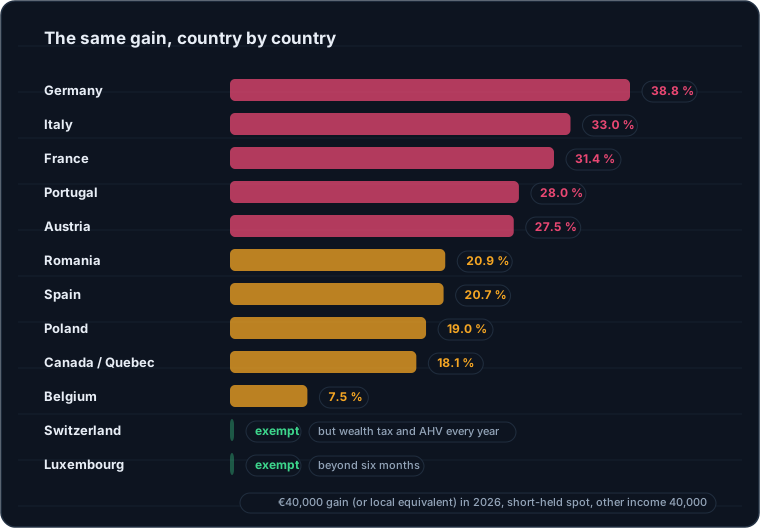
A €40,000 gain realised on the same day, on the same exchange, with the same strategy, costs a German resident who sells within a year €15,507 in tax, a French resident €12,560, a Spanish resident €8,280, and a Luxembourg resident who held the position for more than six months precisely nothing. This isn't a loophole or a scheme: it's the law in each of these countries. What changes isn't the crypto — it's the tax address of the person selling.
This page compares twelve countries: France, Belgium, Switzerland, Luxembourg, Canada and Quebec, Germany, Austria, Italy, Spain, Portugal, Poland and Romania. Twelve approaches that have almost nothing in common. Three wipe out the tax after a holding period — one year in Germany, six months in Luxembourg, 365 days in Portugal. In the other nine, holding for ten years gives exactly the same bill as selling the next day, with two exceptions: Austria's Altvermögen acquired before 1 March 2021, and the six-month holding period that counts, in Switzerland, among the criteria for private asset management. Three tax the holding itself, every year, whether or not you sell.
The comparison covers 2026 gains, the ones you'll declare in 2027, reflecting the law as it stood on 7 September 2026, with every figure backed by a linked official source, and it points to the fuller country-by-country detail behind each figure. When a point isn't settled by any text — and there are plenty, all in the same place — we say so rather than guess.
The essentials at a glance
Three countries wipe out the tax with time: Germany beyond one year, Luxembourg beyond six months, Portugal beyond 365 days. In the other nine, the holding period changes nothing, with the sole exception of Austria's Altvermögen acquired before 1 March 2021.
Germany: the most expensive country and the cheapest, depending on the month you sell. Within a year, the gain follows the progressive income tax scale — €15,507 on our example, 38.8% effective. Beyond a year, zero. On derivatives, neither applies: a flat 26.375%, with no holding period at all.
Italy: 33% on spot since 1 January 2026, against 26% on derivatives — the only country in the series to flip the usual order, with the derivative costing seven points less than spot.
France: 31.4%, not 30%, from the first euro above €305 of annual disposals — but it's one of only three countries, alongside Austria and Portugal, to treat crypto-to-crypto swaps as neutral.
The instrument decides, and the baskets don't talk to each other. In Austria, the same economic gain costs €11,000 in spot and €16,771 in non-securitised derivatives — the sharpest gap in the series. In Poland, spot and derivatives share the 19% rate but live in two watertight baskets: a loss on perpetuals doesn't offset a spot gain, and the PIT-38 return is due even in a year with no sale at all.
Four countries tax you on something other than your actual gain. Switzerland through a cantonal and municipal wealth tax, Spain through the Impuesto sobre el Patrimonio, Italy through 2 per mille a year on the value of the portfolio — the only crypto-specific holding tax in the series. And Romania adds a 10% CASS health contribution on top of its 16%, assessed on a flat-rate base in tiers — RON 24,300, 48,600 or 97,200 — meaning RON 2,430, 4,860 or 9,720 due: 20.86% effective on our example.
Loss carryforward divides the twelve countries more sharply than the rates do: unlimited in Poland, Canada and Germany — though ring-fenced by category in the latter — ten years on French derivatives, five years in Romania and Portugal, four years in Italy and Spain, zero in Belgium, Austria and Luxembourg, and no deduction at all in Switzerland.
Moving abroad wipes out nothing, and five countries tax you on the way out: Belgium and Canada through a deemed disposal, Portugal by treating the loss of residence as a disposal, Austria through its Wegzugsbesteuerung, Poland on derivatives only. Three offer a step-up on arrival: Belgium, Canada and Austria.
2026 is the first year collected under DAC 8 in the EU countries of the series — except Spain, which still hasn't transposed it. The first transmissions run from 15 March 2027 in Romania to 30 September 2027 at the Belgian deadline.
None of the twelve regimes seriously deals with perpetuals, funding, liquidations and DeFi: that's the common blind spot across all twelve.
The big comparison table
First pass: the regime, the rate, the exit door if there is one, and what you pay without having sold anything.
Country
Private gain regime
Rate on the capital gain
Threshold or allowance
Annual holding tax
Germany
Private disposal, § 23 Abs. 1 Satz 1 Nr. 2 EStG; out of scope beyond one year
Progressive scale up to 45% + Soli within a year; 0% beyond
Freigrenze of €1,000: at €1,000.00, the whole gain becomes taxable
None since 1997
Austria
Einkünfte aus Kryptowährungen, § 27b EStG 1988
27.5%, a special flat rate with no progressivity effect
None. Altvermögen acquired before 1 March 2021: out of scope after one year
None: no wealth tax, no inheritance tax
Belgium
Miscellaneous income, article 90, first paragraph, 9° CIR 92
10%, with no municipal surcharge
€10,000 allowance per person
None
Canada (Quebec)
Capital gain, 50% inclusion rate, section 38(a) Income Tax Act
12.845 to 26.6525% effective in Quebec
None
None
Spain
Ganancia patrimonial, savings tax base, articles 33 to 35, 66 and 76 LIRPF
19 / 21 / 23 / 27 / 30% across the savings-income bands
None: the personal minimum is absorbed by the general tax base
Yes: Impuesto sobre el Patrimonio, regionalised, plus the tax on large fortunes
France
Prélèvement forfaitaire unique (flat tax), article 150 VH bis of the CGI
No threshold: everything hinges on the 365-day holding period
None
Romania
Venituri din alte surse, article 116 alin. (2¹) of the Codul fiscal
16% since 2026, plus the 10% CASS on a flat-rate base
De minimis: gains under RON 200 per transaction, if the annual total stays under RON 600
None on crypto
Switzerland
Private capital gain out of scope, article 16, paragraph 3 LIFD
0%
Not applicable
Yes: cantonal and municipal wealth tax, plus AVS/AHV contributions
Second pass, the active trader's view: what happens to futures contracts and perpetuals, what becomes of a loss, how the acquisition price is calculated, and what you need to file.
Country
Derivatives and perpetuals
Loss carryforward
Calculation method
Reporting obligations
Germany
Termingeschäfte, § 20 Abs. 2 Satz 1 Nr. 3 EStG: 26.375%, no holding period and no Freigrenze
Spot: one year back, unlimited forward, but ring-fenced within § 23. Derivatives: against all capital income, the €20,000 cap repealed by the JStG 2024
Individual identification; FIFO accepted as a simplification, wallet by wallet
Anlage SO and Anlage KAP. No foreign-account reporting form
Austria
Non-securitised: excluded from the special rate by § 27a Abs. 2 Z 7 → progressive scale up to 50%, 55% above one million
No carryforward. Offsetting within the year only, and ring-fenced between categories
Moving average price in euros (gleitender Durchschnittspreis)
E 1 and E 1kv: Kennzahl 174 for spot, 857 for derivatives at the progressive scale
Belgium
Same category, same 10% rate
No carryforward: offset within the year, across all category c) items
Acquisition price, or the value at 31 December 2025 for assets held before
Personal income tax return always required
Canada (Quebec)
Every close-out and every liquidation is a disposition
Three years back, indefinitely forward, against capital gains only
Average cost of identical property
T1 and Schedule 3; T1135 above CA$100,000; in Quebec, TP-21.4.39 from the mere fact of possession
Spain
Instrumentos financieros outside the crypto regime: same rates, DGT doctrine on contracts for difference
Four years within the savings tax base
FIFO under administrative doctrine — not the law itself; contract by contract on derivatives
Modelo 100; Modelo 721 above €50,000 held with a foreign custodian
France
Outside the spot regime: forward financial instruments, article 150 ter
Spot: no carryforward. Derivatives: ten years
Pro rata of the overall portfolio value: neither FIFO nor LIFO
Forms 2086 and 2042 C, plus 3916-3916 bis for any foreign account
Italy
Article 67, lettera c-quater: 26%, seven points less than spot
Four years, provided the loss was declared in the year it was realised
LIFO compulsory under the regime dichiarativo, by token denomination
Quadro RT sezione V-A and II-A; quadro RW even for self-custody held in Italy
Luxembourg
Unsettled: the circular doesn't contain the word "derivative" at all
Beyond six months: nothing. Speculation: same year only
Weighted average price compulsory, FIFO and LIFO excluded
Form 100, boxes 1109 to 1112
Poland
Article 30b ust. 1 pkt 1: 19% too, but in a separate basket that never talks to spot
Spot: excess costs carry forward without time limit. Derivatives: five years, up to 50% of the loss per year — or a single offset up to PLN 5,000,000
No matching at all: the year's proceeds minus the year's costs, neither FIFO nor LIFO
PIT-38, due even without a single sale, from 15 February to 30 April
Portugal
Alínea e): 28% on the annual net result, never benefiting from the 365-day exclusion
Five years, but only if you opt for englobamento
FIFO, article 43.º n.º 8 g), assessed provider by provider
Anexo G quadro 18A and quadro 13; Anexo G1 quadro 7 even for an exempt gain
Romania
Venituri din investiții, article 123 alin. (1²): 16% with no Romanian intermediary, plus CASS
Derivatives: five years, up to 70% of annual net gains, and country by country for losses of foreign source. Spot: no legal text
No method is prescribed for virtual currency: an unsettled point
Declarația unică, formularul 212, by 25 May at the latest
Switzerland
Same regime as spot: exempt — but they count towards the safe-harbour criteria
No private loss is deductible
Market value at 31 December; the ICTax list takes priority
Cantonal securities statement: no dedicated form for foreign accounts
The same gain, twelve bills
Same assumption everywhere: a €40,000 spot gain held short-term, or its round local equivalent, plus €40,000 of other income. Two exemptions, and each hides a condition.
These figures come from this series' own simulator, not a back-of-envelope calculation: it's the same engine that feeds the chart above. A single person, a capital gain realised in 2026 on bitcoin bought two years earlier, plus €40,000 of other income. Countries outside the eurozone work from a round local equivalent of their own currency — CA$60,000, PLN 170,000, RON 200,000, CHF 40,000 — because that's how their own tax scale reasons: it's the rates that are comparable, not the amounts.
On this short-spot scenario, the gap runs from €15,507 in Germany to zero in Switzerland and Luxembourg — and climbs to €16,771 as soon as you move to Austrian perpetuals. The exact figure for each country appears in its own section. But in none of the twelve is the headline rate the real cost: there is always a situational variable behind it — a holding period, an instrument, a region, a social contribution, a requalification — and that variable is what actually decides.
Germany: one year, and everything changes
Germany has no dedicated crypto regime: it applies the general rules of the Einkommensteuergesetz, clarified by a ruling of the Bundesfinanzhof of 14 February 2023 and by the federal circular of 6 March 2025. On spot, everything comes down to § 23 EStG: sold within the year following purchase, the gain follows the progressive scale up to 45%, plus the Solidaritätszuschlag. Sold beyond a year, it falls out of scope entirely. On our example, that's €15,507 on one side and nothing on the other.
The real German trap lies elsewhere, and it's a trader's trap. Perpetuals and cash-settled futures don't fall under § 23 but under § 20 Abs. 2 Satz 1 Nr. 3 EStG: a flat 26.375%, with no holding period whatsoever. On our example, that's €10,286 — cheaper than short-term spot, infinitely more expensive than long-term spot. And the two regimes are watertight: a loss on perpetuals never offsets a spot gain, and vice versa.
The point nobody writes: the two relevant circulars simply ignore each other. The one on crypto-assets never once mentions Termingeschäft, Future, CFD, Derivat, Hebel or Margin; the one on the Abgeltungsteuer never mentions crypto. Attaching perpetuals to § 20 is a sound legal deduction, not a published administrative position specific to crypto. We say so rather than paper over it.
Two details are costly. The two "€1,000" figures in the German file aren't the same thing: on spot, it's a Freigrenze — at €1,000.00 of total gain, the whole amount becomes taxable; on derivatives, it's an allowance shared with interest, dividends and ETFs. And if you also use a German intermediary, the request for a Verlustbescheinigung must reach them by 15 December at the latest: it's the one hard German deadline that permanently forfeits a right if missed. The German article covers all of this in detail, though it is published in German only.
Austria: 27.5% on spot, the progressive scale on perpetuals
Since 1 March 2022, Austria has done what no other country in the series has done: create a category dedicated to cryptocurrencies, the Einkünfte aus Kryptowährungen under § 27b EStG 1988, taxed at 27.5%, a special rate that never mixes with the progressive scale. No holding period, no threshold, and — a peculiarity it shares with France — crypto-to-crypto swaps are neutral. On our example: €11,000, no more and no less.
One door remains, closed since 2021: tokens acquired before 1 March 2021 count as Altvermögen, still under the old Spekulationsgeschäfte regime, whose one-year window closed long ago. Selling them in 2026 costs nothing and doesn't even require a form.
Then there are derivatives, where Austria becomes the toughest country in the series. A perpetual, a future or a CFD taken out with a platform is not securitised: § 27a Abs. 2 Z 7 excludes it from the special rate whenever no eligible institution voluntarily withholds KESt — the case for every crypto platform — and the gain then falls back onto the progressive scale: up to 50%, 55% above one million. On our example, the same €40,000 gain costs €11,000 in spot and €16,771 in perpetuals: a €5,771 gap for an identical economic result. Here, it's neither the holding period nor the amount that decides — it's the instrument.
One last, very recent point: since 1 July 2026, the Budgetmaßnahmengesetz 2026 has created an annual proof requirement for anyone who obtained non-fixation of their exit tax and whose relevant income exceeds €100,000 in a year, plus a one-off proof to be filed by 31 December 2026 for earlier cases above the same threshold. The deadlines are set out in the Austrian article, published in German only.
Belgium: 10%, a snapshot at 31 December 2025 and no carryforward
This is the sharpest change in the series. Until 31 December 2025, a crypto gain from normal management was exempt in Belgium. Since 1 January 2026, the law of 6 April 2026 taxes it at 10%, after an annual allowance of €10,000 per individual. On our example, the base drops to €30,000 and the tax to €3,000, or 7.5% effective. Good news that nobody dwells on: no municipal surcharge is added on top — the 10% is the final rate.
The central mechanism is the reference value at 31 December 2025: for any asset acquired before 2026, that value stands in as the acquisition price. Gains accrued before that date are out of scope. But the mirror image is cruel, and nobody writes it up: the same rule applies to losses. A token bought for €10,000 in 2021, worth €3,000 at the end of 2025 and sold for €2,000 in 2026, doesn't generate an €8,000 loss but a €1,000 one. The snapshot locks in past gains and amputates past losses.
For a trader, two points matter. Derivatives fall into the same category as spot: a loss on perpetuals offsets a spot gain, or even a share gain, within the same year. But there is no carryforward to the following year at all: a drawdown year is fiscally lost for good. What's left is the most dangerous layer: if the tax authority establishes that the trading goes beyond normal private management, the rate jumps to 33%, municipal surcharges are added, and the 31 December 2025 snapshot disappears. Leverage is one of the indicators weighed in that assessment. The Belgian article sets out all three tiers.
Canada and Quebec: half the gain, and two returns
Canada has no wealth tax, no inheritance tax and no flat crypto regime: everything runs through ordinary income tax, and each transaction is treated as a barter. The proceeds are classed either as a capital gain, of which section 38(a) of the Income Tax Act includes only half in taxable income, or as business income, included at 100%. One point that needs correcting everywhere: the higher 66.67% inclusion rate announced in 2024 was scrapped. The rule that applies to 2026 income is indeed 50%, with no CA$250,000 threshold of any kind.
On our example — CA$60,000 of gain and as much again in other income, a Quebec resident — half of it, CA$30,000, enters taxable income: CA$10,835 in tax, made up of CA$5,135 in net federal tax after the 16.5% Quebec abatement and CA$5,700 in Quebec tax, or 18.1% effective. The theoretical range runs from 12.845% to 26.6525% depending on the marginal rate reached.
The real dividing line lies elsewhere. The Canada Revenue Agency publishes six signs of carrying on a business, one of which names debt financing specifically; crossing over to that side doubles the tax base, and no single criterion is decisive on its own. If you trade through a prop firm, the question is framed differently, since the payout generally isn't a capital gain. On paperwork, Canada is the heaviest of the twelve: the T1135 from CA$100,000 of cost of foreign property, with a CA$24,000 penalty for gross negligence after formal notice, plus 5% of the cost of the property beyond two years, and in Quebec the TP-21.4.39, due from the mere fact of possession. The Canada and Quebec article sets out the combined thresholds.
Spain: no crypto tax, but a tax on what you haven't sold
Spain has no crypto regime: it applies the IRPF and places the gain in the savings tax base, taxed in bands from 19% to 30% under articles 66 and 76 of Ley 35/2006. On our example: €8,280, made up of 19% on the first €6,000 and 21% on the rest, 20.7% on average. There has been no reduction for holding period since 2015, and no ordinary-regime autonomous community can alter this scale — contrary to what is often claimed. The Basque Country and Navarre, though, run their own IRPF.
The method itself isn't in the law. FIFO as applied to cryptocurrencies comes from Dirección General de Tributos doctrine; a Basque Country court actually set it aside in 2025, in foral territory. It's an administrative criterion, binding on the authority that wrote it, not an untouchable rule.
On derivatives, Spain doesn't change the rate: perpetuals, futures, options and CFDs follow the same savings-income scale, under doctrine published on contracts for difference, including the consulta V0597-18. What changes is the method: contract by contract, with no FIFO and no permuta, and a day-by-day allocation for a perpetual, where each interim settlement is a taxable event. A position still open on 31 December has already generated taxable results.
What Spanish guides tend to forget: Spain taxes the holding itself, through the Impuesto sobre el Patrimonio, whose exempt minimum ranges from €500,000 in Catalonia to €3,000,000 in the Balearic Islands, and through the solidarity tax on large fortunes. And the Modelo 721 is due between 1 January and 31 March once balances held with a foreign custodian exceed €50,000 — self-custody, by contrast, is excluded. All of this is set out in the Spanish article, which we have not translated.
France: the first euro, but a deferral worth its weight in gold
France is one of the most expensive countries in the series on the gain itself, and one of the most comfortable along the way there. The rate is 31.4%: 12.8% income tax and 18.6% social contributions, as the DGFiP states. The 30% figure repeated across the French-speaking web reflects the old 17.2% social rate, raised by the 2026 Social Security Financing Act. On our example: €12,560, regardless of the holding period.
But article 150 VH bis of the CGI reasons in terms of the whole portfolio: as long as you stay within the crypto universe, nothing is due. Moving from BTC to ETH, taking shelter in a stablecoin, rotating across twenty pairs — no immediate tax. This is the deferral of tax on swaps, close to a singularity: only Austria and Portugal offer comparable neutrality, the latter under article 10.º n.º 23 of the CIRS. Italy, Spain, Belgium, Germany, Poland, Luxembourg, Romania and Canada all treat a swap as a taxable disposal. For an active trader rotating a portfolio without ever cashing out into euros, the cash-flow gap is considerable.
Second peculiarity: perpetuals don't fall under this regime at all. Article 150 VH bis only covers crypto-assets subject to MiCA, and MiCA excludes anything that qualifies as a financial instrument. The texts then point to article 150 ter of the CGI: same overall rate, but no €305 threshold, no deferral, form 2074 instead of 2086 — and losses carried forward for ten years, where spot losses can't be carried forward at all. This attachment remains a coherent legal deduction, not a published position.
Finally, France penalises the mere fact of not declaring a foreign account: a €750 fine per omitted foreign wallet, a ten-year reassessment window, with no de minimis tolerance. Alongside Spain, Italy and Canada, it's one of the few countries in the series to require a crypto account declaration. The article on France sets out the line-by-line calculation, the option to elect for the progressive scale, and the NFT regime.
Italy: 33% on spot, 26% on derivatives
Italy is the only country in the series where the perpetual costs less than spot. Since 1 January 2026, article 1, comma 24, of law 207/2024 raises the imposta sostitutiva on crypto gains from 26% to 33%, with no allowance at all — the old €2,000 allowance disappeared for gains realised from 1 January 2025. Derivatives, meanwhile, fall under lettera c-quater of article 67 of the TUIR: 26%, seven points less. A reduced 26% rate does exist under article 1, comma 28, of law 199/2025, but only for e-money tokens denominated in euros: neither USDT nor USDC qualifies, and selling bitcoin against either remains a gain on bitcoin, taxed at 33%.
On our example, the imposta sostitutiva comes to €13,200. On top of that comes the imposta sul valore delle cripto-attività, 2 per mille a year, assessed not on the gain but on whatever is left in the portfolio at 31 December: €100 on €50,000 of residual ETH, for a total of €13,300. It's the only crypto-specific holding tax in the series. On derivatives, the same performance costs €10,400, and margin left in euros triggers no holding tax at all.
Two Italian traps deserve attention. The first: the method is LIFO, compulsory under the regime dichiarativo, applied by token denomination — the exact opposite of Spanish and Portuguese FIFO. The second: the quadro RW is due regardless of where the assets are held, including a self-hosted wallet kept in Italy, as the circolare n. 30/E states. That's unique in the series.
One last point, a closing window: crypto losses realised up to 31 December 2022 live in the derivatives compartment and can offset 2026 gains on perpetuals, futures and options one final time. After that, they expire for good. This bridge is set out in the Italian article, which currently exists only in Italian.
Luxembourg: six months, and it's zero
Luxembourg has no tax specific to crypto-assets, and no tax law even uses the word. The circular of 26 July 2018 states that virtual currencies "constitute intangible assets": they follow the general rules for movable property in the private estate, and everything hinges on six months. Beyond that, the gain falls into none of the eight income categories: it isn't an exemption, it's an absence of any taxable event, and our example costs €0. Within that window, it's speculation profit taxed at the progressive scale, with a cliff-edge €500 annual allowance that pools every speculative asset for the year.
What that 0% actually costs, though, is written nowhere. A loss realised beyond six months isn't deductible against anything at all. And within six months, the regime grants neither the €50,000 allowance endlessly repeated by the Luxembourg press and advisory firms, nor the half-rate for extraordinary income: the law reserves both for other articles entirely. A large one-off gain is therefore taxed at the full rate, up to 47.18% once the tax, the employment fund contribution and the dependency contribution are combined.
Two blind spots complete the picture. The 2018 circular contains not a single occurrence of the words "derivative", "future", "option", "leverage" or "CFD": the treatment of a cash-settled derivative gain is settled by no text at all, and we won't put forward a rate. What remains certain is that the acquisition price is determined at the weighted average price, with FIFO and LIFO expressly excluded. The Luxembourg article sets out the filing process in detail, along with the case of cross-border commuters.
Poland: two 19% baskets that never talk to each other
Poland has made a rare choice: a self-contained regime, created in 2018, where gains on virtual currencies live in a closed compartment, taxed at 19% under article 30b ust. 1a of the PIT Act. No holding period, no threshold, no social or health contribution. On our example — PLN 170,000, the round equivalent of €40,000 — the tax comes to PLN 32,300, leaving PLN 137,700 net.
Poland's real peculiarity is the method: there is no matching at all. No FIFO, no LIFO, no average cost. You add up every disposal proceed for the year, subtract every acquisition cost for the year, and any excess of costs carries forward with no time limit. A trader who has bought heavily and sold little builds up a stock of costs that will outlive their bad years.
Derivatives, on the other hand, sit outside the crypto basket entirely. Perpetuals, futures and CFDs fall under article 30b ust. 1 pkt 1: the same 19% rate, but in a separate compartment. A loss on perpetuals doesn't offset a spot gain. Along with Romania, it's one of only two countries in the series where two baskets at the same rate stay hermetically separate.
Three obligations that rarely get mentioned. The PIT-38 return is due even in a year with no sale at all: the mere fact of buying requires filing, to establish the carried-forward costs. The pre-filled Twój e-PIT service contains nothing for crypto: accepting it as it stands means filing an incomplete return. And since March 2026, your platform must obtain a self-certification of tax residence from you, to be updated within 30 days — failing which it is required to block your reportable transactions after 60 days. The boxes on the PIT-38 form are set out in the Polish article, published in Polish only.
Portugal: 365 days for spot, never for derivatives
Portugal has no crypto law as such: it inserted criptoativos into the Código do IRS in 2023, spread across three existing categories. On spot, article 10.º of the CIRS imposes a taxa autónoma of 28% under its article 72.º n.º 1 c), with no social contribution or surcharge of any kind, and excludes from scope any gain on crypto held for 365 days or more. On our example: €11,200 below the threshold, zero beyond it.
The trap is that the 365-day exclusion covers spot only. A future, a perpetual, a CFD fall under alínea e), taxed at 28% on the annual net result, with no holding-period exclusion and no crypto-to-crypto neutrality. On our example, derivatives cost €11,200, exactly like a spot sale made too soon — and infinitely more than a patient spot holder.
Second trap, specific to Portugal: an exempt gain must still be declared. The quadro 7 of Anexo G1 must be completed for crypto held for 365 days or more, even though no tax is due; failing to do so risks a fine of €375 to €22,500. And the method is FIFO, assessed provider by provider: moving tokens from one exchange to another changes the calculation.
One last, recent point: decree-law no. 97/2026 of 20 May 2026 renumbered the entire crypto regime under article 10.º without updating the internal cross-references — to the point that the tax authority's own brochures still cite the old numbering. This renumbering is untangled in the Portuguese article, published in Portuguese only.
Romania: 16%, plus a health contribution that ignores your actual gain
Romania raised its rate from 10% to 16% on 1 January 2026 through Legea nr. 239/2025. Crypto gains have no category of their own: they sit within venituri din alte surse, under a single calculation rule, article 116 alin. (2¹) of the Codul fiscal, with a de minimis allowance — gains under RON 200 per transaction, provided the annual total stays under RON 600.
What the 16% rate doesn't tell you is the CASS, the 10% health contribution. It isn't assessed on your gain at all, but on a flat-rate base in tiers: RON 24,300, 48,600 or 97,200 depending on the level of your non-salary income, meaning RON 2,430, 4,860 or 9,720 due. On our example of a RON 200,000 gain: RON 32,000 in tax and RON 9,720 in CASS, for a total of RON 41,720 and 20.86% effective. A resident already affiliated to another European social security system owes no CASS at all: their cost drops to 16%.
On derivatives, Romania applies the same 16% when there is no Romanian intermediary — the case for every foreign platform. The real difference lies elsewhere: derivative losses can be carried forward for five years, up to 70% of annual net gains, whereas nothing in the law says what becomes of a spot loss. No text, no guidance, no brochure: we won't settle it either.
Two points of method. The law prescribes no method at all for determining the acquisition price of virtual currency: no FIFO, no average cost, no specific identification. And Romania taxes one concept — monedă virtuală — while reporting on another under DAC 8's criptoactiv definition. Everything runs through the Declarația unică, formularul 212, by 25 May at the latest. The relevant sections are set out in the Romanian article, which we have not translated.
Switzerland: zero on the gain, but you pay every year
Switzerland does not tax capital gains realised by an individual on privately held movable assets: article 16, paragraph 3 of the LIFD puts them out of scope. The point every Swiss guide forgets: this exemption also covers derivative products. The Federal Tax Administration's briefing on bonds, derivative and combined products states that gains from forward transactions "remain exempt from any tax whatsoever". On our example: CHF 0, spot and perpetuals alike.
The trade-off is total: no private loss is deductible, including a liquidation on perpetuals. A Swiss trader who loses CHF 100,000 over the year has nothing to deduct, anywhere. It's the only one of the twelve countries where the symmetry runs this deep.
Beyond that, you pay without having sold anything. Wealth tax is exclusively cantonal and municipal — no federal layer at all — and the gap is striking: on CHF 500,000 of net wealth, a single person pays around CHF 187 in the city of Zug and CHF 2,509 in Lausanne, a ratio of 1 to 13. Everyone quotes that ratio, and almost nobody qualifies it: someone living off their portfolio with no employment also pays AVS/AHV contributions on that wealth, from CHF 530 to 26,500 a year, under article 28 of the RAVS. That levy is federal: it swamps the cantonal gap.
Finally, the real Swiss risk isn't the rate — it's the classification. AFC circular no. 36 sets out five cumulative criteria and expressly treats derivatives as securities: every opening and every closing counts towards the volume threshold, and the use of borrowed funds is described there as "the most relevant indicator" of professional trading. Trading perpetuals with leverage reliably ticks the volume box; the financing box remains open, with no doctrine saying whether an exchange's internal margin counts as third-party financing. The Swiss article gives the cantonal scales and all five criteria.
What happens when you relocate
It's the most frequently asked and the most poorly answered question: leaving doesn't reset the clock, and five of the twelve countries tax you at the moment you depart.
Country
On departure
On arrival
Austria
Wegzugsbesteuerung: leaving counts as a disposal at the value on that day. To the EU or EEA, non-fixation on request until the asset is actually sold; to a third country, tax due immediately
Step-up: the market value on the day of arrival stands in as the acquisition price
Belgium
Deemed disposal of the whole portfolio: moving your home outside Belgium is treated as a disposal for consideration
Step-up: the acquisition value is deemed equal to the value on the first day of tax liability
Canada
Deemed disposition at fair market value, except for a resident of fewer than sixty months over the past ten years
Step-up: the new resident is deemed to have acquired their assets at fair market value on the day they arrive
Poland
Partial exit tax: spot crypto isn't included, but derivatives are, above PLN 4,000,000 of transferred value and after five years of Polish residence over the past ten. PIT-NZ due on the 7th of the following month
No step-up: acquisition costs predating Polish residence remain deductible
Portugal
Loss of residence treated as a disposal, article 10.º n.º 25 — though the 365-day exclusion applies here too
No step-up; holding before arrival still counts towards the 365 days
The other seven tax nothing on departure. Germany, because § 6 AStG only covers shareholdings. Italy, because article 166 of the TUIR only covers businesses — a widely shared reading of the text that no administrative guidance has written for crypto-assets specifically. Spain, whose exit regime is reserved for significant shareholdings. France, on a reading of the texts that no administrative guidance has confirmed. Luxembourg and Switzerland, which tax only income arising during the period of residence. And Romania, subject to the additional three years of worldwide taxation for anyone leaving towards a state with no tax treaty.
Three practical lessons. First, leaving Belgium, Canada, Austria or Portugal with a portfolio carrying a large unrealised gain triggers tax without a single euro being cashed in. Austria softens the blow within the EU — non-fixation on request, with no late-payment interest — but taxes it outright on a move to Dubai or Singapore.
Second, the absence of a step-up deserves to be faced squarely. Moving to Luxembourg, Portugal, Italy, Spain, Germany or France resets nothing: any gain accrued abroad stays within the tax base if you sell too soon. Only Belgium, Canada and Austria reset the cost basis to the value on the day of arrival.
Finally, two countries punish the destination itself: Portugal treats a national who moves to a low-tax territory as remaining resident for the year of departure and the four years that follow, and Romania extends worldwide taxation by three years for anyone leaving towards a state with no tax treaty. In every case, tax residence isn't a matter of choice: it is established from the facts — home, time spent, centre of economic interests. Moving out in December to sell in January, while keeping your home, family and accounts in the country of origin, is exactly the pattern tax authorities look at first. A move decided for tax reasons is not illegal; a sham move is.
2026, the first year without anonymity
The "they'll never find out anyway" reasoning now has a use-by date, different in every country. Two twin frameworks are rolling out: the OECD's CARF and its European counterpart DAC 8, directive (EU) 2023/2226. In both cases, it's the platforms that report, not the users.
Country
National implementing text
Transactions collected
First transmission
Germany
Kryptowerte-Steuertransparenzgesetz of 22 December 2025
Since 2026
By 31 July 2027 at the latest
Austria
Krypto-Meldepflichtgesetz, in force from 1 January 2026
Since 2026
31 July 2027
Belgium
Transposition of DAC 8
Since 2026
Between 1 January and 30 September 2027
Canada
Part XXI proposed, not enacted
No obligation
Not in force
Spain
DAC 8 not transposed; Modelo 172 for resident providers already in place
Possible implementation from 1 January 2027 at the earliest; first exchange not yet set
Three corrections are worth making, because they cut against what gets written everywhere else. Spain, despite its internal reporting arsenal, still hasn't transposed DAC 8: the bill exists, but it hasn't been passed. Switzerland is deliberately behind: its State Secretariat for International Financial Matters states that "the AEOI for crypto-assets cannot be implemented by Switzerland before 1 January 2027 at the earliest", with partner states and dates still under parliamentary deliberation. And Canada has adopted nothing at all: platforms there report nothing automatically in 2026.
Two nuances apply to the countries that do collect data. The first: DAC 8 sees flows, not results. A perpetual isn't a crypto-asset: the tax authority will see your collateral deposits and withdrawals, never the result of the contract. So a gap between what the platform reports and what you declare is normal — and it's exactly the profile that attracts an inquiry if you can't explain it. The second: in Poland and Austria, the law creates obligations that fall on you — self-certification to be provided by 1 January 2027 for Austrian accounts opened before 2026, an update within 30 days in Poland, and a block on your transactions if you stay silent.
What the twelve countries have in common: the grey area
All twelve bodies of law can talk about a purchase and a sale; none of them can talk about anything else. Staking isn't addressed by any statute in any of the twelve countries. France relies on an FAQ page, Belgium on an unconfirmed classification, Luxembourg has nothing at all, Canada only covers centralised staking, Germany files it under service income by circular, Portugal defers taxation until the received tokens are sold, and Poland offers the rare spectacle of a tax authority and its own courts contradicting each other for three years running. Yield farming, lending and airdrops sit in a grey area across all twelve.
Perpetuals are even worse. None of the twelve countries has published so much as a position on funding rates: proceeds of the contract, or a separate type of income? Spain offers the most delicious case — two neighbouring, opposite doctrines, one refusing the carrying cost of a CFD, the other allowing FOREX fees — with neither one aimed at a crypto perpetual. None has published anything on forced liquidation either: loss on the contract, disposal of the collateral, or both? None says what becomes of a gain settled in stablecoin rather than legal tender — the case for absolutely everyone on Binance, Bybit or OKX. Twelve countries, twelve silences, in exactly the same place.
The consequence, valid everywhere: the burden of proof is on you. A cleanly kept trading journal, dated exports, a documented method applied consistently year after year, are worth more than any answer found on a forum. Five countries even offer an official mechanism to have your own situation ruled on in writing — the French rescrit, the Polish interpretacja indywidualna, the Italian interpello, the Spanish consulta vinculante, the Portuguese pedido de informação vinculativa. Use them rather than guessing.
What we won't claim
An honest comparison also states where its knowledge stops. As of 7 September 2026, the following points are settled by no text and no case law.
The classification of a crypto perpetual contract, across all twelve countries. The treatment used here is, in most cases, a legal deduction: § 20 in Germany, § 27 Abs. 4 in Austria, lettera c-quater in Italy, the savings tax base in Spain, alínea e) in Portugal, article 30b ust. 1 in Poland, article 123 in Romania, article 150 ter in France. Belgium is the only country to name them in a text, its article 92, § 1er, a) referring to the financial instruments of the law of 2 August 2002, CFDs included; Canada treats every close-out as a disposition; Switzerland exempts them just like spot; Luxembourg has nothing whatsoever. None of these texts names the crypto perpetual specifically: Italy and Spain do have published doctrine, but on CFDs and futures, and Switzerland is the only one to address forward transactions, without ever targeting crypto. To check for yourself, go to the source: the BMF circular on the Abgeltungsteuer, the Austrian EStR guidelines, the French BOFiP, the Italian Circolare 30/E, the Spanish PETETE database, the Portuguese "Criptoativos" leaflet, the Polish EUREKA database, the Romanian ANAF brochure, and Swiss AFC circular no. 36. For Belgium, Luxembourg and Canada, the texts are linked in their own section.
Funding, liquidations and stablecoin settlement: nothing, nowhere, in any of the twelve. The fate of a spot loss in Romania: the law refers only to a "positive difference"; we will not write that losses are deductible, nor that they aren't. The acquisition-price method in Romania: no text requires either FIFO or average cost. The very scope of the concept of virtual currency in Romanian tax law.
Five further points. Whether a step-up exists on arrival in France, which no text provides for. Whether Spanish FIFO applies to tokens that aren't cryptocurrencies — governance tokens, LP tokens, leveraged tokens. Whether the Italian risparmio amministrato regime is open to a crypto provider, whose legal basis was repealed at the end of 2024 without being rebuilt. The deductibility of a loss from theft, hacking, lost keys or platform insolvency, across all twelve. And the 2026 vintage form numbers, not yet published in any of the twelve countries.
Finally, three timing caveats. In Germany, a reform of the crypto regime has been announced but not voted through: it does not apply to 2026 income. In Italy, a new tax code takes effect on 1 January 2027: it does not touch the 2026 year. In Spain, the transposition of DAC 8 could happen at any moment. Document your method, stick to it, and have your own situation checked by a professional rather than copying an answer from a forum or an artificial intelligence.
The simulator for all twelve countries
Choose your country, your amounts and your situation: the calculation runs on this series' own verified parameters — the widget carries its own verification date in the footer — and every line shows the rule applied. For Switzerland, the canton is required. For Germany, Luxembourg and Portugal, the holding period changes everything; for Austria and Italy, it's the instrument. Everything is calculated in your browser: nothing is sent or stored.
It deliberately stops at the cases no text settles: DeFi, funding, liquidations and change of residence. Derivatives, on the other hand, are calculated, with caveats displayed. No figure at all beats a wrong figure.
Frequently asked questions
Which of the twelve countries is taxed the least?
Four countries can show a zero: Switzerland, as long as the activity stays private asset management; Luxembourg beyond six months; Germany beyond one year; Portugal beyond 365 days. But these zeros aren't all the same. The last three are conditional on a holding period and revert to full rate below it: the progressive scale in Luxembourg and Germany, 28% in Portugal. The Swiss zero doesn't depend on any holding period, but it assumes the activity stays private asset management, and it comes with an annual wealth tax and, for someone without employment, AVS/AHV contributions assessed on that same wealth. None of the four is "free", nor available without actually being resident there.
In which countries does the holding period change anything?
Only three, and never on derivatives. Germany exempts spot beyond one year, Luxembourg beyond six months, Portugal beyond 365 days. Everywhere else, holding for ten years gives exactly the same bill as selling the next day — with the sole exception of Austria's Altvermögen, acquired before 1 March 2021 and left out of scope under the old regime. And in these three countries, the holding period never applies to a perpetual, a future or a CFD: keeping a derivative position open for years exempts it from nothing.
Where are perpetuals treated the most harshly?
In Austria: non-securitised derivatives fall out of the special 27.5% rate and revert to the progressive scale, up to 50%. On our example, the same gain costs €11,000 in spot and €16,771 in perpetuals. Conversely, Italy is the only country where the derivative costs less than spot: 26% against 33%. Germany is a mixed case — a flat 26.375%, cheaper than a spot sale within the year, infinitely more expensive than a spot sale after one year.
In which countries is a crypto-to-crypto swap taxed?
In eight out of twelve. Only France, Austria and Portugal offer genuine swap neutrality. Germany, Italy, Spain, Belgium, Poland, Luxembourg, Romania and Canada all treat a swap as a disposal followed by an acquisition. Switzerland doesn't tax it, simply because it doesn't tax the private gain at all, but every swap still counts towards the volume tracked by the safe harbour. For an active trader rotating a portfolio without ever cashing out into legal tender, it's the most concrete cash-flow gap.
Where are my losses treated best?
In Poland, for spot: excess costs carry forward with no time limit at all. Canada too: three years back and indefinitely forward. In France, ten years, but on derivatives only. Then come Romania and Portugal at five years, Italy and Spain at four years, and Germany with an unlimited but category-ring-fenced carryforward. And right at the bottom: Belgium, Austria and Luxembourg limit offsetting to the same year, and Switzerland allows no deduction of a private loss at all — the flip side of its exemption.
Which countries tax crypto even if I never sell?
Three. Switzerland, through a cantonal and municipal wealth tax, topped up with AVS/AHV contributions for anyone without gainful employment. Spain, through the regionalised Impuesto sobre el Patrimonio, and the solidarity tax on large fortunes. And Italy, through the imposta sul valore delle cripto-attività: 2 per mille a year on the portfolio's value at 31 December, with no allowance for an individual. It's the only crypto-specific holding tax in the series.
Do I have to declare a portfolio held abroad?
The income itself must always be declared; the account itself, only in four countries. France has a dedicated form and a €750 fine per omitted account. Spain requires the Modelo 721 above €50,000 held with a foreign custodian. Italy goes further still: the quadro RW is due even for a self-hosted wallet held within Italy. Canada requires the T1135, and Quebec a form due from the mere fact of possession. The other eight have no specific form at all — but Portugal punishes the omission of an asset held in a low-tax territory with a reassessment window extended to twelve years.
Does moving abroad before selling actually work?
It depends entirely on your country of departure, and five of them tax you at the moment you leave. Leaving Belgium or Canada triggers a deemed disposal of the whole portfolio. Austria also taxes on departure, with possible deferral towards the EU and EEA but immediate payment towards a third country. Portugal treats the loss of residence as a disposal, except beyond 365 days of holding. Poland only targets derivatives. The other seven trigger nothing at all on directly held crypto. And tax residence is established from the facts — home, time spent, centre of economic interests — not from an address on paper.
Do platforms already report my transactions to the tax authorities?
They have been collecting data since 1 January 2026 in nine of the ten EU countries in this series — Spain is the exception, not having transposed DAC 8. The first transmissions run from 15 March 2027 in Romania to 30 September 2027 for the Belgian deadline. In Switzerland, nothing before 2027; in Canada, the framework is still only a proposal. What matters most is that what gets reported is flows: deposits, withdrawals, swaps. The result of your derivative contracts doesn't appear in it — that's for you to calculate.
Does a self-hosted wallet change anything?
On the tax itself, no: where you keep your assets changes neither the taxable event nor the rate. On reporting obligations, it depends entirely on the country — in France, a self-hosted wallet isn't an account held with a third party; in Spain, self-custody sits outside the Modelo 721; in Italy, by contrast, it falls within the quadro RW even when held on Italian soil. It never makes the income disappear: it just shifts the burden of proof onto you.
Disclaimer
This content is for information only and current as at 7 September 2026. It does not constitute personalised tax advice: we are not tax advisers, and each individual's situation differs according to their tax domicile, the nature of their transactions, their canton, province or autonomous community, and the history of their portfolio. A comparison is compressed by nature: every line in the tables above hides exceptions set out in detail in the country articles, seven of which are published only in the language of the country concerned. The texts cited may be amended, in particular by the 2027 finance laws. Before any decision involving significant amounts, and all the more so before a change of residence, consult a professional in each of the countries concerned.