The Chicago Mercantile Exchange, or CME Group, plays a crucial role in understanding market dynamics. In practical terms, the price gap between the Bitcoin futures listed on CME Group and the same asset on the spot market can be a great opportunity to seize.
In this guide, we’ll explore in detail why and how to analyze these divergences. The goal is to focus on the key elements such as open interest (OI), volume, and the link between spot prices and futures contracts.
What Does CME Mean? A Definition
As of today, CME Group is the world’s leading marketplace for financial derivatives, offering a trading platform for contracts such as futures and options. Founded in 1848, CME helps manage financial risk by offering futures contracts tied to interest rates, currencies (USD), stock indices (Dow Jones) and commodities (natural gas or oil). Its execution speed and exceptional liquidity make it a key player in global markets.
The “group” part was actually formed following a merger on July 12, 2007 between the Chicago Board of Trade and the Chicago Mercantile Exchange.
Unfortunately, it’s an exchange reserved for asset-management professionals. So it isn’t open to us as retail or individual traders.
CME & Spot: Why Are the Divergences So Crucial?
If you’re wondering why the divergences between Bitcoin on CME Group and Bitcoin’s spot price matter, here’s a first essential piece of the answer. These divergences aren’t simply price gaps; they act as signals in the sometimes cryptic world of cryptocurrencies.
In fact, they are a high-quality technical indicator, able to offer a glimpse into overall market sentiment and upcoming trends. On top of that, they can also reveal the potential bias of institutional players, giving investors and traders an even more complete perspective.
The “CME Gap”: What It Was, and Why It No Longer Exists
For eight years, the most talked-about CME/spot divergence in the entire crypto ecosystem had a name: the CME gap. If you landed on this guide looking for it, here’s the short answer: no new one has formed since May 29, 2026. Here’s the full story, because it’s still worth understanding.
How the CME Gap Used to Form
The mechanism came down to a scheduling mismatch. Spot Bitcoin trades 24/7; CME futures, on the other hand, closed on Friday evening and reopened on Sunday evening. If price moved over the weekend — and it did — the futures chart showed a hole between Friday’s close and Sunday’s open: the famous gap. Nothing to do with a Fair Value Gap, which forms during continuous trading, inside a single session.
Why did everyone watch it? Because a piece of folklore was doing the rounds: “the market always ends up filling the gap.” Plenty of traders turned it into a price target — the classic “we’re going to go grab the gap at 73K.” Honestly: it was neither a law nor a guarantee, more a liquidity zone that the market often revisited, on timescales ranging from a few hours to several months.
What Changed on May 29, 2026
Announced in February 2026 and driven by record institutional demand, CME Group moved its crypto futures and options to continuous 24/7 trading on Globex. All that remains is a two-hour maintenance window on Saturday (03:00–05:00 UTC). No more weekend interruption, so no more gap: Bitcoin’s most closely watched technical marker went dark overnight.
Two caveats that matter. First, past gaps haven’t disappeared from the charts: at the time of the switch, three gaps opened in 2026 still hadn’t been filled — two above the market (around $80,000 and $78,500) and one below (just under $70,000). Second, weekend trades are indeed executed continuously, but their clearing is still processed on the next business day: the CME quotes 24/7, while the post-trade plumbing keeps its own calendar.
What This Changes for Your Analysis
- One marker less, and that’s a good thing. The gap had become a crutch: people justified a bias with “there’s a gap above” instead of reading the structure. The levels that remain — open interest, premium, volume — are the ones that say something about positioning, not about the calendar.
- The weekend is no longer an institutional blind spot. Big players can now hedge their positions on Saturday: the violent Sunday-evening moves, which came from a spot market left to its own devices, should settle down over time.
- Spot/futures arbitrage tightens up. With no close, the price gap corrects continuously: the premium (contango/backwardation) becomes a cleaner signal, less polluted by the reopening effect.
- Beware of outdated content. Most of what’s floating around online about the “CME gap” was written before May 2026 and still presents a strategy that no longer has a purpose. A good reflex, and one that goes well beyond this topic: check the date before the method.
CME Group: Open Interest, Volume and Price Differences
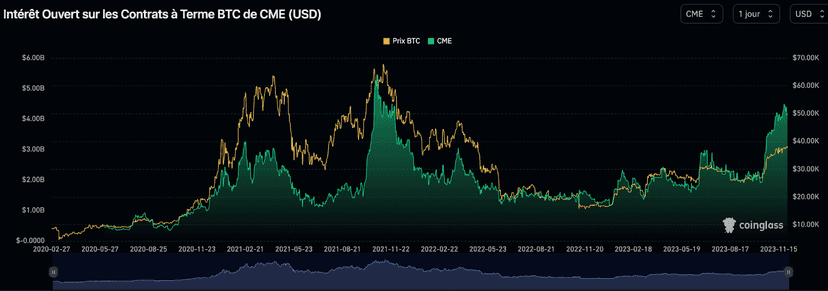
CME Open Interest
Let’s dive into some trading jargon: open interest, or OI for short. It’s essentially the total number of contracts outstanding. When this figure runs high on CME Group futures, it can signal that institutional players are lurking nearby.
It’s a bit like the market’s sharks making waves.
CME Trading Volume
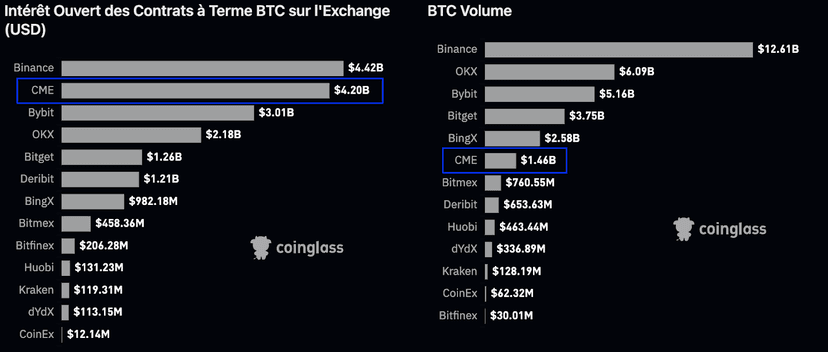
Trading volume on both futures and the spot market is another important parameter. High volume can indicate strong investor participation, underscoring the significance of the divergence you’re seeing.
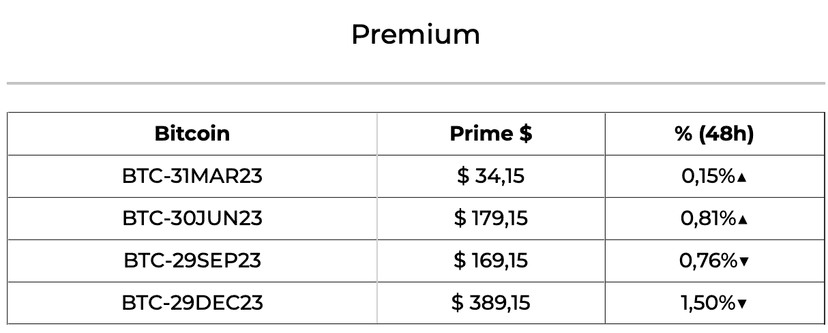
Chicago Mercantile Exchange: Premium
The price differences (the premium) between the futures and spot markets are telling.
If futures trade at a higher price than the spot price — “contango” — it can signal a positive market outlook.
Conversely, a “backwardation” situation can indicate downside concerns.
By the way, I created la Vigie du Cap,
La Vigie is THE daily info sheet I personally created for the community.
On top of a daily dose of concentrated info, I keep you posted on things like the premiums on BTC and ETH options.
Bitcoin on CME Group vs. Spot Bitcoin
Traders’ Future Expectations
It’s essential to understand that futures contracts are influenced by the SPOT price of Bitcoin and by traders’ future expectations.
If the market anticipates a rise in Bitcoin, futures tend to trade higher than the spot price, creating a contango situation — and vice versa, in which case we talk about backwardation.
A significant gap between spot and futures prices can reveal market expectations, liquidity, carrying costs and the risks investors perceive.
It’s a valuable indicator for anyone looking to gauge the overall health of the Bitcoin market.
The Current Trend: Coinglass Data
Data from Coinglass, which you can check live, shows sustained investor interest in Bitcoin futures on the CME Group exchange.
This observation highlights the importance of ongoing market analysis, with particular emphasis on the divergences between futures and spot prices.
Here’s also a ranking of the exchanges with the highest open interest. You can see that the battle is raging between Binance and CME Group.
Conclusion: How to Put All This Into Practice
In short, exploring the world of Bitcoin on CME Group — especially by scrutinizing the differences between futures and spot prices — gives investors a real edge. By staying attentive to futures fluctuations and understanding key elements like open interest (OI), volume and price gaps, you can anticipate trends more clearly and spot opportunities.
Stay alert and ready to adapt as you interpret Bitcoin’s dynamics. By using this analysis to define your bias, you can seize setups, minimize risk and stay ahead of the crypto market. Ultimately, the key lies in a complete understanding of the market. Interpreting the signals given by CME Group wisely should be part of your decision-making process.
Every guide here is free. Browse the full course and join a community of traders who share ideas every day.