Here are 3 basic examples of using a limit order!
Keep in mind that no single approach fits every market. That said, you’ll often notice traders with a similar style placing similar levels (SL / SR / etc.).
From there, the “triggers” — of which limit orders are one — can make the difference between a trader who turns a profit and one who loses money.
Always remember that technical analysis isn’t trading … at least not yet!
On top of that, there’s no point in following a market if you can’t make money from your own analysis. You’ll agree it’s pretty time-consuming. And if you do nothing with it, what’s the point?!
What Is a Limit Order?
There are several types of orders you can place on the stock market or on crypto markets: the Market Order or order at market price, the Limit Order or order at a limited price, and so on. So today we’re going to focus on limit orders.
A limit order is a precise instruction issued by a trader to buy or sell an asset at a specified execution price or better.
Unlike a market order, which executes immediately at the best available price, a limit order gives you a degree of control by setting a maximum price to buy or a minimum price to sell.
This lets the investor target specific entry or exit points, while leaving open the possibility that the order won’t be executed if market conditions aren’t favorable at the predefined price.
Selling with a Limit Order = selling at the exact price or above
Buying with a Limit Order = buying at the exact price or below
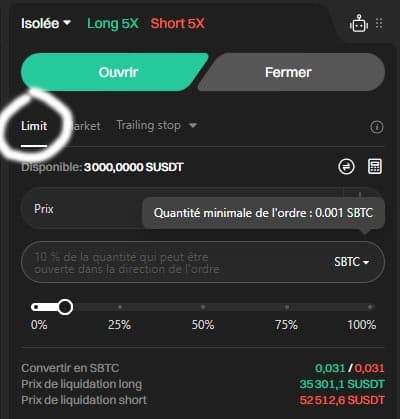
Advantages of the Limit Order
- Low costs
- Your maximum buy price or minimum sell price is fully under control.
Limit orders: the drawbacks
- Your orders don’t always get filled …
- The price may never reach the limit you set.
- Even if the price reaches the limit you set, your orders sometimes won’t fill in full if there aren’t enough buyers/sellers on the other side. So it’s common to see orders filled only partially. That’s exactly why Stop Losses must ALWAYS be placed as Market Orders …
To place that whole set — limit order, stop, take profit — in a single motion on MT4/MT5, the Trade Assistant panel drops all three levels on the chart and works out the position size along the way.
Use Case #1: The Pullback
This is a buy limit order placed immediately after a presumed breakout level, or a sell limit order placed following a breakdown.
Here, I’d suggest you review the theory on Support and Resistance.
Context: It consists of loading up after a very short-term retest of a resistance that has flipped into support, in the hope of a trend continuation.
It’s really the “break-and-retest” strategy I talk about so often when we’re in an uptrend.
Don’t forget: the retest has to happen very quickly after the price crosses the level.
Advantages
Practicing this strategy lets you anticipate the snowball effect that can follow the breakout of a major level.
Drawbacks
- Lower probability of success than a rounded retest (risk of a fakeout)
- It very often requires paying close attention to smaller timeframes.
- And finally, if the order isn’t executed, you risk missing your opportunities
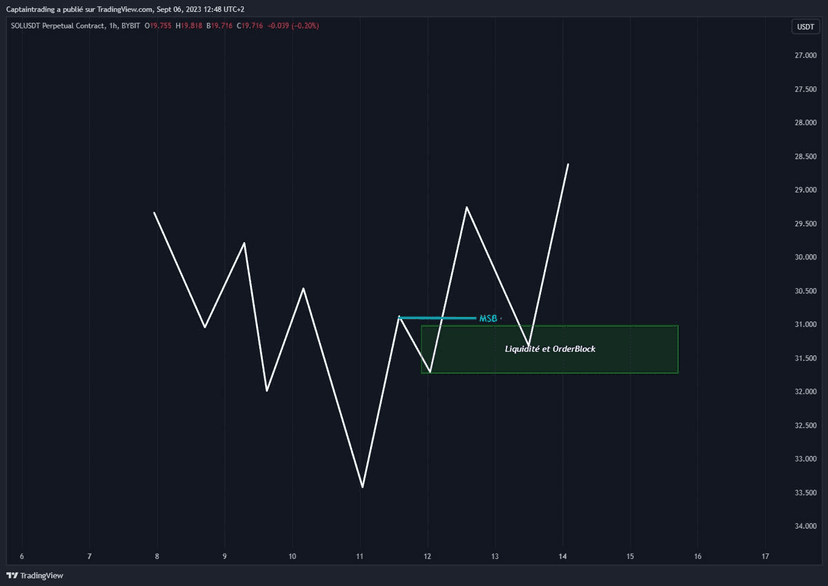
Use Case #2: The “Rounded” Retest
This is a buy limit order on a structure after an upside break. In a downtrend, it means placing a sell limit order on a structure after a downside break.
Context: The break-and-retest strategy, except that time passes between the break and the new test — hence the rounded test.
Advantages
- Better odds of success than the Pull Back entry
- There’s no need to focus on the small timeframes. So it’s easier to concentrate on the higher timeframes.
- Less time spent watching the charts, and therefore more time to act!
Drawbacks
- Trades can take a while to set up: PATIENCE!
- This strategy puts blinders on you a little, so you may end up detaching too much from the bigger picture!
- It’s easier to “forget” the level
Use Case #3: “Buy the Dips”
This means placing buy limit orders below prior lows in bullish conditions, or placing sell limit orders above prior highs in bearish conditions.
Context:
Buying the dips in bullish conditions = buying where inexperienced traders have their sell stop orders (below prior lows).
Selling the bounces in bearish conditions = selling where inexperienced traders have their buy stop orders (above prior highs).
Advantages
The risk of drawdown and/or failure is relatively low
Drawbacks
- Placing your stops isn’t always obvious
- Risk of slippage if there’s a violent breakout instead of a stop being triggered.
- Runs to the upside and downside can go much deeper than expected
- It’s not always intuitive to pick which highs/lows will be triggered when stops have piled up, for example, along the trend.
Limit Order: the Basics!
Getting into the habit of using limit orders will teach you the constraints they impose. Once you’ve mastered them, they’ll let you make substantial savings and therefore boost the profitability of your trades.
Of course, market orders can also be an excellent solution, especially when it comes to placing a Stop Loss.
That said, in most cases, if you don’t use limit orders, you’re sabotaging your own work!
This free course is meant to keep growing, so stay tuned! In the meantime, feel free to check out the rest of my free trading course.
Every guide here is free. Browse the full course and join a community of traders who share ideas every day.