In this investing and crypto course, we’re going to talk about DCA: Dollar-Cost Averaging. In French, this translates to achat périodique par sommes fixes. It’s a method that’s especially popular in the crypto space, because it helps you rein in volatility!
Along the way, we’ll see how a solid strategy can maximize your returns on investment. Ideally, you want to buy low and sell high. So what do you do when asset prices are changing all the time and you have no desire to become a pro trader?
First, let’s be clear. There’s no secret technique for consistently buying at low prices without dedicating yourself every day to the in-depth study of price action.
For those who don’t have the time to devote to learning to trade but still want to invest for the long term, I can tell you that all is not lost. There is indeed a buying technique that can help you smooth out your costs: DCA. For highly volatile investments, this technique can significantly reduce your average cost over time.
There are several types of DCA: notably simple DCA, Enhanced DCA (EDCA) and Smart DCA (SDCA). In this review, we’ll treat DCA and simple DCA as meaning the same thing and refer to both as DCA, but be careful not to confuse simple DCA with Smart DCA (SDCA). At the end of this guide, I’ll walk you through a detailed tutorial to introduce you to the DCA system on Bybit, which I recommend more or less by default. As a reminder, keeping your crypto anywhere else is still a bad idea! And DCA doesn’t necessarily mean staking, either…
If you want to know my take on DCA crypto from 2 or 3 years ago, you can also check out the very first piece I ever wrote on the internet!
DCA Definition: The Simple Method
DCA, or simple DCA, is a technique that involves investing the same amount of money in a security at regular intervals over a certain period of time, regardless of price. The term was coined by Benjamin Graham in his book “The Intelligent Investor.” Graham writes that DCA simply means the trader invests the same number of dollars in common stocks every month or every quarter. This way, they buy more shares when the market is low than when it is high, and they are likely to end up with a satisfactory overall price for all of their holdings.
There are two parameters for the investor to set: the fixed amount that will be invested, and the interval between each investment. One study found that the safest interval, in terms of balancing return on investment against risk, was 6 or 12 months.
DCA Crypto: The Advantages
In my view, DCA is more useful for investors than for traders. For those who don’t have the time to get involved in trading, it lets you:
- Build savings into your ongoing budget by investing them through an automated strategy. This technique forces you to save, because it removes the temptation to spend the money set aside for savings. It keeps money from slipping through your fingers.
- Help lower your average investment cost : this is a very important benefit of DCA, because it helps set you on the path to “buying low.” In the next section, I’ll walk through the mechanics of how it works
- Align with a passive investment strategy: passive investments are an integral part of any diversified portfolio. They should, in fact, be an investor’s default preference. Using DCA is an ideal way to build the passive-investment portion of your portfolio
- Reduce the time and effort needed to research investments and set buying targets. Most people don’t have the time or the patience to actively carry out research and analysis. Without doing that work, it’s very hard to determine buying targets for your investments. With DCA, you don’t spend your time working out a buying target. Once you’ve decided which passive investments you want in your portfolio, DCA is a simple “set and forget” strategy for quietly growing the value of your portfolio. Over time, DCA produces a smoothed average cost that proves more profitable than an impulsive purchase made without any prior analysis.
- Reduce the negative effects of investor psychology and market timing on a portfolio. By committing to a DCA approach, investors avoid the risk of making counterproductive decisions out of greed or fear, such as buying more when prices rise or panic-selling when prices fall. Instead, dollar-cost averaging forces investors to focus on contributing a fixed amount each period while ignoring the target security’s market price.
Understanding Average-Cost Reduction Through an Example
One of the main advantages of DCA is that it lets you smooth out the costs of an investment. For volatile investments like crypto, with frequent sharp swings up and down, DCA on crypto can therefore help lower your average cost as you build your position.
Over time, thanks to the magic of mathematics, the weighted average cost of your investments falls closer to the lower end of the prices paid than to the average. This seems counterintuitive, so let me give you a concrete example:
Norbert is going to invest $500.00 in the stock market, in the S&P 500 index.
With DCA over 10 installments, Norbert spent $500 in total across the 10 installment periods and bought 47.71 shares. He paid an average price of $10.48 ($500/47.71). Norbert bought different quantities of shares as the value of the index fund rose and fell with market fluctuations.
| Installment | Cost of the S&P 500 Index | Shares Bought | Contribution | Shares Held | Total Value |
|---|---|---|---|---|---|
| installment 1 | $10.00 | 5.00 | $50.00 | 5.00 | $50.00 |
| installment 2 | $10.50 | 4.76 | $50.00 | 9.76 | $102.50 |
| installment 3 | $10.75 | 4.65 | $50.00 | 14.41 | $154.94 |
| installment 4 | $11.00 | 4.55 | $50.00 | 18.96 | $208.54 |
| installment 5 | $10.25 | 4.88 | $50.00 | 23.84 | $244.32 |
| installment 6 | $9.95 | 5.03 | $50.00 | 28.86 | $287.17 |
| installment 7 | $10.15 | 4.93 | $50.00 | 33.79 | $342.95 |
| installment 8 | $10.35 | 4.83 | $50.00 | 38.62 | $399.70 |
| installment 9 | $10.75 | 4.65 | $50.00 | 43.27 | $465.15 |
| installment 10 | $11.25 | 4.44 | $50.00 | 47.71 | $536.79 |
| DCA | Total | Total | Investment | Capital Gain | |
| Average Price | $10.48 | 47.71 | $500.00 | $536.79 | $36.79 |
Without DCA : Suppose that, instead of using DCA, Norbert had spent his $500 all at once during installment 4. He would have paid $11 per share. That would have resulted in a purchase of 45.45 shares ($500/$11).
There was no way for Joe to know the best moment to buy. By using DCA, however, he was able to take advantage of several price dips even though the share price rose above $11. He ended up with more shares (47.71) at a lower average price ($10.48).
DCA Crypto: Contribution and Investment Frequency
This can depend on your time horizon, your outlook on the market, and your investing experience.
In the medium term (between 1 and 3 years), if you expect a bullish (rising) market, it can make sense to invest the same amount every week. If you’re dealing with a bearish (falling) market, it’s often best to avoid it. But if you’re thinking of using it for a long-term investment (10, 20, or 30 years) and you’re wondering which buying interval makes the most sense, devoting a share of your monthly income to regular purchases of one or more stocks may well be the best choice.
Advanced DCA: Enhanced DCA and Smart DCA
The enhanced variable-contribution averaging method (Enhanced DCA) is an investment strategy that involves investing a variable amount of money based on a stock’s price at regular intervals over a given period. The goal of this strategy is to improve on the return of simple DCA. E-DCA is therefore a variant of this strategy that aims to maximize returns by taking advantage of market fluctuations.
With an E-DCA strategy, you don’t invest the same amounts of money. That said, the investment interval stays the same. So you invest more when the market is falling, and vice versa. You invest less when the market is rising. This means you buy more shares when the price is relatively low, and fewer shares when the price is relatively high.
Enhanced DCA: Example
For example, suppose you have a budget of $1,000 to invest each month over the coming year. With traditional DCA, you would invest $1,000 every month, regardless of market conditions. With E-DCA, on the other hand, you would invest more than $1,000 when the market is falling and less than $1,000 when it is rising.
E-DCA in practice:
- In month 1, the market is falling, so you invest $1,200.
- In month 2, the market is rising, so you invest $800.
- In the third month, the market is falling, so you invest $1,200.
- In the fourth month, the market is rising, so you invest $800.
And so on…
Over time, this strategy can help you buy more shares or crypto when the price is low and fewer shares when the price is high, which can translate into higher overall returns than simple DCA.
Smart DCA: Even Better Than EDCA?
The main difference between Smart Dollar-Cost Averaging (Smart DCA) and Enhanced Dollar-Cost Averaging (EDCA) is the method used to determine the investment amount at each interval.
Smart DCA uses an algorithm or automated system to determine the best time to invest the money based on market trends, historical data, and technical analysis. The algorithm can adjust the investment amount according to market conditions, but the investor has no direct control over the investment amount. The goal of Smart DCA is to maximize returns while minimizing risk, by taking advantage of market fluctuations and making investment decisions based on data analysis.
E-DCA, on the other hand, lets the investor adjust their investment amount based on their own analysis of current market conditions, instead of relying on an algorithm or automated system. The investor can use technical analysis, fundamental analysis, or other market indicators to determine the best investment amount at each interval. The goal of E-DCA is also to maximize returns while minimizing risk, but it requires more analysis and research than Smart DCA.
Conclusion
Overall, Smart DCA relies on an algorithm or automated system to make investment decisions, whereas EDCA lets the investor adjust their investment amount based on their own analysis of market conditions. Smart DCA may be better suited to investors who prefer a hands-off approach. EDCA, for its part, may be better suited to investors who want more control over their investment decisions through the use of a bot.
DCA Crypto Investor Profiles
DCA is perfect in the crypto space if you fit one of the following profiles:
1) Long-Term Holder
You want to build a long-term cryptocurrency portfolio and you have an investment horizon of several years. DCA lets you gradually build your position up to your desired level of exposure while avoiding the risk of overextending yourself.
2) Investor With a Low Risk Tolerance
You prefer to invest in low-volatility assets. While it’s true that cryptocurrency prices tend to swing sharply, that doesn’t mean investors with a low risk tolerance should stay away from crypto markets. If you’re someone who is optimistic about the future of crypto, you can systematically buy using the DCA strategy. Ultimately, this minimizes the risks tied to market timing and makes the idea of investing in cryptocurrencies less intimidating for investors with a low risk tolerance.
3) Beginners
You’re a newcomer to the cryptocurrency market and you’re looking for ways to invest. For newcomers, investing can certainly feel intimidating, because the question of what to invest in and how to invest comes up again and again. Fortunately, DCA gives beginner investors the perfect opportunity to enter the market, because it makes them less sensitive to certain aspects such as technical analysis. It lets you dive straight into investing by allocating part of your funds to buying securities without trying to time the market.
Do you recognize yourself in one or another of these profiles, and are you curious to learn more about DCA? Read on to discover how the DCA trading bots we offer can be tailored to your personal investment goals.
How to Do DCA in Crypto
Many online stock exchanges or crypto platforms offer a DCA feature: Etoro, Binance, Bybit…
Let’s take a closer look at what Bybit offers, because it’s the platform I recommend for futures trading and the only one, among those I use for my own trading, that provides it. So if you have a provider that seems more “secure” to you’though Bybit looks to me like it holds up in times of crisis’feel free to look into others!
Even though investors should regularly set aside a sum of money for investing, variables such as neglect and fear often come into play. For example, you might forget to execute your planned purchase amid the bustle of everyday tasks, or be afraid to buy your crypto because of a possible catalyst.
The Benefits of a Bot, Using Bybit as an Example
- No fees, which lets you earn more over the long term.
- Settings that can be tailored to your investment preferences
- A minimal amount of money: 1 dollar is enough to get started.
Once you’ve configured your Bybit trading bots: amount, distribution, and frequency. The bots then start running a DCA on a portfolio of up to five different coins or tokens. You’ll no longer have to worry about irregular purchases, because the bots will keep buying according to the criteria you’ve set.
Setting Up an Automated DCA on Bybit
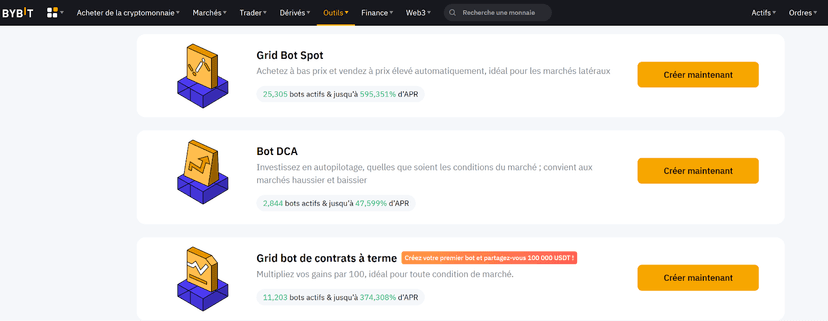
Creating a DCA trading bot on Bybit is a simple process. Are you eager to get started? If so, here’s how to create your own DCA trading bot on your PC:
1. Fill Out the Form
To begin, you need to fund your bot. Start by choosing between USDT and USDC. Keep in mind that you won’t be able to build a portfolio of stablecoin pairs, so make sure the trading pairs you want are available.
2. Select the Crypto(s) to Invest In
Now it’s time to build your DCA portfolio. You can choose up to 5 cryptos, ranging from BTC to ETH, for the DCA. Once you’ve made your decision, provide the amount of stablecoins you’ll use with each DCA buy order.
3. Choose the Frequency of Your Investments
Next, you need to decide how often your DCA trading bot buys. To avoid the instability that usually comes with timing your purchases, there is a range of timeframes available, from ten minutes to four weeks.
4. Set a Maximum Investment Amount
Investors looking for a safer approach can cap the total amount they allocate to their DCA portfolio by taking advantage of this optional setting.
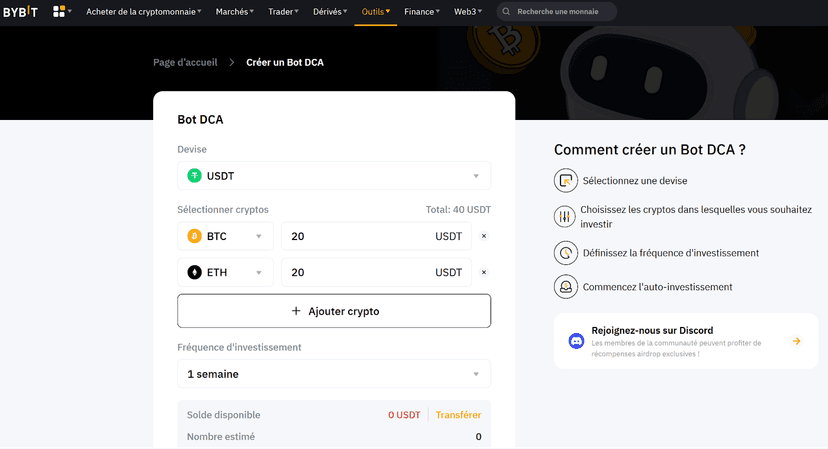
Once you’ve checked the settings, select Create Now and Confirm to complete the process of building your DCA bot.
Adjusting Your DCA Bot’s Settings
If you’d like to make a few adjustments in light of recent fluctuations, try the following tips:
1. Find Where Your Trading Bot’s Dashboard Is Located
To change the DCA bot’s settings, you can go to the Bybit trading bot page and select the “View My Bots” option in the top right. Once you’ve done that, click the “Details” button in the top-right corner of the DCA bot you want.
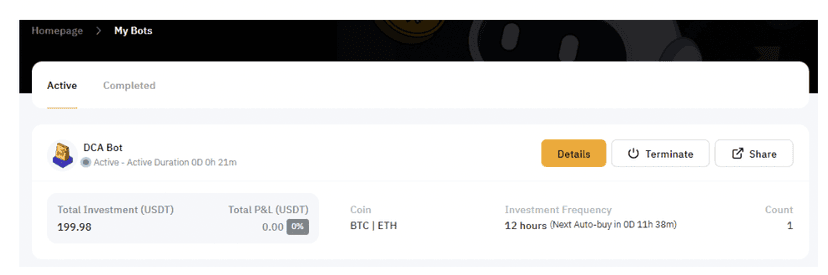
2. Choose Settings and Tap Edit
The following settings can be changed here:
- The frequency of investments
- The amount invested
- The maximum amount that can be invested in a mutual fund is optional.
Dollar-Cost Averaging on Crypto: My Take and Conclusion
The simple DCA, E-DCA, and S-DCA are closely related techniques. They involve making a recurring purchase of a given security on fixed dates and in fixed amounts (or variable amounts based on market analysis). They let you smooth out market fluctuations and free your mind by setting up an automatic periodic purchase.
These techniques let investors strike a compromise between the regret of not making the most of a rising market and the regret of investing in a falling one. DCA helps investors enter the market by establishing a routine based on time and/or market fluctuations. It also removes emotion from investing by spreading the purchase out over time. These strategies are aimed more at investors than at traders. Still, even for a crypto trader, it’s important to diversify your portfolio over the long term. DCA lets the trader save time on their investments, too… Besides real-estate investment, buying crypto or stocks through DCA, EDCA, or SDCA can be a good way to do it. Finally, many platforms offer a DCA feature that’s relatively simple to set up.
If you don’t have the time to analyze the market for trading, or if you don’t yet have enough confidence to jump straight into trading, you still have at least two options:
1. Learn to trade for free using a demo account and all the online courses I make available to you free of charge
2. And, of course, put Dollar-Cost Averaging into practice’it now holds no more secrets for you.
Every guide here is free. Browse the full course and join a community of traders who share ideas every day.