Day Trading is a trading style that is thrilling and turbulent. If you become an expert at it, you can make significant gains over short periods. Of course, the opposite is just as possible if you take reckless risks. As a day trader, you need to be well prepared, with solid theoretical foundations and practical skills. The goal of this methodical guide, or course, is to help you go from beginner to day trader. In this free trading course, we’ll cover topics such as the technical basics, the regulations and the strategies specific to Day Trading.
In the following sections, you’ll discover genuinely useful tips and tricks for trading intraday. Among other things, we’ll look at the most common mistakes to avoid.
Ready to become a true Day Trader?!
What Is Day Trading?
Before diving into Day Trading, it’s essential to understand the basics.
Day Trading is a short-term style of trading that involves buying and selling financial instruments or assets within a single trading day. The main goal is to generate profits from the price fluctuations that occur throughout the day.
In Day Trading, traders generally focus on assets or other financial instruments that are specifically liquid. This aspect is essential, because it offers more opportunities to execute fast, profitable trades.
Getting Off on the Right Foot …
Among the most popular financial instruments for Day Trading are assets, options and currencies ( Forex ), not forgetting crypto trading, of course.
To become a high-performing Day Trader, you need to develop your skills in technical analysis, risk management and trading psychology, as well as in scalping or swing trading.
Technical analysis consists of studying historical data on price movements, the price action in order to anticipate potentially profitable moves.
Risk management consists of controlling potential losses by setting appropriate stop-loss levels and position sizes.
The psychology of the Day Trader, for its part, deals with the emotional aspects of trading, such as discipline, patience and decision-making.
Day Trading Regulation
As a Day Trader, it’s essential to know the regulations that govern your activity; so I encourage you to look into them more closely, because what follows is only a non-exhaustive introduction. What’s more, as a trader based in Spain, I’m not familiar with the practice of trading in French-speaking countries.
In the US, when we talk about day trading, the most common status is that of the “pattern day trader” (PDT). It was introduced by the Financial Industry Regulatory Authority (FINRA).
The PDT rule states that if you execute four or more day trades within five business days, you’re considered a “pattern day trader”. To maintain this status, you must keep a minimum balance of 25,000 dollars in your account.
In the US there are multiple regulations, such as the “wash-sale” rule, which prevents traders from claiming a tax deduction for a security sold at a loss and repurchased within 30 days.
In Europe, there’s no regulation equivalent to the “Pattern Day Trader”. However, that doesn’t mean there are no rules and regulations for European traders.
In fact, our regulators — such as the Autorité des marchés financiers (AMF) in France, the Financial Conduct Authority (FCA) in the United Kingdom and the Autoriteit Financiële Markten (AFM) in the Netherlands — impose regulations to protect investors and ensure the transparency of financial markets in Europe.
Regulation in French-Speaking Countries
In Belgium, day trading is considered a commercial activity and is therefore subject to the rules of the Companies Code. Belgian day traders must also comply with the rules of the Financial Services and Markets Authority (FSMA), which regulate investment services.
For more information on Belgian regulations regarding trading and day trading, I invite you to refer directly to the FSMA website.
In Quebec, day traders are subject to the same rules and laws as all stock traders. Trading activities are governed by the Autorité des marchés financiers (AMF) and the Toronto Stock Exchange (TSX). Day traders must therefore comply with the rules and obligations regarding transparency, disclosure of interests and the prevention of market manipulation. It’s also important to note that there are specific regulations for online brokers offering trading services to Quebec residents, who are regulated by the AMF.
For more information on Quebec regulations regarding trading and day trading, I invite you to refer directly to the AMF website
In France, the legal framework for day traders is regulated by the institution of the same name: the Autorité des Marchés Financiers (AMF). Day traders are considered active investors who buy and sell financial assets (stocks, options, derivatives, etc.) within a single day.
To carry out this activity, day traders residing in France must comply with several rules, notably:
- Registering as a professional with the AMF if their activity is regular or if their earnings are high
- Using a regulated trading platform
- Following risk management rules (limiting losses, diversifying investments, etc.)
- Knowing the market rules (trading hours, order types, etc.)
In order to move forward with peace of mind in any entrepreneurial activity, including trading, it’s essential to become familiar with its regulations. The goal is to make sure you’re operating within a legal framework: with no risk of long-term legal action, either from financial institutions or from the tax authorities.
5 Day Trading Strategies to Get Started
As a beginner day trader, it’s essential to start with simple, effective trading strategies that can help you build your skills and confidence through practice. As a reminder, when you’re a beginner, betting money you’ll lose just to learn how to place an order is pointless; for that, you can perfectly well use a testnet.
Here are a few day trading strategies that are popular with beginners, plus others that I recommend when you’re starting out!
Momentum Trading
This strategy involves identifying assets or other financial instruments that are experiencing strong price swings and trading in the direction of the trend.
To set up a Momentum-style strategy, you can use technical indicators, such as moving averages and the relative strength index (RSI), to identify momentum opportunities. Here we get very close to price action, of which I’m very fond.
My Momentum Trading Course on YouTube

Breakout Trading?!
Trading a breakout involves anticipating the break through significant support or resistance levels. Our profits are made after that break.
Some people use trading patterns, such as triangles and flags, to spot potential breakouts and enter positions. It’s already not great in swing trading… so in day trading, forget it!
Personally, I avoid trading breakouts. I almost always wait for the trend to confirm. I need a bullish or bearish market structure to take shape after a key zone is broken. Waiting for a key level to break very often amounts to wasting time and, above all, missing opportunities, because they’re relatively rare; the Bull Run only comes around once every 4 or 5 years.
Exploiting Pullbacks and Retests
In my opinion, when it comes to breakouts, this strategy is far more profitable and offers much better odds of success. It’s simple and effective when you have a strong trend.
The pullback & retest consists of taking advantage of a pullback or correction to enter, in the hope of riding the initial move. In my pullback strategy, I like to use market dynamics or structure to find entry points. But I have to say that Fibonacci already works very well for finding optimal entry zones.
To succeed with your pullback trades, my little ultra-effective tip is to predefine the zones that interest you ( because they’re predictable and highly reactive ) so that you’re ready to spring into action when opportunities arise.
Example of a Pullback & Retest in Day Trading

Fakeouts
Being far more frequent than breakouts, I also recommend keeping an eye on them, because reclaims are at least as frequent as genuine breakouts! A nice fakeout lets institutional players take breakout traders for a ride. Don’t get caught out …
Scalping
You could consider scalping a specific Day trading strategy.
Personally, I consider it a strategy and a trading style in its own right. The timeframes used are just much shorter (1 min to 1 hour, generally). Sure, you can scalp within a single day, since it’s about capitalizing on small price movements by entering and exiting several trades throughout the day.
Nevertheless, this strategy, or trading style, demands far more discipline, which in my view makes it a very specific strategy. It’s not at all suited to beginners. In fact, when you scalp, it’s necessary to be ultra-reactive and present in front of your screens at all times. The point is to place your orders in real time: closing your positions quickly to avoid heavy losses. Very high leverage is required in scalping, which is why you have to be especially reactive. Here again, I’ve made several resources on the subject available to you on my site and on YouTube.
Day Trading: 3 Advanced-Level Strategies
Once you’ve mastered the basics and gained a bit of experience, you can start exploring more advanced Day Trading strategies to broaden your opportunities to enter positions.
Gap Trading
Gaps occur when a financial instrument opens at a level significantly higher or lower than its previous closing price. We also call these “imbalances”.
The market tends to fill gaps and thereby restore a certain balance between supply and demand. A day trader can exploit this recurring price behavior by taking positions right at the market open and holding them until the gaps are filled.
Trading Plan for a GAP Caused by the C.M.E

News Trading
This involves taking advantage of the market volatility caused by the economic calendar, announcements and financial events: the release of economic data or a company’s annual results announcement, for example. Traders need to be able to react quickly to these events and execute trades before the market has fully absorbed the news.
Range Trading
This strategy involves identifying a channel, going long at its support and going short at its resistance. A good command of price action and my favorite technical indicators is more than enough to perform well within a range.
How to Get Started in Day Trading
If you want to get started in Day Trading right now with a step-by-step method, here it is:
1. Educate yourself: Start by learning the basics of Day Trading, including trading strategies, risk management and trading psychology. Read books, watch online tutorials and join trader communities to deepen your knowledge.
2. Choose your trading platform: Research and select a reliable trading platform that offers the tools, resources and support you need to succeed as a day trader. In my opinion, the best trading platforms are Bybit and OKX for futures, and Delta Exchange for options.
3. Develop a strategy and your first trading plans: Create a complete trading plan that outlines your trading goals, your strategies, your risk management rules and your daily routine. Every day, I draw up my trading plan first thing in the morning, and I encourage my students to do the same.
4. Practice ! Before risking real money, practice your trading skills with a demo account to gain experience and build confidence. I’ve written a whole article on the subject. Whatever your trading style (Scalping, Intraday Trading or Swing), it’s essential to start on a demo account or a testnet. I’ve also recently written a whole article explaining the steps to follow to practice risk-free: Trade for Free! Even just learning to place every order type cleanly will save you plenty of blunders!
5. Fund a small trading account: Once you feel comfortable with your trading abilities, fund your account with the minimum required balance and start day trading. Always start with small amounts and, at first, don’t risk more than 1% of your available capital on any single trade.
6. Track your progress and your rules, but adapt: Keep an eye on your performance with your trading journal! This will let you learn from your mistakes and refine your strategies. To assess how you’re evolving as a trader, there’s nothing better than setting up a trading journal in which you methodically write down every trade you’ve taken. Here again, I’ve made a tutorial available to help you set up this journal.
Day Trading: Pros and Cons
Like any investment activity, Day Trading has advantages and disadvantages:
The Advantages
- High potential return on investment
- Flexible hours and the ability to work from home
- An exciting, dynamic environment
- Many trading opportunities throughout the day
The Disadvantages
- High risk of financial losses if you don’t fully master risk management techniques.
- Requires a significant commitment and dedication in terms of time: day trading requires spending long hours in front of your screens.
- Can be mentally and emotionally demanding: personally, the shorter the timeframes, the better I manage my stress.
- Possible account restrictions due to trading regulations: more and more restrictions are being put in place all over the world, particularly in the US and Europe. Just recently, Spain banned options trading and Bybit had to comply.
Ultimately, the decision to practice Day Trading depends on your personal goals, your risk tolerance and your willingness to learn and refine your skills.
Day Trading: Courses and Resources
There are many day trading courses and resources to help you learn and improve your skills. Among the most popular options:
- Online courses: Websites such as Udemy, Coursera and Investopedia offer comprehensive Day Trading courses that cover everything from the basics to advanced strategies.
- Books: Among the most popular day trading books are “A Beginner’s Guide to Day Trading Online” by Toni Turner and “Day Trading for Dummies” by Ann C. Logue. Unfortunately, they haven’t been translated into French yet.
Here are a few titles published in French:
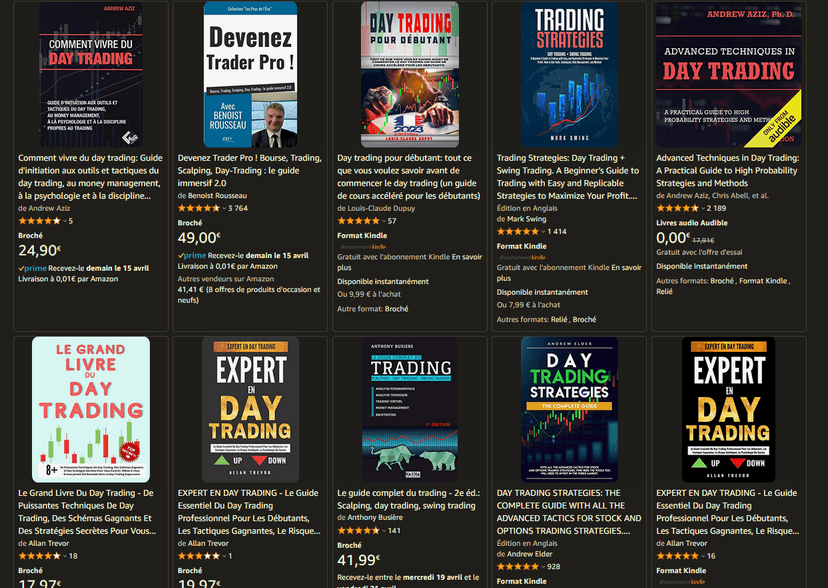
- Trading communities: By joining online trading communities and forums, you can benefit from valuable information, advice and support from your fellow traders.
- Mentoring: If you can find an experienced day trader willing to act as your mentor, it can be an invaluable resource for learning and refining your skills.
Common Mistakes: Avoid Them!
To increase your chances of success in Day Trading, self-control is crucial. It’s therefore essential to cultivate your mindset . The following flaws must be banished:
1. Lack of discipline: Day Trading demands discipline and a well-planned trading strategy. Failing to follow your trading plan or making impulsive decisions can lead to significant losses.
2. Overtrading: Overtrading occurs when you execute too many trades over a short period, which leads to increased transaction costs and potential losses.
3. Ignoring risk management: Risk management is a crucial aspect of Day Trading. Failing to set appropriate stop-loss levels or position sizes can lead to significant losses.
Assess and commit the amount of capital you’re willing to risk on each trade. Many successful day traders risk less than 1% to 2% of their account per trade. If you have a $20,000 trading account and you’re willing to risk 0.5% of your capital on each trade, your maximum loss per trade is $100 (0.5% x $20,000). Even if your position is larger thanks to leverage, the point is to calculate your stop-loss so that you can’t lose more than €100.
4. Impulsively trying to make back losses (revenge trading): Trying to recover losses by placing bigger trades or taking unnecessary risks can lead to further losses, or even the rapid draining of your account.
5. Lack of patience: Day Trading demands patience and discipline. Trying to force trades or enter positions on the spur of emotion can lead to poor decision-making and losses.
The psychological side is therefore very important in Day Trading, because it can have a significant impact on a trader’s performance. Emotions such as fear, greed, excitement and anxiety can influence a trader’s decision-making, which can lead to errors of judgment and financial losses.
Traders must be aware of their emotions and able to manage them effectively to avoid falling into behavioral traps such as FOMO (Fear Of Missing Out) or revenge trading (trading to get back at earlier losses).
Conclusion: Becoming a Successful Day Trader
Becoming a successful Day Trader takes commitment, discipline and a solid understanding of trading principles. By following the tips and strategies laid out in this guide, you can take your trading skills from beginner level to that of a professional day trader.
Remember to always keep educating yourself, to build a complete trading plan and to put your skills into practice before risking real money. In addition, avoid common mistakes, stay up to date with regulations and market trends, and continually refine your strategies to reach your trading goals.
With the right mindset and the right approach, Day Trading can be an exciting and rewarding career that offers significant opportunities for financial success.
Day Trading: Which Platform Should You Use?!
Personally, I day trade on all 3 of the platforms I use, because even Delta Exchange lends itself to it with its very short-term options. When it comes to futures, I favor Bybit for its futures contracts and liquidity, but it’s perfectly possible to do high-performing day trading on OKX.
Whatever trading style you end up choosing based on your personality (Scalping, Intraday Trading, Swing Trading, …), you first need to become familiar with a trading platform. It will need to give you the opportunity to trade on a testnet or a demo account. That being the case, I especially recommend Bybit if you want to make day trading your specialty.
Every guide here is free. Browse the full course and join a community of traders who share ideas every day.