Choosing a trading style that fits you is a decisive factor when you are starting out. As of today, three styles dominate: Scalping, Day Trading and Swing Trading. The latter, if it suits you and if you are a hard worker, is just as likely as the other two to lead you toward success and profit !
Swing Trading: Definition
Swing trading is a trading technique used to buy and sell stocks when the indicators point to a potential trend to the upside (positive) or the downside (negative), over a period that can range from a single day to a few weeks. Swing trading aims to profit from buying and selling intermediate troughs and peaks within a broader overall trend. Swing trading is also defined as trading whose time horizon is relatively wide compared with other styles such as scalping and day trading.
How to Swing Trade?
Swing trading lets us take advantage of the upward and downward “swings” in the price of a security. The idea is to capture the small moves within a broader overall trend. Swing traders aim to rack up many small gains that add up alongside larger ones.
For example, long-term traders might wait five months to book a 25% profit, whereas swing traders can capture 5% gains each week and thereby outpace the long-term trader’s returns.
As swing traders, we use charts daily (charts with a 60-minute, 24-hour, 48-hour timeframe, etc.) to pick the best entry or exit point. That said, some traders may use shorter-term charts, such as 4-hour or hourly charts.
Swing Trading vs Day Trading
Swing trading and day trading are alike in some respects. What sets the two techniques apart most is, above all, how long positions are held. While swing traders may hold stocks for a few days or even several weeks, day traders work with shorter timeframes, which can range from a few minutes to several hours, and make sure their trades always close before the market close.
As a day trader, we generally do not hold our positions overnight. This lets us avoid exposing our positions to the risks stemming from news announcements (FOMO). However, our more frequent trades incur higher transaction costs, which can significantly eat into our profits. To offset this, we use leverage to maximize our profits from small price moves.
As a swing trader, we are exposed to the unpredictability of risks that can arise overnight and trigger large price moves. As a swing trader, we have to check our positions periodically and take action when critical points are reached: a break through support, resistance, or trendlines…
Unlike day trading, swing trading does not require constant monitoring since trades last several days or weeks.
Understanding Swing Trading…
As a general rule, swing trading involves holding a long or short position for more than one trading session, but usually no longer than several weeks up to two months. This is a general timeframe, because some trades can last more than two months, yet the trader may still regard them as swing trades. Swing trades can also play out within a single trading session, though this is a rare outcome driven by extremely volatile conditions.
The goal of swing trading is to capture part of a potential price move. While some traders look for volatile assets with plenty of movement, others prefer quieter assets. Either way, swing trading is about identifying where an asset’s price is likely to head, taking a position, and then capturing part of the profit if that move materializes.
Successful swing traders only aim to capture part of the expected price move, and then move on to the next opportunity.
Swing Trading Strategies
Before choosing the best market, you first need to understand the different types of markets.
I. Choosing the Best Market for Swing Trading
1. The Different Types of Markets

2. Mass Markets
A mass market is a market where essentially everyone has the same need. For example, food, drinks, clothing, housing, and potentially mobile phones, and so on. It is an unsegmented market. For mass markets, you need the distribution capabilities and the network to match that scale. In general, you need a marketing budget large enough to support a mass-marketing strategy that relies on media such as television advertising. Some claim that mass markets no longer exist in the age of personalization and individualization. In reality, they still exist, but segmentation and targeting are becoming more popular thanks to the successes of companies that have managed to win market share this way. Likewise, companies that aim to be cost leaders or to offer the lowest prices for the highest value will generally target a mass market, because they need to achieve economies of scale with the masses to make that strategy viable.
3. Broad Markets
A broad market is a very large market that has a wide category of appeal but is not absolutely necessary for everyone. It can be segmented into lower levels. So, for example, within the mass beverage market, there is a vast market for beer. In this sense, a market can be called broad if it appeals to the majority of people. So, in a room of 100 people, 90 of them will drink beer. If you segment down one level, into dark or light beer for instance, you are now targeting a niche. Another example would be the mass clothing market: the men’s or women’s segment could be considered a broad market, since each represents roughly half the population. You could even say that children’s clothing constitutes a broad market, because all the children who need clothing represent a significant demographic within the narrow framing of adults versus children, even though they make up less than half the population. But as soon as you segment one level further, you start entering niche territory — for example, boys’ clothing.
4. Niche Markets
A niche market is a multi-segmented market that goes down three levels or more, as in the examples above. When you launch a business in a market where competition is fierce, gaining market share can be difficult and slow. As a result, many startups choose to target niches first, in order to capture one segment at a time. But there are a few things every entrepreneur or executive needs to know when deciding on their market strategy.
In this sense, we can consider that the cryptocurrency market is still a niche market. Even though it is gradually broadening, we are still far from mass adoption.
II. Market Trends
Financial markets generally exhibit three dominant long-term trends: the bear market, the bull market, or an in-between market (range). The swing trading strategy differs in each environment.
Swing Trading in a Bear Market
Swing trading in bear markets is one of the hardest for the usual buy-and-sell trades. In a downtrend environment, stock market prices fall over the long term. As a result, it is not worthwhile to buy a security and hold it hoping for price appreciation. There are several strategies to work around this problem:
- We can shorten our trading period. Instead of holding assets for weeks, you can prepare for a quicker reversal of the ones you hold.
- We can also hold on to our cash. Keeping part of your capital in cash in a bank account or in stablecoins can be the best choice in case the assets you hold suffer large price drops. Not trading is also trading!!!
- Another option: hedge (protect yourself) by buying put options. Instead of buying now and selling later, the best solution, if prices are falling, is probably to sell an asset first and then buy it back later.
Swing Trading in a Bull Market
Unlike bear markets, trading in bull markets – trading in a bull market can be easier. Since prices tend to rise in these market conditions, it is easier to buy an asset and turn a profit shortly afterward. However, there are a few things to keep in mind when swing trading during bull markets:
- Entry points are higher. After you have liquidated your position and captured profits, there is a greater chance that the assets of the general market are now more expensive if the broad markets have gained value. So you are likely to enter positions at higher prices.
- Be careful not to pick up bad habits!!! It is often said that bad trading habits form during bull markets. It is important to keep exercising caution by doing market research on the best assets to hold: fundamentals, tokenomics, volumes, open interest, and so on; even though it may seem that every asset is a winner, that will not always be the case. The cryptos that performed in the previous bull market will not all perform as well in the next one!
- Learn to use leverage effectively. Leveraged trading is not for everyone. It is important to know yourself well and to gauge your appetite for risk before resorting to it. Feel free to review my tutorials and videos on Risk Management and to use paper trading before you dive in. Once you have mastered this skill, leverage lets you multiply your position and your gains.
In-Between Market Conditions: Range Market
Good swing trading conditions can also arise when the financial markets trade sideways (in a range). When the market is transitioning between bull and bear markets, or when it faces great uncertainty, good opportunities to enter positions can often present themselves to the swing trader. Here are a few things to consider:
- Volatility is a good thing. When markets are volatile in both directions, it is also possible to get good results in swing trading. When volatility is strongly directional (as in bull or bear markets), it is not always easy to enter a position and land winning trades : it is possible, but it takes method!!!.
- Conditions are at their safest. Not every trade taken in swing trading mode works out. If you have to hold assets, neutral market conditions will likely minimize your losses. Instead of being stuck with assets during a strong downtrend, there is often a greater chance that prices will bounce back.
Swing Trading: How to Choose the Best Assets
The first key to swing trading success is choosing the right assets. There are two key variables to consider when choosing which assets to trade: liquidity and volatility.
The best candidates are large-cap stocks, which are among the most actively traded assets on the major exchanges. In an active market, these assets have a high trading volume. If an asset is illiquid or there is not much movement in a broker’s order book, it can be hard to sell or you may have to accept steep price discounts to offload it.
What’s more, volatility can be the swing trader’s best friend. Without price movement, there are no opportunities to make profits. Although volatility is often viewed negatively, swing trading relies on volatility to create an opportunity to capitalize on the appreciation of an asset’s price. The assets with the highest volatility are certainly the best suited to swing trading, because they offer the most profit opportunities.
Since cryptocurrencies are highly volatile assets, swing trading cryptos is therefore not to be overlooked.
Effective Tactics and Tools in Swing Trading
A swing trader tends to look for patterns over several days. Some of the most common patterns are moving-average crossovers, cup-and-handle patterns, head-and-shoulders patterns, flags, and triangles. Reversal candles can be used alongside other indicators to build a solid trading plan.
Even when I put on my Swing Trader hat, the foundation of my trading method remains Price Action analysis, which I enrich with other tools such as Fibonacci retracements.
As swing traders, we can use the following strategies to look for actionable trading opportunities:
I. Swing Trading Tactics
Ultimately, every swing trader seeks to build a plan and a strategy that will give them an edge over other traders. This means looking for trade setups that tend to lead to predictable moves in the asset’s price. It is not easy, and no strategy or setup works every time. With a favorable risk/reward ratio, you do not need to win every time. The more favorable a trading strategy’s risk/reward ratio, the fewer times it needs to win to produce an overall profit across many trades. Risk management and risk/reward management are therefore also essential in Swing Trading.
II. My Favorite Tools
1. Price Analysis Using Japanese Candlesticks
Most traders prefer to analyze Price Action using Japanese candlesticks, because they are easier to understand and interpret.
In my Swing Trading method, analyzing support and resistance on the Daily is fundamental.
To reinforce our PA analysis, we can rely on specific candlestick patterns to identify trading opportunities.
2. Fibonacci Retracements: Essential
As swing traders, we will also use, just as in Day Trading, the Fibonacci retracement indicator to identify support and resistance levels. Based on this indicator, we can find market reversal opportunities. The 61.8%, 38.2%, and 23.6% Fibonacci retracement levels are supposed to reveal possible reversal levels. For example, Fibonacci will help us enter a buy trade when the price is in a downtrend and appears to find support at the 61.8% retracement level of its previous peak. On that note, I invite you to review my articles and videos on using Fibonacci.
3. The Chop Index on the Daily
This indicator is designed to determine whether the market is choppy or trending. It is choppy when prices move erratically and trending when prices move up or down. It therefore helps us measure the accumulated strength/energy or identify when the move is running out of steam.
For Swing Trading, I use it to anticipate the market trend, mainly on the higher timeframes, especially the Daily.
I use the other tools presented below little if at all. Depending on your personality and your own trading style, they may perhaps prove useful to you.
III. Other Tools and Indicators Used by Swing Traders
Swing traders use tools such as moving averages overlaid on daily or weekly candlestick charts, momentum indicators, price-range tools, and market sentiment measures. Swing traders are also on the lookout for technical patterns such as the head and shoulders or the cup and handle.
1. T-Line Trading
T-Line traders use the T-Line on a chart to decide the best time to enter or exit a trade. When a security closes above the T-Line, it indicates that the price will keep rising. When the security closes below the T-Line, it indicates that the price will keep falling.
2. Moving Averages
Simple moving averages (“SMAs”) provide support and resistance levels, as well as bullish and bearish patterns. Support and resistance levels are often useful information for determining a plan of action. Bullish and bearish crossover patterns signal the price points where you should enter and exit assets.
The exponential moving average (EMA) is a variant of the SMA that places more emphasis on the most recent data points. The EMA gives traders clear trend signals and entry and exit points faster than a simple moving average. The EMA crossover can be used in swing trading to determine entry and exit points.
A basic EMA crossover system can be used by focusing on the 9-, 13-, and 50-period EMAs. A bullish crossover occurs when the price moves above these moving averages after having been below them. This means a trend reversal is possible and an uptrend may begin. When the 9-period moving average crosses above the 13-period moving average, it signals a long entry. However, the 13-period EMA must be above the 50-period EMA or crossing it.
On the other hand, a bearish crossover occurs when a security’s price falls below these EMAs. It signals a potential reversal of the trend and can be used to exit a long position. When the 9-period EMA crosses below the 13-period EMA, it signals a short entry or an exit from a long position. However, the 13-period EMA must be below the 50-period EMA or crossing it.
3. Using the Baseline Value
Extensive research on historical data has shown that, in a market conducive to swing trading, liquid assets tend to trade above and below a base value, which is represented on a chart with an EMA. Once the swing trader has used the EMA to identify the typical baseline on the chart representing the Price Action, they take a long position at the baseline when the stock is rising and a short position at the baseline when the stock is falling.
Often, swing traders are not trying to make an enormous profit on a single trade. It is not buying an asset exactly at its lowest level and selling it exactly at its highest level (or vice versa) that concerns them most. In a perfect trading environment, they wait for the stock to reach its baseline and confirm its direction before acting.
Things get more complicated when a stronger uptrend or downtrend is at play: the trader may paradoxically take a long position when the asset plunges below its EMA and wait for the asset to climb back up in an uptrend, or they may short-sell an asset that has moved past its EMA and wait for it to fall if the long-term trend is bearish.
Taking Profits
When taking profits, the swing trader will want to exit the trade as close as possible to the upper or lower channel line without being too precise, which could cause them to miss the best opportunity.
In a strong market, when an asset shows a strong directional trend, traders can wait for the channel line to be reached before taking their profits, but in a weaker market, they can take their profits before the line is reached (in case the direction changes and the line is not reached on that particular swing).
Getting Started in Swing Trading?
Swing trading is the type of trading that suits beginners; however, I recommend that you only start making concrete decisions in the markets once you have mastered Price Action, completed a full training course, and gone through a series of backtests and paper trading sessions.
Can You Make a Living from Swing Trading?
As a Swing Trader, it is entirely possible to make a good living. A few caveats are nonetheless in order. Swing trading often requires holding positions for days or weeks while waiting for them to play out. That is why other trading styles allow you to lock in gains more quickly and can sometimes be more profitable.
What’s more, swing trading relies on precise, fine-grained, and methodical technical analysis. Without the right set of skills, beginner investors may see their trades fail and can therefore lose money. Finally, market conditions determine the opportunities; in markets with low volatility, swing trading will be less lucrative.
How Risky Is Swing Trading?!
Swing trading is arguably less risky than other forms of short-term trading. By relying on technical analysis and holding positions for a short period, there is less risk that you will be stuck with an unclosed position.
That said, swing traders must correctly identify the most opportune moment to enter and exit positions; if they read it wrong, there is a risk of capital loss.
Swing trading is in fact one of the best trading styles for beginner traders. It still offers significant profit potential for intermediate and advanced traders. Methodical swing traders get enough profitable feedback from their trades to stay motivated, but their multi-day long and short positions do not let them get distracted for too long.
Advantages and Disadvantages of Swing Trading
Many swing traders evaluate trades on a risk/reward basis | RR | Risk to Reward. By analyzing an asset’s chart, they determine where they will enter, where they will place a stop-loss, and then anticipate where they can exit with a profit. If they risk €100 per trade on a setup that could reasonably produce a $300 gain, it is a favorable risk/reward ratio.
On the other hand, will risking €100 to make 75 really be worth it?!
Swing traders mainly use technical analysis, due to the short-term nature of their trades. That said, fundamental analysis can be used to improve the analysis. For example, if a swing trader sees a bullish setup in an asset, they may want to check that the asset’s fundamentals also look favorable or are improving.
Swing traders often look for opportunities on the daily charts and may watch the one-hour or 15-minute charts to find a precise entry as well as stop-loss and take-profit levels.
| Pros | Cons |
| Requires less time to trade than day trading | Trade positions are exposed to market risk overnight and over the weekend. |
| It maximizes short-term profit potential by capturing the bulk of market swings. | Sudden market reversals can lead to substantial losses. |
| Traders can rely essentially on technical analysis, which simplifies the trading process. | Swing traders often miss out on long-term trends in favor of short-term market moves. |
My Take on Swing Trading
As for me, I find that Swing Trading is harder to manage emotionally. Letting positions run for more than a day weighs on me more psychologically. In Scalping or Day Trading, the psychological strain is less intense over time: the adrenaline rush is certainly immediate, but it can subside quickly once you close the trade. Scalping and Intraday trading cause me less stress than Swing Trading. That does not stop me, however, from committing to Swing Trading every week by putting into practice the well-known principle: “always let your winning trades run.” Certainly easier said than done. There have been times when I lost a lot of money by failing to find the right timing to close my positions – too early or too late – or by setting a stop-loss that was too tight. How many times have I kicked myself for letting a winning position run only for it to end up a loser?
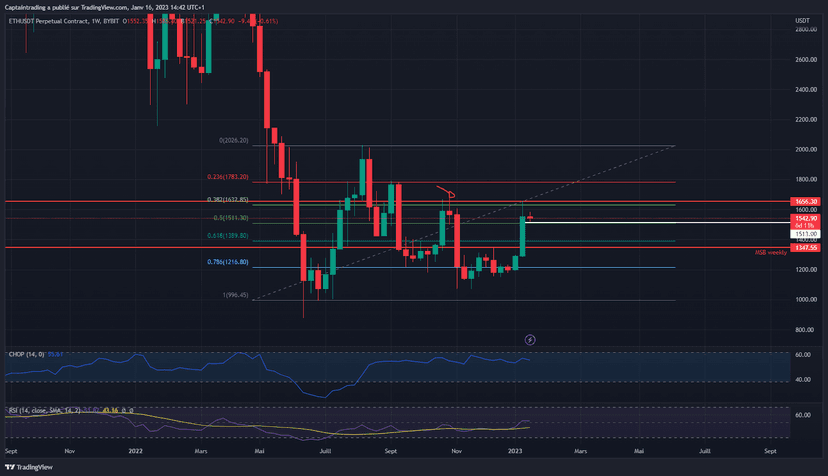
Here is a recent example of analysis (January 16). As I write this article (January 20), I still have SWING TRADING positions running on ETH!!!
Every guide here is free. Browse the full course and join a community of traders who share ideas every day.