SMC: A Revolutionary Method?!
SMC — the concepts tied to Smart Money from ICT — are all the rage: they’re talked about everywhere on social media. Whether you lean more toward Price Action in the classic sense or toward SMC & ICT, solid technical analysis is always done on TradingView!
That’s probably why you’re also wondering what SMC actually is and whether it deserves all the fuss. I’ve already answered that question in an earlier full article on Smart Money Concepts. And if you’re looking for an SMC strategy you can put into practice quickly, I’d recommend taking a look at my Order Block trading course.
Smart Money Concepts: Definition
The simplest way to describe trading based on Smart Money concepts is to say that it’s the study of Price Action under another name — nothing more, nothing less. And I could end this article right here.
According to its proponents, Smart Money Trading — which uses Smart Money concepts — refers to using institutional trading strategies that are aligned with the outlook of the Smart Money. In their view, institutional Smart Money Trading is superior to any retail trading strategy in many respects. Its advocates are firmly convinced that institutional trading is more powerful and more precise than anything the retail market can offer. The Smart Money is supposed to have greater access to knowledge and resources than retail traders (small individual traders) or the “Dumb Money.”
In reality, SMC uses the classic concepts of traditional trading — such as supply and demand, price patterns, support and resistance — but all of it has been given new names and described in a different way.
So SMC-style traders refer to concepts like “liquidity grabs” and “mitigation blocks.” Although this terminology may seem obscure, once you study SMC you’ll realize it’s a far more traditional trading approach than it appears at first glance.
SMC: Definition and Theory of the System
The SMC system isn’t just a trading strategy; it’s also an entire philosophy about how the markets work.
Fundamentally, the SMC trading system claims that market makers (i.e., banks, hedge funds, and so on) are manipulative entities and that, on top of that, they actively make life hard for retail traders (small individual traders).
According to this SMC system, as a retail trader you must base your strategy on the “smart money” — that is, the money belonging to the market makers.
The idea is for you to trade the way the market makers do. Since they’re supposed to call the shots in the markets based on supply, demand, and market structure, under the SMC system you’ll aim to put yourself in the market makers’ shoes and anticipate their reactions whenever you have to take a trade.
The Origins of the SMC Trading System
Smart Money concepts come from the trading school The Inner Circle Trader: ICT, founded by Michael J. Huddleston, a professional trader.
Core Concepts and Terminology: The Vocabulary
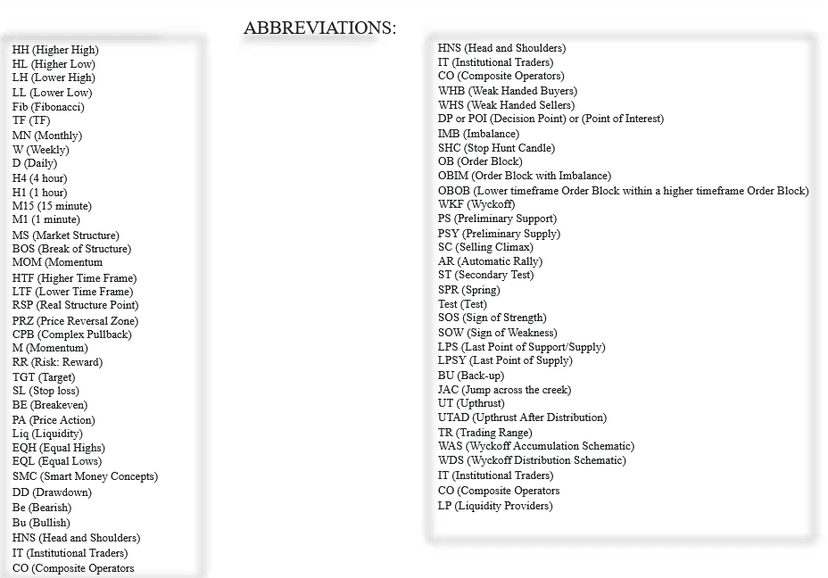
The SMC system looks very technical when you first start digging into it. The basic vocabulary can seem somewhat abstruse (hard to understand). So here are the definitions of the most common terms used by “SMC-style” traders:
Order blocks (OB): this terminology is used to talk about supply and demand. Some SMC-style traders claim that the concept of order blocks (OB) is more “refined” than the more ordinary supply and demand (a claim that is often disputed).
Breaker blocks and mitigation blocks: these terms refer to support and resistance.
Fair value gaps: this expression means we’re dealing with a kind of void that creates an imbalance in the price action, one we can exploit in our decision-making process when taking a trade. There are several types, all of them identified ages ago: common gaps, exhaustion gaps, breakaway gaps, and runaway gaps.
Killzones: the time windows, around the London and New York opens, where institutional volume concentrates. It’s the only term on this list that doesn’t describe a shape on the chart but a moment: a time filter, not a signal.
Support – A price level where buyers are considered stronger than sellers: it is usually represented by at least 2 red candles around the Lows (low points forming a kind of floor), which creates a support zone the price can react to.
Resistance – A price level where sellers are considered stronger than buyers. It is usually represented by at least 2 green candles around the Highs (high points forming a kind of ceiling), which creates a resistance zone the price can react to.
Impulse – A strong, fast move in the direction of the trend.
Pullback – A weak, slow move in the direction opposite to the trend.
Fair Market Value = 50% (Equilibrium)
There are many other concepts in the SMC system. If it interests you, I encourage you to do your own research and dig deeper into the subject, in particular by reading this older article, but in my view, mastering price action analysis (rounded out with a few extra tools such as the RSI or Chop Index indicators, open interest, or even Fibonacci), which is what I’m offering you, is more than enough to become a profitable trader — provided you’re motivated and disciplined.
In my daily market analysis, I also frequently use the terms “liquidity” or “Order Flow” — concepts supposedly derived from the SMC system. Along with PA, they’re among the pillars of my method. So not everything in the SMC system should be dismissed.
Smart Money Concept: Conclusion
In conclusion, the SMC trading system is far from revolutionary, and Michael J. Huddleston didn’t reinvent the wheel. He created new packaging out of old concepts. This way of trading with the SMC system can no doubt be effective and suit some people, but in my opinion, nothing will replace the daily study of our good old Price Action (with support and resistance levels, Order Flow, entries and exits, and so on) — which forms the basis of my trading system!
Last but not least: beware of the miracle-workers and the online courses on Smart Money Concepts that are thriving all over the web — they’re most often sold for a fortune while delivering quality that falls well short.
To go further, I once again recommend my first article on SMC as well as my Order Flow tutorial!
OKX — MiCA & MiFID II compliant: futures are legally accessible from the EU, and demo mode lets you practise without risking your capital. Open an OKX account
Every guide here is free. Browse the full course and join a community of traders who share ideas every day.