Even as an experienced trader, risk is everywhere on the financial markets. To keep it under control, I regularly use Hedging. It's a particularly useful strategy when corrections show up on the financial markets: forex / currencies, crypto, commodities / raw materials, stocks, etc.
This strategy is set up to cover the financial risk that long positions involve; it is practiced by the majority of institutional players.
Hedging is one of my specialties. It's also the topic of the first webinar I ran when Captain Trading launched. To this day, you can find this hedging trading course in our video-on-demand catalog.
This strategy will fit perfectly into your risk management. It lets you protect your positions and smooth out your profit curve.
That's why I put together a first free guide on Hedging and the various methods for hedging. It will give you an in-depth understanding of Hedging, as well as the different methods for fine-tuning your risk management!
Whether you're a beginner trader or an experienced one, this guide is a valuable resource. It will help you understand the subtleties of hedging instruments. From there, you'll be able to develop a tailor-made risk management strategy and reach your trading and/or investment goals with a little less stress!
It's about strengthening our portfolio's resilience to market swings. The goal is, above all, to protect your hard-earned capital. Once you've internalized the register of foreseeable risks, risk analysis, and risk assessment.
We're not here just to bet on the downside. We're here to do it in a balanced way, so that if the market corrects, we land on our feet even though we were long. That's the whole concept of hedging!
Introduction to Hedging
Hedging Definition and the Meaning of "Hedge"
Hedging is an essential financial strategy for protecting your investments against potential risks and market uncertainty. This technique consists of taking a position on a financial instrument or a related asset, such as a derivative or a security, in order to offset the potential losses of your main investment.
Hedging is a form of insurance that helps me minimize financial losses and reduce my exposure to unfavorable market conditions. In other words, thanks to Hedging, I'm able to diversify my investments while limiting the effects of market swings on my portfolios.
Be careful not to confuse an edge, which means an advantage, with a hedge, which literally means a barrier or fence. As you'll have gathered, by building your "hedge" or hedging, you protect yourself from the market's setbacks. When you build your edge, it means you're building the advantages that will let you make the difference on the financial markets!
Hedging: For What Purpose?!
In the world of finance, hedging is critically important. It offers first-rate protection against the market's surprises. Since financial markets are by nature changeable and unpredictable, it's important for us as traders and investors to stay prepared for tough conditions.
It's also essential to make sure our investments are stable. By using Hedging strategies, we can limit potential risks, reduce the impact of market volatility on our portfolios, and improve our long-term performance.
A Must-Have in These Times of Financial Insecurity
Hedging is especially useful for us during periods of heightened market uncertainty, because it lets us keep a balanced portfolio and avoid heavy losses. On top of that, we can also use this technique to lock in our profits and take advantage of price movements across the different markets, which makes it an essential tool for managing risk and maximizing our profits.
Hedging genuinely helps stabilize the economy by structuring big portfolios. Hedging is available to all traders, small and large portfolios alike, so why go without it! It has even become hugely democratized thanks to platforms specialized in options, such as Delta Exchange.
Hedging achieves key objectives; they all contribute to its importance in trading and investment practices:
Risk Mitigation or Reduction
Hedging is primarily aimed at reducing the potential risks associated with an investment, thereby minimizing the financial impact of adverse market movements.
Portfolio Optimization
Hedging strategies help optimize portfolios by striking a balance between risk and return. By carefully selecting and managing their hedge, an investor can achieve an efficient allocation of capital and thereby improve their long-term performance. Hedging contributes to the diversification of our investments; in fact, our portfolio is optimized when we hedge!
Protecting Profits
Hedging can be used to capitalize on existing profits with complete peace of mind and prevent them from being eroded by market swings. By taking a complementary position on a related asset or instrument, investors can secure their gains and minimize the risk of a sudden market reversal.
Seizing market opportunities:
Hedging techniques allow investors to capitalize on market opportunities and benefit from price movements across different asset classes. By setting up hedges, traders can profit from divergences in the market and even generate profits if the strategy is well honed.
I'm convinced that Hedging is an indispensable tool for succeeding on the financial markets, and I'm far from the only one. It helps you guard against unpredictable market swings and reduce your risk exposure.
With a well-thought-out hedging strategy and constant monitoring of the economic climate and the economic calendar, you can achieve long-term financial stability and smooth out your profits. Those are already a few good reasons why I strongly recommend you get familiar with hedging.
The 4 Main Hedging Methods
In this section, we'll look at four Hedging methods commonly used by investors and companies to manage the risks tied to their financial activities. These methods are the direct hedge, the cross hedge, the proxy hedge, and the portfolio hedge. Each of these hedging techniques has its own advantages and limitations, which we'll examine in detail.
Direct Hedging
A direct hedge involves taking an offsetting position on a related financial instrument, such as a futures contract, an option, or a swap, in order to protect against potential fluctuations in the price of the underlying asset. This method is widely used to lock in a predetermined price for the asset and mitigate the risks associated with adverse price movements.
For example, a farmer who wants to protect against a fall in corn prices can sell a corn futures contract. If the price of corn drops, the farmer's loss on the physical corn market will be offset by the gain made on the futures market.
Cross Hedging
A cross hedge is a strategy in which an investor hedges the risk tied to one asset by taking an offsetting position on a different but related asset. This method is especially useful when no direct hedge exists or when the correlation between the two assets is strong.
For example, a gold-mining company can hedge its exposure to fluctuations in the price of gold by taking a short position on a silver futures contract. Since gold and silver prices tend to move in the same direction, a drop in gold prices can be offset by a corresponding drop in silver prices, which reduces the risk for the gold-mining company.
Proxy Hedging
A proxy hedge involves using a financial instrument or asset that isn't directly linked to the hedged asset but has a strong correlation with it. This method is used when a direct hedge isn't available or when the cost of a direct hedge is too high.
For example, say you've opened several positions on altcoins but no solution is offered for taking put options on those alts. So you decide to hedge with options contracts on Bitcoin or Ethereum. Since the entire crypto market is strongly correlated to BTC and ETH, this type of hedge makes perfect sense.
Portfolio Hedging
A portfolio hedge is a technique used to manage the risks associated with an entire investment portfolio. It involves taking positions in various hedging instruments, such as options, futures contracts, swaps, or ETFs, in order to offset the potential losses of the underlying assets within the portfolio.
For example, a portfolio manager heavily exposed to tech assets can use an inverse tech ETF as a hedging instrument. If the tech sector experiences a downturn, the inverse ETF will rise in value, which will help offset the losses suffered by the portfolio's tech assets.
Understanding the different hedging techniques, such as the direct hedge, the cross hedge, the proxy hedge, and the portfolio hedge, can all help you in your quest for stability. It's up to you to choose the ones that suit you best!
4 Hedging Strategies for Managing Risk
Risk management is an essential aspect of investing and trading. It involves various hedging strategies that can help investors and companies protect their financial interests against market swings and other potential risks. In this section, we'll examine four popular hedging strategies: delta hedging, gamma hedging, vega hedging, and tail risk hedging (a term I'll keep as is).
Delta Hedging
Delta hedging is a strategy that aims to reduce or eliminate the risk tied to changes in the price of an underlying asset by taking an offsetting position, generally by means of options contracts. Delta is a measure of the change in an option's price relative to the change in the price of the underlying asset.
To implement a delta hedging strategy, an investor will buy or sell options contracts to reach a delta-neutral position. This means the portfolio's overall delta exposure will be zero, which makes the portfolio's value less sensitive to price changes in the underlying asset. Delta hedging often requires frequent adjustments to maintain a delta-neutral position, because the price of the underlying asset and the option's delta change over time.
Gamma Hedging
Gamma hedging is a strategy used to reduce or eliminate the risk associated with the change in delta, known as gamma risk. Gamma measures the speed at which an option's delta changes as a function of the underlying asset's price.
Investors use gamma hedging to maintain a gamma-neutral position, which means the portfolio's overall gamma exposure is zero. To do this, they generally buy or sell additional options contracts. Gamma hedging is especially useful for options traders who want to minimize the impact of large price swings in the underlying asset on their portfolio. Like delta hedging, gamma hedging also requires continuous adjustments to maintain a gamma-neutral position.
Vega Hedging
Vega hedging focuses on managing the risk associated with changes in the implied volatility of an underlying asset. Implied volatility is a measure of how large the market expects an asset's future price movements to be. Vega is the sensitivity of an option's price to changes in implied volatility.
A vega hedging strategy aims to establish a vega-neutral position, which means the portfolio's overall vega exposure is zero. This objective is generally reached by taking offsetting positions on options contracts with different implied volatilities. By maintaining a vega-neutral position, an investor can reduce the impact of changes in implied volatility on the value of their portfolio. Like delta and gamma hedging, vega hedging requires regular adjustments to maintain a vega-neutral position.
Tail Risk Hedging
Tail risk hedging is a strategy that aims to protect a portfolio against extreme market events, or "black swans," which have a low probability of occurring but can lead to particularly heavy losses. These events, which generally occur in the tail of a probability distribution, can trigger substantial drops in asset prices and cause significant, even fatal, damage to a portfolio.
Tail risk hedging involves using financial instruments such as options, futures contracts, or swaps to protect a portfolio against extreme market moves. Although tail risk hedging can be expensive, it can also offer investors valuable protection during periods of market stress and uncertainty.
The Tools and Instruments for Hedging
Let's now turn to the hedging instruments at your disposal for setting up the strategies we saw earlier.
I'll introduce you to the four main hedging instruments: futures contracts, options contracts, swaps, and ETFs. Personally, I only use futures and options contracts — that's more than enough in my case.
Futures Contracts
A futures contract is a standardized agreement between two parties to buy or sell an asset at a predetermined price on a given future date. Traders use futures contracts to hedge their positions, because they can lock in the price of an asset and protect themselves against possible price fluctuations.
What better than a course to learn how to short with visuals and clarify the concept!
My Free Course on How to Short the Market

Options Contracts
They give the buyer the right, but not the obligation, to buy or sell an underlying asset at a predetermined price (called the strike price) before or on a specific expiration date.
There are two types of options contracts: call options and put options. In both cases, you can either write the options or buy them.
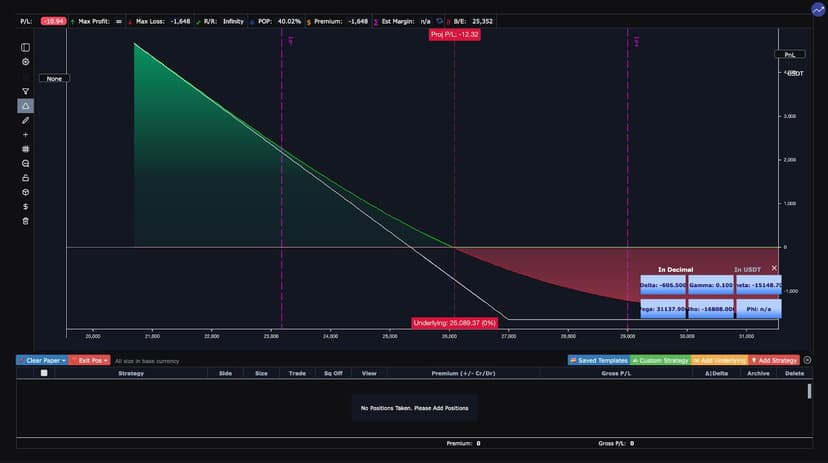
Options can be used to hedge against adverse price movements in the underlying asset. For example, an investor holding a company's assets can buy put options to protect their investment against a potential drop in the stock price.
What interests us about options when it comes to hedging is using the purchase of put options to anticipate potential drops "just in case." To get you started with options — one of the best ways to hedge — I offer free options courses and paid options courses (and affordable ones) for those who want to study practical cases with me and walk away with a few turnkey strategies!
Personally, I trade options contracts to hedge on Coincall. Given that these are very specific financial products (only about 5% of total trading volume), I always favor a specialized platform!
Example of the risk/profit curve of a Put option
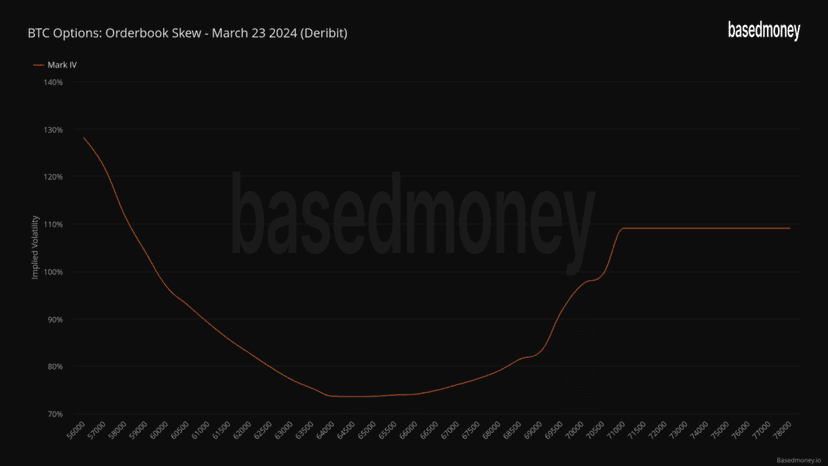
Implied volatility curve for Bitcoin Options contracts
Swaps
Swaps are financial contracts between two parties that involve the exchange of cash flows, assets, or liabilities. The most common types of swaps are interest rate swaps and currency swaps.
Swaps can be used to hedge against various risks, such as interest rate fluctuations or exchange rates. For example, a company that has taken out a loan in a foreign currency can enter into a currency swap to exchange the loan's cash flows into its domestic currency, thereby minimizing its exposure to currency risk.
Exchange-Traded Funds (ETFs)
An ETF is a type of investment fund that holds a diversified portfolio of assets, such as stocks, bonds, or commodities, and trades on an exchange like a stock. ETFs can be used as hedging instruments to mitigate the risks associated with specific market sectors, asset classes, or geographic regions.
By investing in an ETF that tracks the inverse performance of a particular index or asset, traders can hedge their exposure to potential losses in their portfolio. For example, an investor concerned about a slowdown in the tech sector can invest in an inverse tech ETF
I want to stress the crucial importance of hedging instruments. Futures contracts, options contracts, swaps, and ETFs are effective ways to hedge.
Of course, it's essential to understand these tools thoroughly and use them correctly to get optimal results. With them, you can effectively minimize risks and successfully navigate volatile, uncertain markets. Hedging is rarely perfect, but it's essential!
Pros and Cons of Hedging
Hedging strategies are essential for investors and portfolio managers to manage the risks associated with their investments. While these strategies offer many advantages, they also come with certain drawbacks. In this section, we'll examine the pros and cons of Hedging strategies.
The Advantages
Risk Reduction
The main advantage of Hedging is risk reduction. By using various hedging techniques, investors can limit their exposure to adverse market movements, such as sharp drops in asset prices or major swings in interest rates or exchange rates. This helps protect their portfolios against heavy losses and provides a safety net during periods of high volatility.
Predictable Results
Hedging strategies often allow investors to achieve more predictable results. By softening the impact of market swings, Hedging helps stabilize portfolio returns, which lets investors better anticipate the performance of their investments over time. This can be especially useful for investors with specific financial goals or commitments, as it reduces the uncertainty surrounding their future cash flows.
Portfolio Diversification
Hedging strategies can also contribute to portfolio diversification. By investing in various asset classes or using various financial instruments, such as options or futures contracts, investors can spread their risk across several investments. This helps reduce the overall volatility of their portfolio and limit the impact of poor performance from any single investment.
The Drawbacks
While Hedging operations offer many advantages, they also carry potential drawbacks that investors must take into account before implementing these strategies.
Additional Costs
Hedging operations can incur additional costs, such as transaction fees, bid-ask spreads, and the expenses tied to purchasing derivative contracts. These costs can add up over time and cancel out some of Hedging's benefits in terms of risk reduction. Investors must carefully weigh the potential benefits of Hedging against the associated costs to determine whether it's a strategy suited to their individual needs.
Potential Trade-Offs
Hedging strategies often involve trade-offs (compromises in investment decisions). For example, by reducing their portfolio's risk, investors may also limit their potential for high returns.
Indeed, Hedging strategies generally involve taking opposing positions in the market, which can offset the gains of one investment with the losses of another. As a result, investors must carefully consider the balance between risk reduction and return potential when implementing Hedging strategies.
Complexity
Hedging strategies can be complex and require a high level of financial knowledge and expertise to implement effectively. This can be a challenge for individual investors who may not have the experience or resources needed to navigate the intricacies of hedging strategies. In that case, it can be worth seeking the advice of a finance professional who can help you build and manage an appropriate hedging strategy.
Hedging strategies offer undeniable advantages, but it takes balance. It's really important to make sure you'll be able to adapt to each of these challenges before diving in!
My Tips for Defining Your Strategy
Assess Your Risk Tolerance
Understanding your risk tolerance is a crucial first step in building a risk management strategy. Risk tolerance refers to the level of risk you're willing to accept to reach your financial goals. Factors such as age, investment horizon, financial goals, and personal circumstances can all help determine your risk tolerance. To assess your risk tolerance, ask yourself the following questions:
How comfortable are you with the idea of spending in the short term simply to smooth out your gains over the long term?
In fact, you may have far better reasons to do so…
What is your investment horizon, and how much time do you have to recover from any losses?
What are your financial goals, and what level of risk is needed to reach them?
Identify Your Risk Situations to Anticipate Them
Once you've determined your risk tolerance, it's essential to identify the potential risks that could affect your investment portfolio.
These risks can come from various sources, such as market volatility, changes in interest rates, currency fluctuations, and geopolitical events. Identifying these risks lets you better understand the potential challenges you might face and make informed decisions about your investment strategies.
Choose the Strategies That Suit You!
Once you have a good grasp of your risk tolerance and the potential risks, you can now choose suitable Hedging strategies to balance your risk-taking.
Among the good questions to ask yourself:
- How effective is the strategy at reducing the identified risk?
- What costs are associated with implementing the strategy?
- How does the strategy align with your overall investment goals?
Your Strategy Must Be Dynamic!
As market conditions change and new risks emerge, it's essential to evaluate the effectiveness of your Hedging strategies and make the necessary adjustments. By regularly reviewing your portfolio and your Hedging strategies, along with the opportunities to hedge, you ensure that your plan stays relevant and effective over time.
By following these steps, you can build a comprehensive risk management strategy that matches your risk tolerance, protects your assets, and improves your long-term investment performance. Implementing such a strategy can help preserve your financial stability and give you peace of mind, even during periods of market uncertainty.
My Take on Hedging
With a bit of experience, I can attest that Hedging is a key milestone in my personal growth. Ever since I mastered the subject, I've had a much broader view of the market!
Hedging offers us protection against market volatility, improves our long-term investment performance, and guarantees a degree of stability in our income.
Those who incorporate Hedging into their trading are generally among the winners in the ultra-volatile crypto sector!
One last hedging tip: When you see everyone flipping into "to the Moon, guys" mode, think the opposite and immediately look for the best way to hedge if you're positioned!
To go further with hedging in the crypto sector, I offer 1 Beginner Hedging Course and 1 Advanced Hedging Course on VOD! I'll take this opportunity to invite you to join the free Captain Trading space: with a simple account, you get the daily plan in your trading journal, decoded COT reports, lives and their replays, and the community help room built right into your dashboard — you ask your question in your language and we answer in your language! It’s all free. If you’d like to support us, open an account with one of our partner platforms through the Cashback page: 5% of your trading fees are yours for good, and 10 to 20% in the months when your volume justifies it — that’s what allows us to keep going.
Every guide here is free. Browse the full course and join a community of traders who share ideas every day.