The Maximum Pain Theory, or Max Pain Theory, tells us that as their expiration approaches, the price of options | put options and call options | tends to gravitate toward a strike price at which most open options expire worthless.
Options traders often pair this indicator with a straddle strategy to profit from big moves in either direction around that strike price.
This is the Max Pain Price: the point at which options buyers feel the “maximum pain.” In other words, it’s the price that, once reached, makes options buyers lose the most money while the sellers pocket the most. Be careful: if you trade traditional markets, you have to learn to source the right information outside the New York markets.
Max Pain is a non-essential indicator. Still, it would be a shame to skip it, so it’s worth mastering and keeping an eye on.
And no, it has nothing to do with Max Payne and Bullet Time mode…
How is the price manipulated?
The theory holds that options sellers hedge the contracts they themselves created in order to manipulate prices and thus push toward the levels that are profitable for them.
Call sellers will sell shares to push the price down, while put sellers buy them to support a move higher.
Max Pain: How Do You Calculate It?
Max pain is calculated by summing the intrinsic values (cash value) of every put and call contract at each strike; the strike price being the one determined by the minimum intrinsic value.
- First, set each strike as the expiration price.
- Then, for each closing price | Closing Price
- Calculate the difference between the strike price and the expiration price.
- Multiply the result by the Open Interest at the strike price
- Add up the dollar value of the puts and calls at the strike price.
- Finally, repeat the calculation for each strike price.
We use the reasoning above to calculate the cash value of each contract.
I’m walking you through this so you can understand what’s under the hood of Max Pain, but I never actually calculate it myself!
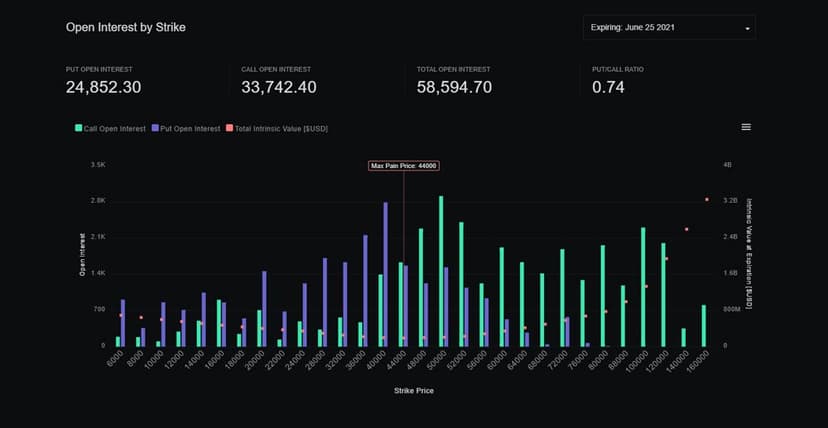
Here’s the site I regularly show you in the Minutes Marchés to track Open Interest and Max Pain: BasedMoney, formerly Coinoptionstrack.
The red dots show the total intrinsic value (cash value) that would be paid to the sellers on all the calls and puts at the strike price.
The max pain level is marked by the lowest red dot on the chart. In this case, that’s $44,000. Note that here a specific expiration date is set: June 25, 2021
This level shifts as the contracts’ expiration approaches.
These can be used to flag key support and resistance points.
The Open Interest walls are more reliable because they factor in a price between two strike prices rather than the exact price at the close or expiration date.
Max Pain: My Take & Conclusion
Max Pain isn’t an indicator you can really rely on. That said, it can give you some idea of the price at expiration.
To improve your odds of success, max pain theory can be used in tandem with the “Open Interest walls.” Open Interest walls are levels made up of the contracts with the largest volumes around the max pain.
My Experience With Max Pain
Whether you’re an options holder or an options seller of calls and puts, this is an indicator that’s very useful for anticipating where price is headed. It has often given a head start on the trend. When we were in a full-blown bull market and price drifted too far from the max pain (gaps of more than $15K between price and max pain), once the end of the month drew near, price would start correcting sharply to move back toward it.
That said, since December I’ve only seen one close of a large contract on the max pain, back in April. Otherwise, price has generally tended to close 20 to 30% above it. It’s no crystal ball, but it’s still one more metric to keep an eye on.
I hear all sorts of nonsense on Twitter and around the web about Max Pain… I hope this article has shed some light on the topic and on my read of this indicator.
See you very soon to talk it over on a Live or on Discord!
In the meantime, to round out the concept of Max Pain, I recommend my trading course on Open Interest, along with my free course on put options and call options, which are must-know topics!
Otherwise, I’ll see you throughout the week in the free Captain Trading space: with a simple account, you get the daily plan in your trading journal, decoded COT reports, lives and their replays, and the community help room built right into your dashboard — you ask your question in your language and we answer in your language! It’s all free. If you’d like to support us, open an account with one of our partner platforms through the Cashback page: 5% of your trading fees are yours for good, and 10 to 20% in the months when your volume justifies it — that’s what allows us to keep going.
Every guide here is free. Browse the full course and join a community of traders who share ideas every day.