Understanding Volume Profile can prove genuinely useful when trading crypto, which is why — after our free Market Profile trading course — here is our introductory lesson on the Volume Profile!
With the rise of technical analysis methods, in particular the Market Profile and the Volume Profile, it’s important for traders to understand how these tools apply to their strategies.
Today, discover a complete lesson for anyone who wants to understand and learn how to use the Volume Profile!
Volume Profile is a trading concept developed by J. Peter Steidlmayer that lets traders identify the market’s key zones and their potential for trading. Volume Profile offers valuable insight into price structure, market activity and even the balance between buyers and sellers.
Volume Profile: the basics
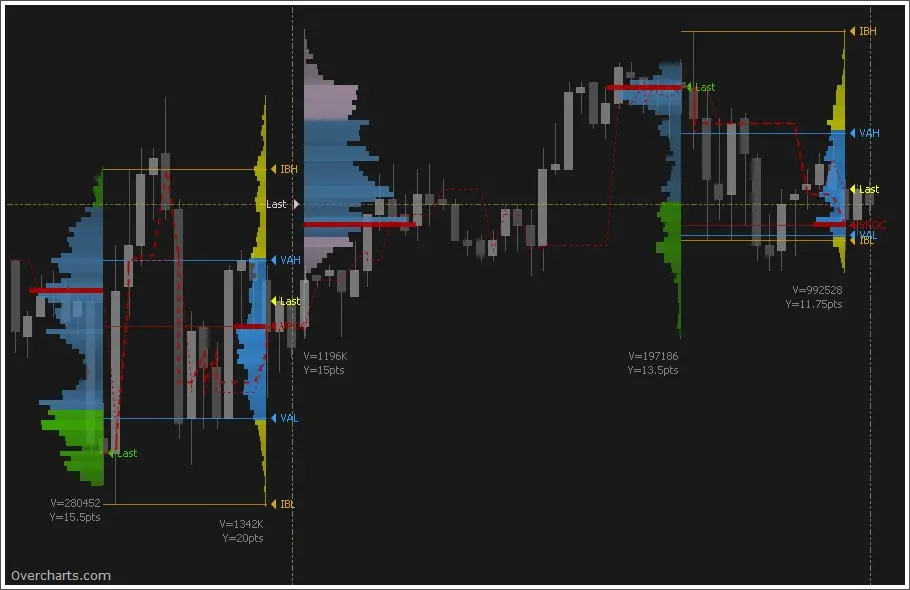
Volume Profile draws on the idea of volume distribution across different levels, or starting points known as the POC. This distribution is displayed as a chart called a “footprint” and is used to identify significant price structures. Traders can then easily gauge how the market is behaving, what the trends are, and whether a specific information watch is currently underway.
The concept of the neutral day centered at 17:30
One of the core concepts of the Market Profile is the neutral day centered at 17:30: this means that each day, the market returns to a starting level based on the daily open and close to form a larger range. The size of this range depends on the strength of the buyers and sellers interacting throughout the day: the wider the spread, the more information becomes available to the trader.
Volume Profile: overlaying it with the Market Profile
Traders can overlay the Market Profile onto the Volume Profile to gain a better visual understanding of market conditions. For example, by looking at the Market Profile, you can quickly see where the value areas sit – these zones are generally seen as significant clues, since they point to a possible future direction for the market.
Using TPOs to fill in single prints
There is another interesting way to use the Market Profile: TPOs | Time Price Opportunities, which are time-price units that let traders pinpoint the right moments to enter and exit the market. These TPOs fill in certain gaps in the developing profile, offering an extra read on price structure. Traders can then factor in this additional information when weighing up whether to enter a position.
Practical tips for trading with the Volume Profile
To get the most out of the Volume Profile, there are a few practical tips to follow: first, always try to use the developing profile before entering a position; next, watch market activity closely and look for key signals pointing to a potential future direction. Finally, always keep a close eye on the initial balance to understand how the market may have moved in the short term. That alone is a good clue as to what will happen next.
Volume Profile: Conclusion
Volume Profile is a fairly powerful tool for trading both conventional financial products and less conventional ones such as crypto.
By combining different concepts — the neutral day centered at 17:30, overlaying the Market Profile with the Volume Profile, and using TPOs to fill in single prints — traders can gain a better understanding of price action and make consistent decisions.
Personally, I use it because it helps me anticipate and define equilibrium points ( > Take Profits ) as well as “liquidity voids”, so I can spot trap trades.
Every guide here is free. Browse the full course and join a community of traders who share ideas every day.