BOS and CHoCH: two acronyms that show up in every Smart Money video, often presented as insider knowledge. Behind them sits an idea every trader knows the moment they open a chart: a trending market moves through successive highs and lows. As long as the sequence holds, the trend holds. The day it breaks the other way, something has changed — and that is exactly what these two acronyms describe.
One clarification up front, true to our line: we don’t do SMC. The Cap sums it up in his introduction to Smart Money Concepts: it is “the study of Price Action under another name.” Our own course, in fact, teaches the break that flips a trend under a different acronym, the MSB. Here you get the full vocabulary — half the market speaks this language — and above all what most definitions leave out: the rules that separate a real signal from a stop hunt, and how to check it in the order flow rather than on the shape of the candles alone.
Key takeaways:
- The BOS (Break of Structure) breaks the last high in an uptrend, the last low in a downtrend: the trend continues.
- The CHoCH (Change of Character) breaks the structure against the trend — in an uptrend, the low that launched the last high. It is the first sign of a reversal, not proof of one.
- The order never changes: a CHoCH first, then BOS in the new direction, which confirm it.
- The close decides, not the wick. A wick that pierces a low and then closes back above it is not a break: it is often a liquidity sweep.
- The right swing matters. A CHoCH on M5 in the middle of an H4 pullback does not announce an H4 reversal: structure is read from the top down.
- A fake CHoCH is a stop hunt: price breaks, triggers the orders, then re-enters. That is Swing Failure Pattern territory, not a reversal.
- Our difference: we confirm in the flow. A CHoCH heralded by a weakening CVD, or backed by new positions in open interest, carries more weight than a break seen on the chart alone.
BOS and CHoCH Definition in Trading
It all starts with market structure: the sequence of highs and lows. An uptrend prints a rising series of highs and lows: higher highs (HH) and higher lows (HL). A downtrend does the opposite: lower highs (LH) and lower lows (LL). BOS and CHoCH are just two ways of breaking that sequence: in its direction, or against it.
The BOS (Break of Structure): The Trend Continues
In an uptrend, price makes a high, pulls back, forms a higher low, then sets off again and closes above the previous high: that is a BOS, a break of structure in the direction of the trend. Each new BOS confirms that buyers are still in control. In a downtrend, it is the mirror image: a close below the last low.
What the BOS mainly tells you is which low matters from now on. The low the break started from becomes the line the trend has to defend: as long as it holds, the bullish structure is intact, whatever pullbacks occur in the meantime.
The CHoCH (Change of Character): The First Sign of a Reversal
The CHoCH is the opposite break. In an uptrend, price no longer just pulls back: it closes below the low it needs to defend — the last higher low, the one that launched the last BOS. The market changes character: it no longer protects its lows. In a downtrend, the bullish CHoCH is a close above the last lower high.
Keep the right word in mind: a CHoCH is a first sign, not a new trend. It says the current sequence is broken; it does not yet say the opposite sequence is in place. For that, you need what comes next — a bounce that fails below the old level, then a break in the new direction.
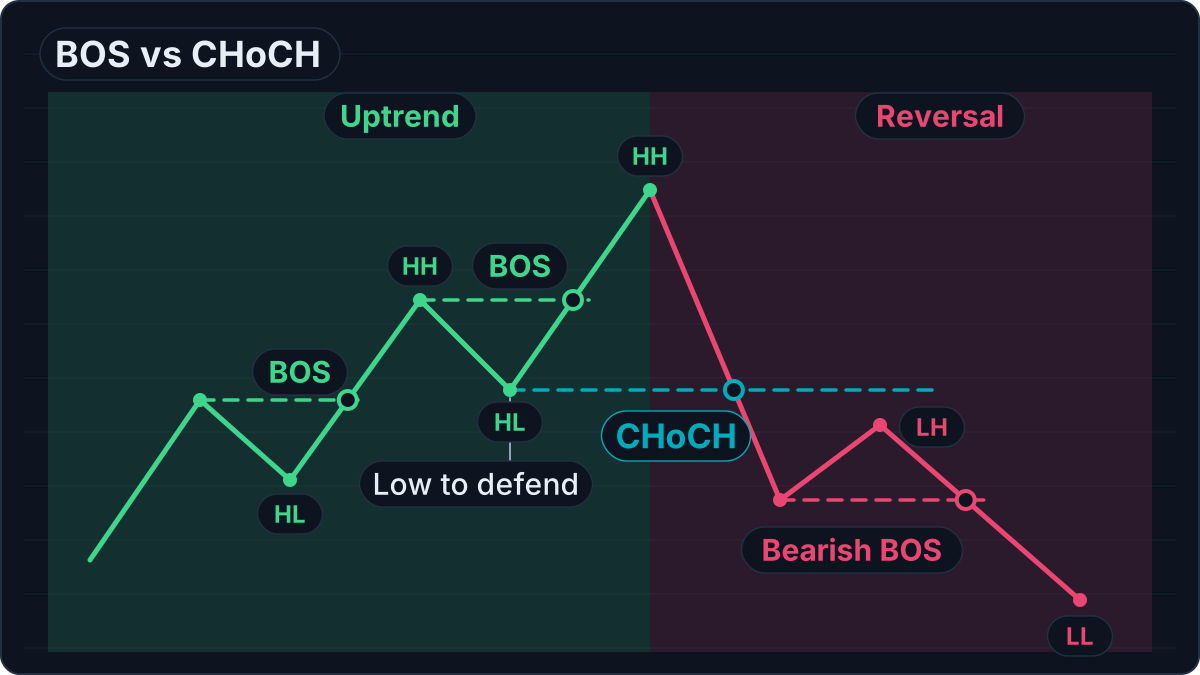
One sequence, two signals: the BOS confirm the uptrend, the CHoCH breaks the low to defend, then the first bearish BOS confirms the reversal.
Nothing New: Price Action Structure, Renamed
If these definitions sound familiar, that is normal. Sequences of highs and lows were the foundation of price action long before Smart Money vocabulary took them over. Our price action course teaches them under the name market dynamics, and calls the break that flips a trend an MSB (Market Structure Break): “a break in the dynamics tells us the market has shifted from one trend to another.”
The Smart Money Concepts guide says it bluntly: “the big trick of ICT and SMC traders is to rename things and thereby overcomplicate them to excess.” That is no reason to ignore their acronyms — they are everywhere, and understanding them makes you self-sufficient. It is a reason not to credit them with any power: a CHoCH doesn’t know any more about the market than a broken low does.
BOS vs. CHoCH: The Comparison Table
The two signals look alike — a close beyond a swing — and that is why people mix them up. What separates them comes down to six rows:
| BOS (Break of Structure) | CHoCH (Change of Character) | |
|---|---|---|
| Direction of the break | With the trend | Against the trend |
| The swing broken | The last high in an uptrend, the last low in a downtrend | In an uptrend, the low that launched the last high (the reverse in a downtrend) |
| What it signals | The trend continues | A possible reversal, not yet confirmed |
| How many per trend | Several, one on each new leg | Just one: it opens the new sequence |
| What to expect next | A pullback that holds above the original low | A bounce that fails, then a BOS in the new direction |
| What invalidates it | A quick move back below the broken level | A return above the broken low, then a new high |
The “how many per trend” row clears up a common confusion: the word CHoCH is not reused. After a bearish CHoCH, the next breaks of lows are bearish BOS — they extend the new trend; they do not reverse it a second time. The order of a clean reversal is therefore always the same: CHoCH first, BOS after.
What Makes a Real CHoCH
On any chart, there are dozens of broken lows every day. Three filters separate the ones that matter from the background noise, and a CHoCH worthy of the name passes all three.
The Close, Not the Wick
First filter, non-negotiable: a break is judged on the candle’s close. Our price action course spells it out for the MSB: you need “a closing price below the previous highest lower wick.” The level is measured at the wick of the low; the break is confirmed at the closing price.
A wick that pierces the low and then closes back above it is not a break. The breaker block guide goes further: it is often the opposite, a rejection. And the formula from the order block guide sums it all up: “wicks test, closes decide.”
In practice, wait for the close on the timeframe where you read the structure. An M1 candle that closes below an H4 low does not make an H4 CHoCH: on H4, it is only a wick until the H4 candle has closed.
The Right Swing: External vs. Internal Structure
Second filter: which swing was broken. External structure means the major swings of your reference timeframe — the ones that produced the BOS. Internal structure means the small swings that form inside a pullback. Breaking an internal low is often just the end of a simple breather; breaking the external low to defend is a CHoCH.
To recognize a swing that matters, the price action course gives a simple criterion: a swing high is “a higher candle in the middle of two lower candles” (and a swing low is the mirror image). Above all, it adds the most useful advice of all: “if it doesn’t look obvious to you, that’s a bad sign!” A CHoCH you need a magnifying glass to find isn’t one.
And always read from the top down: the structure of the higher timeframe is in charge. A CHoCH on M5 in the middle of an H4 pullback does not announce an H4 reversal — at best, it announces the end of the pullback. Often, it is precisely your entry signal into the H4 trend: the “micro-structure break” on a lower timeframe that our zone guides talk about.
Displacement and the FVG Left Behind
Third filter: the manner of the break. A real change of character is visible — full-bodied candles, few wicks, a move that starts fast. That is the displacement of ICT vocabulary. Price that “creeps” below a low, soft candle after soft candle, traps no one and proves nothing.
The clearest signature of displacement is the imbalance (FVG) it leaves behind: a zone price crossed with almost nothing traded. A CHoCH that leaves an FVG tells a story of urgency; a CHoCH without displacement tells a story of drift. And that FVG becomes the first zone to watch when price comes back.
The Fake CHoCH: When the Break Is Just a Stop Hunt
Ask yourself a simple question: in an uptrend, where are the buyers’ stops? Below the last low, obviously. The Smart Money Concepts guide reminds us: “the most obvious liquidity to hunt for sits below the lows and above the highs.” The low that defines the CHoCH is therefore also the spot loaded with more orders than anywhere else on the chart.
When price dives below that low, those stops trigger: they are market sell orders, joined by those of breakout sellers. For a big buyer, that is a windfall — all the counterparty they need, in one place. Price pierces, collects the liquidity, then re-enters: that is a liquidity sweep. On the chart, you saw a CHoCH; in reality, you saw a stop hunt.
This is exactly the mechanism of the turtle soup — a swept extreme that doesn’t hold — and of its cousin, the one we actually trade, the Swing Failure Pattern. In other words, a fake CHoCH is not a failed signal: it is often a signal in the other direction.
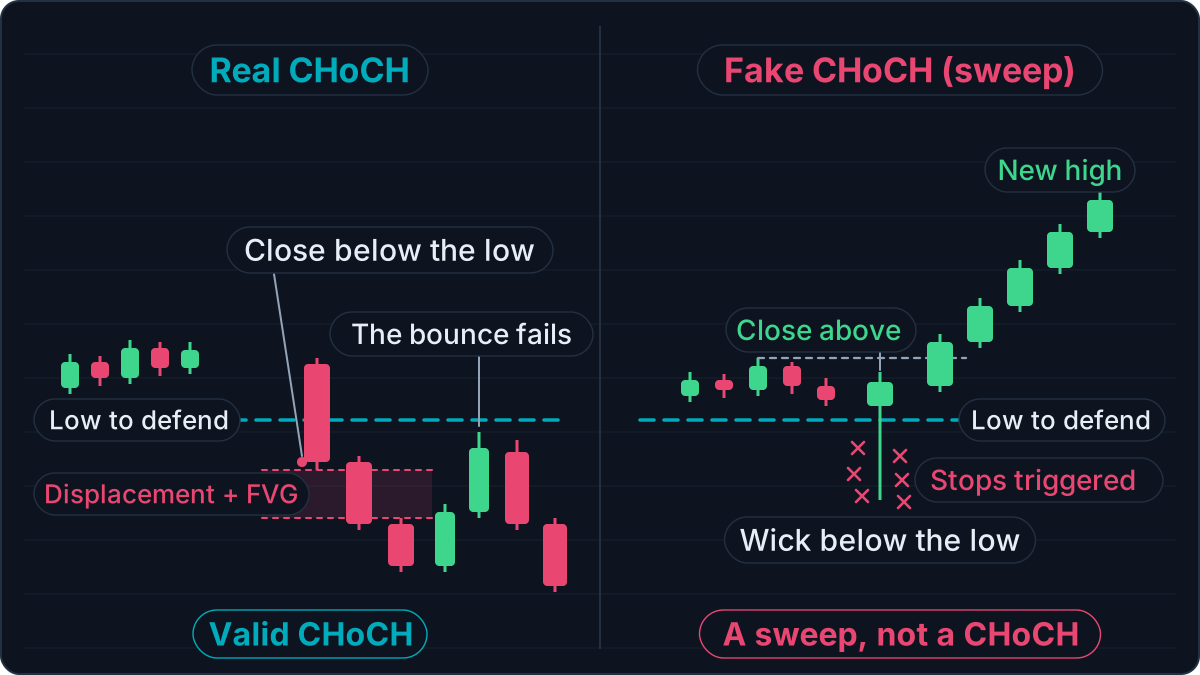
On the left, a close below the low with displacement: the broken level becomes resistance. On the right, a wick sweeps the stops and the candle closes back above: it is a sweep, not a CHoCH.
Four clues let you tell them apart:
- The close. Wick below the low and a close above it: sweep. A decisive close below the low: CHoCH candidate. It is the first sort, and it costs nothing.
- The reclaim. A fake CHoCH quickly gets back above the broken level and heads up again. The real one sees its bounce fail below the old low: the broken support becomes resistance.
- How obvious the level is. The more obvious a low is — equal lows, a floor everyone can see — the more likely it is to be swept before any decision is made. Be wary of breaks that look too easy.
- The flow. Triggered stops are aggressive orders: they leave a trace in the delta. A spike of market sells below the low, followed by price rising anyway, is absorption. We come to that right after.
The strongest sequence is therefore not simply “a CHoCH”: it is a sweep first, then a CHoCH in the other direction. An obvious high is swept, the breakout buyers are trapped, then price closes below the low to defend, with displacement. That is exactly the breaker block checklist: liquidity grab, break on the close, structure shift, displacement.
Confirming a CHoCH with CVD and Open Interest
The chart shows you that a low gave way. It does not tell you who made it give way, or why. This is where we depart from most content on the subject, which stops at the shape of the candles: with us, a break is checked in the flow.
The CVD: Who Broke the Low?
The CVD (Cumulative Volume Delta) accumulates, candle after candle, the difference between market buys and sells — the aggressive orders, the ones that go hunting for liquidity in the order book. Applied to the CHoCH, it reads in three steps:
- Before the break: weakening. Price comes back to its high, but the CVD makes lower and lower highs there: aggressive buying is running out of steam. When the CHoCH arrives behind it, it doesn’t come out of nowhere — it concludes an exhaustion that the flow was already showing.
- During the break: the flow goes with it. A healthy bearish CHoCH comes with a plunging CVD: sellers are hitting the market. Price that slips below the low with a flat CVD is a break nobody is driving.
- Right after: absorption. The stops triggered below the low are market sells, so a spike of selling delta. If price rises despite that spike, the selling was absorbed: you are looking at a stop hunt, not a reversal.
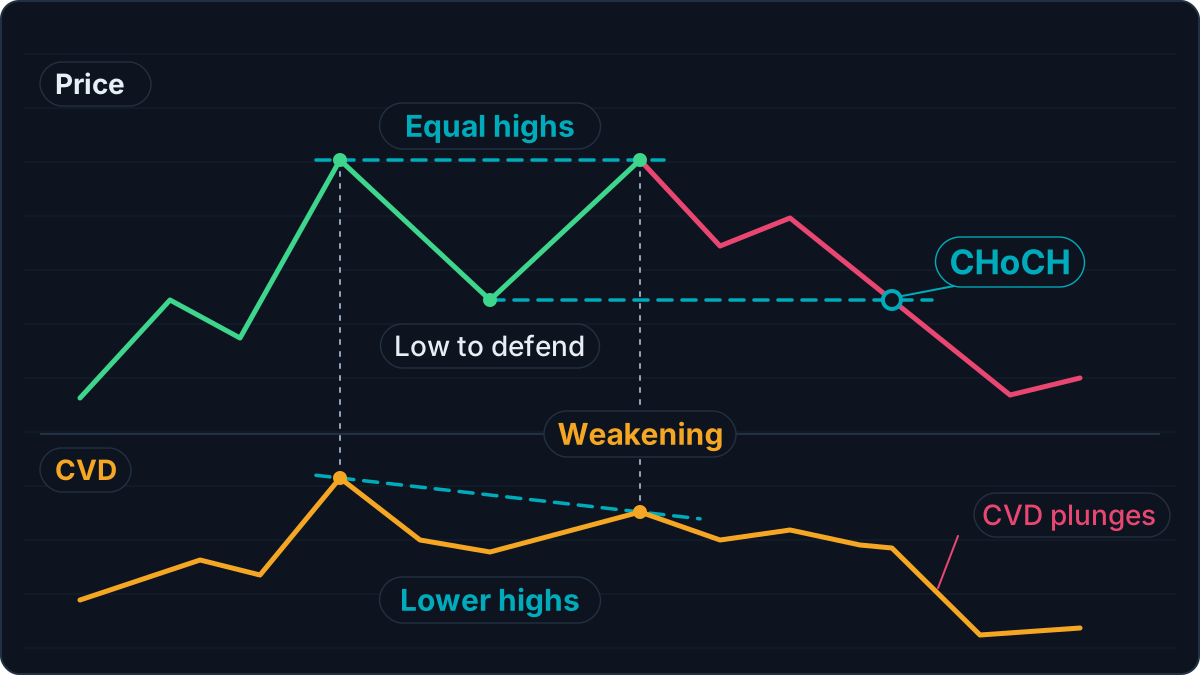
Price makes equal highs, the CVD makes lower highs: the weakening heralds the CHoCH, and the CVD plunging at the moment of the break confirms it.
Open Interest: Entries or Exits?
A second source, specific to futures markets: open interest, the number of open contracts. It gives no direction — every contract has a buyer and a seller — but it tells you whether the break opens positions or closes them:
- Open interest rising, CVD falling during a bearish CHoCH: new short positions are opening. Fresh money is behind the break, and this is the strongest case.
- Open interest dropping sharply just as the low gives way: positions are closing, stops and liquidations first. The break is fueled by exits, not entries; once the purge is over, sometimes no one is left to push. This is the typical profile of a sweep — and, once the dust settles, often the starting point of the opposite move.
Where to Read This Data, and Its Limits
The CVD is not available on TradingView. The Cap displays it on Coinalyze (free, with aggregated open interest from the main platforms), on Velo Data or on Market Monkey. For a glance at the whole market, the OI & CVD screener on our Data & Markets page tracks changes in aggregated open interest, plus spot and futures CVD, in real time.
Two limits, to stay honest. This data comes from crypto futures markets: on a market where you don’t have access to it, the close, the right swing and displacement remain your three filters. And the flow doesn’t work miracles — the CVD guide says so frankly about a losing short: “the read was clean; the trade was a loser.” The CVD and open interest validate or invalidate a scenario built elsewhere; they never replace it.
From CHoCH to Entry: Order Block, Breaker Block, and Timing
A CHoCH tells you the context is changing. It gives you neither your entry price nor your stop. Selling the breaking candle is the worst possible moment: price is far from any zone, the stop is far away, the risk/reward is poor. The method that recurs in all our zone guides comes down to five steps:
- Bias first. Read the structure on the higher timeframe: it tells you whether a CHoCH goes with the market or against it.
- A validated CHoCH. A close beyond the external swing, displacement, no obvious sweep on the other side, and if possible a flow that goes with it.
- The pullback. After a bearish CHoCH, price often climbs back toward the zone the drop started from: the order block (the last bullish candle before the impulse), the FVG left by the displacement, or the breaker block if a high was swept just before. That is where the trade is built, ideally with a micro-structure break on a lower timeframe as the trigger.
- The stop. Beyond the high that preceded the break. If price takes it out, the CHoCH was a sweep: the thesis is dead, and you know it immediately. Never hugging the zone — that is precisely where the market goes hunting for stops set too tight.
- The target. The liquidity on the other side, meaning the next obvious low. Below 2R of potential, sit it out: same rule as for the order block.
Timing matters too. A CHoCH born during the London or New York killzones, when institutional volume is present, is not worth the same as a break in the middle of the night, with no volume. And write everything down in your trading plan before price gets there: a CHoCH spotted after the fact is not a setup, it’s a justification.
CHoCH, MSS, MSB: One Event, Three Names
You will come across several acronyms for the same break, depending on the school of whoever is speaking. They are not signals that confirm one another: it is a single event, seen through three vocabularies.
| Acronym | Full name | School | What it refers to |
|---|---|---|---|
| BOS | Break of Structure | SMC | The break in the direction of the trend: continuation |
| CHoCH | Change of Character | SMC | The first break against the trend: possible reversal |
| MSS | Market Structure Shift | ICT | The same event as the CHoCH, under the name ICT uses |
| MSB | Market Structure Break | Our price action course | A break in the market dynamics: the shift from one trend to another |
Two clarifications to settle any doubt. First, spelling changes nothing: CHoCH, ChoCh, CHOCH or choch all refer to the same Change of Character — the odd capitalization comes from the English acronym, CHange of CHaracter. Second, always judge the direction of the break, not the label: if someone says MSB for a break in the direction of the trend, it is a BOS in the sense used here.
Classic Pitfalls
- Seeing a reversal in every CHoCH. In a strong trend, an internal CHoCH is very often just the end of a pullback: wait for what follows before flipping your bias.
- Confirming on a wick. Until the candle has closed on your timeframe, there is no break.
- Reading structure backwards. Calling an H4 reversal on an M5 break is letting the noise take charge.
- Entering on the breaking candle. The CHoCH gives the context, the pullback gives the entry. If it never comes, so be it: a missed trade beats a begged-for entry.
- Redrawing your swings after the fact. A high moved so the break fits is an analysis being rescued, not a signal being read. Log your swings in your journal before you see what comes next.
Frequently Asked Questions
What Is a CHoCH in Trading?
A CHoCH (Change of Character) is the first break of structure against the trend. In an uptrend, it is a close below the last higher low, the one that launched the last high; in a downtrend, a close above the last lower high. It is the first sign of a reversal, not yet its confirmation: what is needed next is a bounce that fails, then a break in the new direction.
What Is the Difference Between BOS and CHoCH?
The direction of the break. The BOS (Break of Structure) breaks the last high in an uptrend, or the last low in a downtrend: it confirms that the trend continues, and there is one on each new leg. The CHoCH breaks the structure against the trend: it signals that the current trend may be over. Same gesture on the chart — a close beyond a swing — opposite direction, opposite message.
Does the CHoCH Come Before or After the BOS?
Before. In a clean reversal, the CHoCH opens the sequence: it is the first break against the trend. Then come a bounce that fails below the old level, then BOS in the new direction, which confirm the new trend. The word CHoCH is not reused: after a bearish CHoCH, every low that breaks is a bearish BOS.
Is a Wick Enough to Confirm a CHoCH?
No. The level is measured at the wick of the swing, but the break is confirmed on the candle’s close, on the timeframe where you read the structure. A wick that pierces the low and then closes back above it is not a break: it is often a sweep of stops, so more of a signal in the other direction.
How Do You Spot a Fake CHoCH?
Four clues: a wick below the low but a close above it; a quick reclaim, followed by a new high; a very obvious low, and so one loaded with stops; and, in the flow, a spike of market sells that gets absorbed without price following, or open interest that empties all at once. A fake CHoCH is a stop hunt: the mechanics of the Swing Failure Pattern.
Are CHoCH and MSS the Same Thing?
Yes. The MSS (Market Structure Shift) is the name ICT gives to the first break against the trend; the CHoCH is its name in Smart Money vocabulary. Our price action course, for its part, speaks of MSB (Market Structure Break), a break in the market dynamics. Three names for a single event: they do not confirm one another.
Can You Trade the CHoCH on Its Own?
That is not what we recommend. The CHoCH is a context signal: it says the structure is changing, not where to enter. The entry is built on the pullback, in a zone (order block, FVG, breaker block), with a stop beyond the swing that preceded the break and a target on the liquidity on the other side. Selling the breaking candle means entering far from any zone with a distant stop.
Which Timeframe Should You Use to Read BOS and CHoCH?
On at least two. The structure that decides is read on the higher timeframe — in day trading, our price action course reads the dynamics on the Daily and the bias on H4; the lower timeframe (H1, M15) is used to trigger the entry, often on an internal CHoCH inside a zone of the higher timeframe. A CHoCH on M5 does not announce a reversal on H4: you always read from the top down, never the other way around.
What to Take Away
BOS and CHoCH are not magic signals: they are two ways of saying whether the sequence of highs and lows holds or gives way. The BOS confirms, the CHoCH warns. Between the two, all the work is in the filtering — a close, not a wick; the external swing, not an internal low; displacement, not drift — and in a flow that goes along with the break instead of absorbing it.
The logical next step: dig into the entry zone that follows the CHoCH with the order block guide, the sweep that precedes it with turtle soup, and practice reading the CVD on your own charts. Then log each CHoCH in your journal — drawn before what comes next, never after — to see, over fifty observations, how many really hold on your markets. It is the only statistic that counts: yours.
Every guide here is free. Browse the full course and join a community of traders who share ideas every day.