Finding a good entry point and laying out a trading plan on a chart is one thing. Knowing how to manage it through to invalidation or full profit-taking is another. When you start trading, it’s normal to try multiple methods, strategies and technical indicators before blending them into a coherent mix. As you probably already know, in trading, the norm is toxic, so be smarter and set up a genuine Trade Management routine!
After putting the first methods that catch your eye into practice, it’s natural to move on to something else because it didn’t work… You tell yourself it’s not for you and you move on: Mistake #1!
To form an objective opinion on a question or method, you first need to make sure you’re managing your trade, and the strategy that goes with it, optimally!
Today I’m offering you a reflection on trade management by answering the following question:
What are the factors that can influence trade management?
Price Dynamics
No matter the reasoning, the scenarios you can imagine or the logic that follows, only market dynamics or structure comes close to the truth….
Some traders adjust how they manage their positions based on these. But the market behaves cyclically. When that cycle takes a break or is in consolidation or distribution, you get a range. Be objective and you’ll always be able to work out which phase we’re in, give or take a few days or weeks!
Distribution or Consolidation = Range
In Range conditions you’ll be far more conservative when it comes to taking profit at resistance, because you know that the price will, in the overwhelming majority of cases, bounce off resistance!
Uptrend or Downtrend
In a trend, the more pronounced it is, the larger the share of our position we’ll hold on to in order to bet on continuation.
The same goes if you use a trading bot: be smart and adjust it according to your bias. A bias which, let me remind you, must be defined by Price Action as well as market dynamics.
Volatility Is at Rock Bottom: What Do You Do?!
When the market is barely volatile and has been ranging for a relatively long time, you can look at things differently.
In my view, it’s better to manage your positions actively through intraday trading or scalping, with modest profit-taking. You can also short volatility using options. That said, we’re not here to talk strategy but method! (REF range trading article) https://captain-trading.com/2023/05/19/range-trading/
When the trend is strong, you generally find that it extends over several bearish/bullish legs, x times over, before reversing just once.
In this scenario, as mentioned earlier, it’s more sensible to manage a trade by letting an optimized portion of your position run.
Uncertainty Is a Habit…
By nature, financial markets are uncertain. Nobody knows what tomorrow holds, and claiming otherwise with any certainty would be an obvious lack of humility.
It happens… sometimes, that some traders don’t stick to their plan, cutting their positions before invalidation or their Take Profit out of a lack of conviction in the face of uncertainty — and yet the plan is good.
To avoid this pitfall, it’s recommended to backtest your strategy over a substantial sample of trades so you can learn its win rate and expected value. Going back over your trades and measuring your results with statistics gives you more conviction and builds confidence in your strategies, setups, trade management, and so on.
Never forget that it’s impossible to eliminate uncertainty; you can, however, anticipate it and protect yourself accordingly by defining sound risk management suited to your trading style and your strategies.
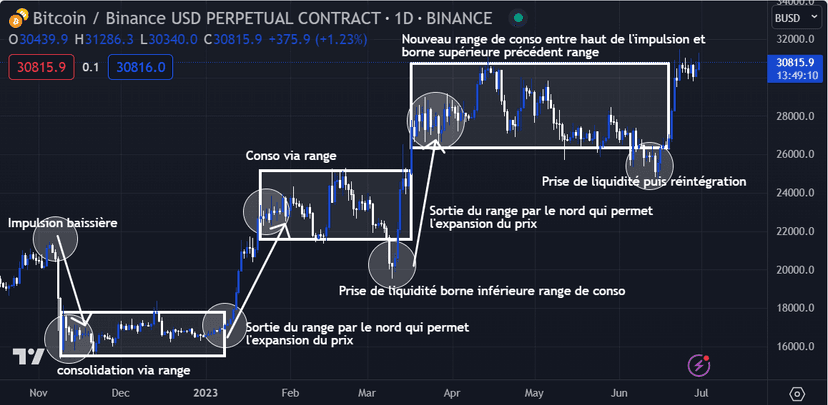
Below is an example of a consolidation > expansion phase and liquidity grab within range trading:
Planning and Organizing Your Trade Management
trading plan text to be linked below
From setting up a trading plan to executing it, it’s important to raise the notion of timing. When a trade is carried out on the market, it happens over a very short window of time. Yet it can be the product of extensive preparation.
There’s a big difference between trade management with profit-taking at predetermined price levels and an ambitious trade with a first TP improvised at the price of the moment.
You’ll tell me there’s worse … placing it higher, maybe?
Before you even start managing a trade, there are 2 simple steps to follow:
- Planning: staggering your TPs and invalidation
- Entering the trade
Then comes the (trade) management phase:
- Taking profit
- Adjusting your invalidation level
- moving into profit: the Break-Even Point
- setting up a running position, swing-trading style.
The entire planning phase is what gets you to that very short moment so you can execute the trade as planned and avoid asking yourself a thousand off-topic questions that will make us/you lose confidence.
In trading, the outcome isn’t the only thing that matters — so is the way you operate. Being poorly prepared can affect your trade management through a lack of conviction. Holding a swing for several weeks without conviction can seem impossible.
Timing: Some Rhythm, Please!
Whether you’re a beginner or an experienced trader, trading the financial markets might look like a marathon — but actually, that’s not quite it!
The logic of a marathon is to try to cover a distance over time at the steadiest possible pace. On the financial markets, it’s better not to step in with the same intensity and regularity, but rather to adapt to it.
If you’re into football, you can easily compare a trader to a goalkeeper, or conversely a striker! You have to stay focused for 90 minutes, and you have to be excellent when the opportunities arise — either to save all the work done beforehand or to make it count!
When you trade, there are several phases. When there’s little interest, volume or liquidity and volatility collapses, opportunities do remain, but they become rare.
That said, it’s possible to speculate on volatility, but it’s better to scale back and conserve your energy so you’re at 100% when the time comes.
Someone who is always at a medium-plus to intense pace is more likely to be “out of breath” and therefore less effective when the market gets genuinely interesting.
Conviction: Convincing Yourself You’re Making the Right Choice!
A. Lack of preparation
Going through the planning step outlined earlier gives you far more conviction.
- the levels are identified
- the invalidation is clear
> calm, composed trade management.
B. The process for building conviction
It’s normal to have little conviction when you’re starting out in trading, given that there are no statistics available or history of previous trades.
For beginners still in the backtesting phase, regardless of whether the strategy you currently have is the right one, you can already work on the execution process:
- Where is the price coming from?
- Where is it now?
- What reaction/setup do I see, or want to see, to enter?
- Do I have a clear invalidation?
- an acceptable number of positions and level of risk
- Have I properly identified the zones for taking profit?
- The timeframes I entered on
- The time horizon over which I hope to exit
Becoming a Rock in the Face of Losses
After a substantial run of losing trades, you can find yourself in a negative spiral.
It becomes easy to make the mistake of avoiding your favorite setup or cutting too early — don’t get caught out!
It’s normal to step out of your comfort zone to learn trading, but when it comes to executing an order, it’s really not advisable to do so every single day!
It’s still important to remember that every trade is an event independent of the others, with its own unique probability of success.
Staying Deaf to Market Noise
Markets form cycles made up of several phases:
- consolidation
- uptrend
- distribution
- downtrend
Lately (late June 2023), in crypto, we’ve been alternating between phase 1 and 2.
During this phase, you notice plenty of trap-like moves designed to hunt liquidity at each boundary quickly. What’s more, this usually happens during the hours when the order book is at its most jittery.
It’s also prime time for market noise: good news, bad news… but then would bad news amount to good news?
We saw it with Covid, or more recently with the SEC lawsuits. Generally, when the worst news hits and everyone gives up, that’s precisely the moment to take a position!
In moments like these, no matter the technical analysis and the reasons behind an explosive move, pump or dump, uncertainty reigns in many respects — so build your own convictions!
Because in the end, only the price and its reaction matter: Long live Price Action!
Below is an example of a range in which there was a huge amount of market noise:
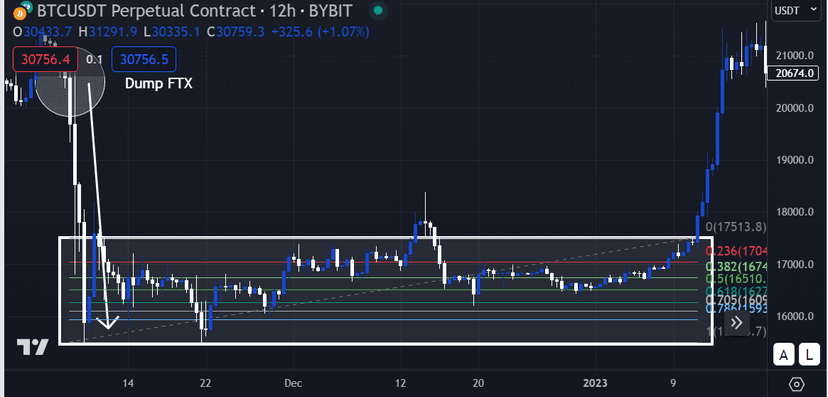
Example of the FTX, BlockFi, Genesis, etc. bankruptcies: At first the price reacts impulsively, then it returns to normal, only to finally explode a few weeks later. In reality, bad news has a short-lived impact… Take a leaf out of that book!
Position Sizing and Risk Management
Without an appropriate position size, it’s very hard to carry out trade management by the book. A position that’s too large can trigger a string of mistakes driven by emotional reactions. That’s to be banned! Even though we’re still human, as you probably already know: in trading, the norm is toxic!
On the execution side, this active management — moving to break even, partial profit-taking, trailing stop — can be tooled up: on MT4/MT5, it's all run from Trade Assistant, covered in a guide of its own.
Example : refusing to accept your loss and revenge trading, moving your SL for no reason, straying from your risk management, and so on.
Conversely, during the backtesting or paper trading (with fictional position sizes) phase, it’s far more comfortable to enter the market with no sense of risk management. But this can breed very bad habits when the time comes to actually manage your trade…
The right position size is the one that lets you stay comfortable, with an acceptable risk.
Timeframes: Put Them to Good Use!
When you’re starting out and still searching for your style by practicing intraday trading, swing trading and investing, it becomes tricky to properly account for the different timeframes and not get your wires crossed.
For example: some market participants enter a position on the H4 timeframe but invalidate on the first m15 or h1 candle.
This can happen because you’ve poorly managed your position size and risk in the face of market noise, for example: mistake!
I can’t say it enough: long live Price Action and risk management!
If you’re short on experience, it’s better to invalidate on the same timeframe that defined your entry.
> Buy m15, sell at m15 resistance, not weekly resistance at +80% from the entry point …
Invalidating on a lower timeframe is still possible, provided it’s clearly predefined to avoid the influence of noise or emotions.
Trade Management in Swing Trading Mode…
When you position for a swing, it’s better to have a sensible profit-taking level; an H4 move will rarely reach 200% or an ATH zone on an asset like BTC. As a result, having a target that’s too ambitious can make trade management completely different.
Classic example: instead of taking profit on the first impulses and securing your risk (because you’re aiming for the moon), the price drifts “gently” back to the entry point or even the SL: not cool!
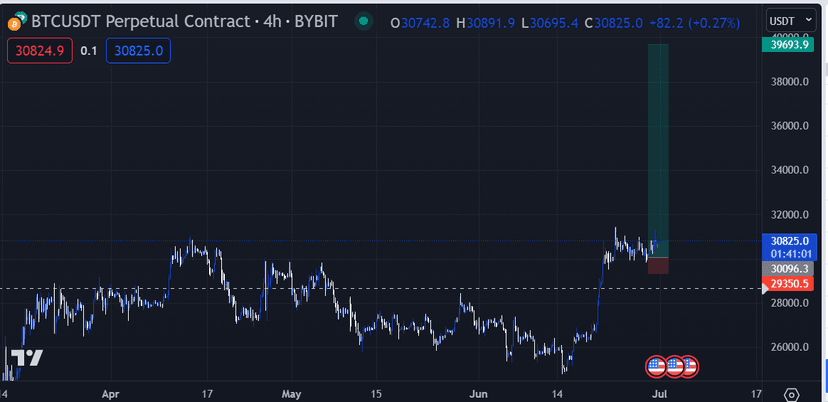
Below is a concrete example of a buy at the bottom of an H4 range with a very ambitious target, 40K. This plan is conceivable, but it’s not at all appropriate in terms of targets relative to the timeframe and the entry point.
In terms of trade management, it’s better to trade the range and, if the breakout happens to the north, leave a runner and/or take a pullback and trade each consolidation up to 40K — up to you.
Below is the same plan:
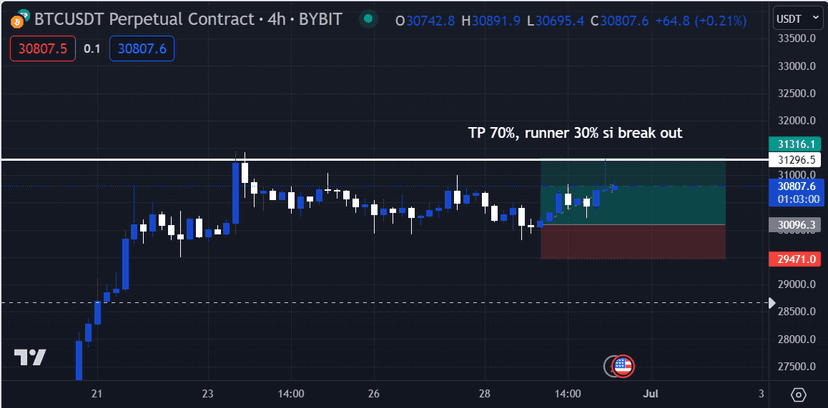
Profit-taking consistent with the timeframe, with the option of reaching 35/40K by letting 30% of the position run and applying trend following.
Capitalize on Your Experience with the Right Tools!
To sit back in a comfortable position for managing your trades, it makes sense to capitalize on every trade you take — even when you lose a few feathers along the way!
Your trading journal is essential, and it must be kept in real time. With every trade, you have to add to it, otherwise you’ll always find a good reason not to — believe me!
On that note, you can join the free Captain Trading space: with a simple account, you get the daily plan in your trading journal, decoded COT reports, lives and their replays, and the community help room built right into your dashboard — you ask your question in your language and we answer in your language! It’s all free. If you’d like to support us, open an account with one of our partner platforms through the Cashback page: 5% of your trading fees are yours for good, and 10 to 20% in the months when your volume justifies it — that’s what allows us to keep going.
Whether it’s the outcome, the way you went about it, what fell short or what performed, it all has to be in there!
You’re not a computer, but you can sharpen your reflexes impressively if you take your notes properly. Trust me on this: taking notes on paper is NOTHING like automated note-taking, in a spreadsheet or on TradingView.
Your goal is to build a substantial track record as soon as the market allows. Generally, after a year, you start to have something constructive. So the earlier you start, the better!
You’ll have a realistic win rate, the true reasons for your successes and your failures, and so you’ll be able to build a vision for the future: expected value, style, high-probability setups, and so on.
Practical example: When a trader steps into the market with a setup they’ve used dozens of times under identical conditions, it’s much easier, isn’t it?
If the win rate is 60%, the expected value 2.2 (risk to reward R:R), they’ll have little trouble managing their trade.
Under those conditions, they know exactly what they’re doing and where they’re headed!
Doubt is normal as long as you haven’t hit TP, but don’t let it eat away at your profits.
Trade Management: Leave Your Feelings Aside!
As you’ll have gathered, learning to manage a trade takes time, work AND skills/qualities:
- planning
- discipline
- patience
- control over your emotions.
The slightest trade-management mistake can be fatal! Who hasn’t already been liquidated over a forgotten SL?!
By the way, let me remind you that a systematic or algorithmic trader doesn’t approach trade management from anything like the same angle. Applying a system requires no thinking during the execution of the trade — from invalidation to profit-taking, everything is planned and standardized.
On the other hand, a system is often not very flexible; it rarely works very well in both a range and a trend. As for algorithmic traders, some have several types of bots and rotate them depending on market conditions — though that requires identifying those conditions properly.
So, on another note, a quick question: what kind of trader are you?
Discretionary?
Systematic?
Algorithmic?
Scalping, Day Trading, Swing Trading?
Either way, I’ve got a free course AND a professional-level course with strategies to boot to round out your skills!
Every guide here is free. Browse the full course and join a community of traders who share ideas every day.